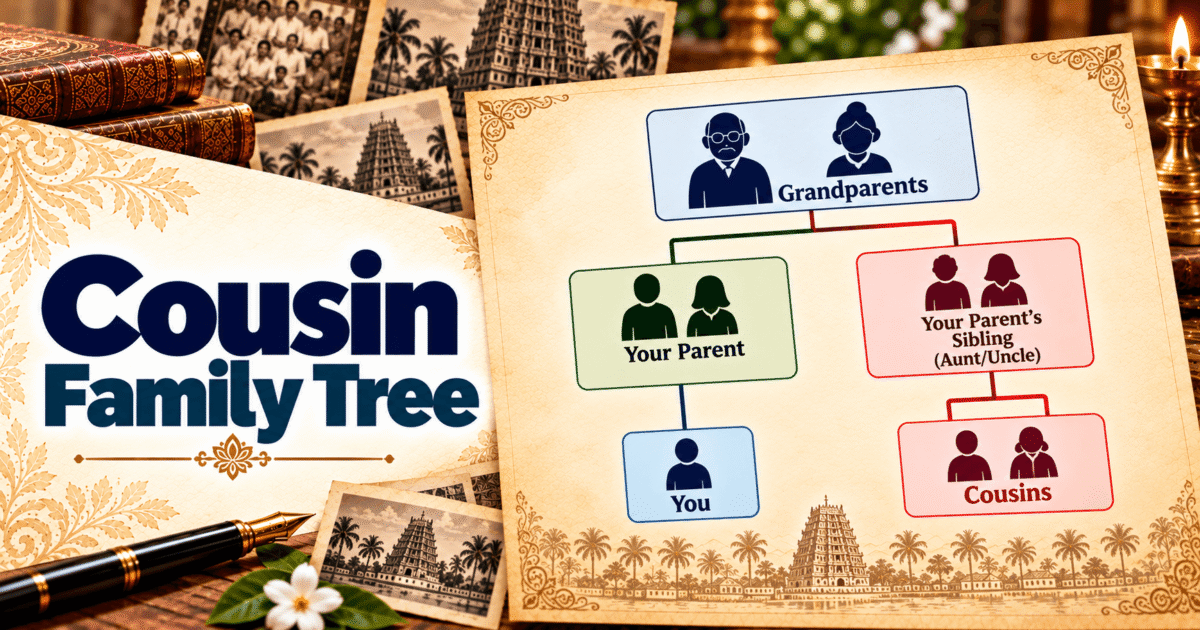
A cousin family tree is the branch of your family tree that documents cousins across generations — first cousins, second cousins, once and twice removed variants. Most standard family tree templates handle direct ancestry (parents, grandparents, great-grandparents) well, but flatten or omit cousins because they’re conceptually side-branches. This makes cousin tracking harder than it needs to be.
This guide covers how to visualise and record cousins on a family tree — the specific diagramming conventions, tree-software features that help, and Tamil-family-specific considerations for placing extended cousins where their kinship relationship is visible at a glance.
Why cousins need a specific approach
Direct-ancestor family trees follow a simple pyramid: you at the bottom, two parents above, four grandparents above them, eight great-grandparents, and so on. Every generation doubles. Cousins don’t fit this pyramid because they aren’t in the direct-ancestor line — they’re descended from your ancestors but off to the side.
The result: cousins get scattered across the tree as descendants of great-aunts and great-uncles, without a clear “cousin view” that shows how you’re related to all your cousins at once. Standard family tree templates tend to prioritize the direct-ancestor pyramid over the cousin network.
For Tamil family history where cousin relationships matter culturally (weddings, festivals, community identity), this omission matters. A useful family tree captures both the direct-ancestor line AND the cousin network prominently.
Diagramming conventions for cousin trees
Two visualisation approaches work well for cousin family trees:
The “hourglass” family tree
Places you (or another chosen individual) in the middle. Direct ancestors go upward (parents, grandparents, great-grandparents). Descendants of ancestors’ siblings (your cousins) fan outward on each generation level.
Layout:
- Great-grandparents at top
- Their children (grandparent + siblings = great-aunts / great-uncles) — one line
- Their grandchildren (parent + siblings + first cousins from that side) — next line
- You + siblings + first cousins + first cousins once removed in your generation — bottom line
The hourglass makes all cousins from one great-grandparent-couple visible at once. Repeat the hourglass for the other great-grandparent-couples to see cousins from all sides.
The “fan chart” family tree
A radial layout where you sit at the centre and generations of relatives fan outward. Cousins appear at the same distance from centre as siblings and first cousins, with second cousins one ring further out.
Advantages: shows the full cousin network at a glance; scales to many cousins without cluttering.
Disadvantages: harder to render on a single sheet of paper for large families; less intuitive for people used to top-down pyramid trees.
Tree software that handles cousins well
For anyone building a cousin family tree in software, look for features that specifically support:
- Automatic cousin labelling — the software computes “1st cousin,” “2nd cousin,” “1st cousin once removed” based on the tree structure and displays the label next to each cousin.
- Sideways expansion — the tree can grow both up (ancestors) and outward (siblings’ descendants) without cluttering the direct-ancestor line.
- Alternative views — descendants view, hourglass view, fan chart, and traditional pedigree view of the same tree.
- Custom notes on relationships — for capturing Tamil kinship terms (athai magal, mama peran, etc.) alongside the English “first cousin” label.
Tools that handle cousins well:
- Gramps (free, open source) — Descendants view + Relationship Chart plugin
- Family Historian (paid, ~£40) — good cousin computation and hourglass display
- RootsMagic (paid, ~$40) — kinship reports that list all cousins with generation labels
- MyHeritage / Ancestry (subscription) — auto-computes cousin relationships but less flexible for custom kinship notes
Placing cousins by relationship type
On a Tamil family tree, cousins fall into distinct categories based on which ancestor-line they share:
- Paternal parallel cousins — children of your father’s brother (periyappa magal / magan or chithappa magal / magan)
- Paternal cross cousins — children of your father’s sister (athai magal / magan)
- Maternal parallel cousins — children of your mother’s sister (periyamma magal / magan or chinnamma magal / magan)
- Maternal cross cousins — children of your mother’s brother (mama magal / magan)
Placing cousins with a note indicating which category they fall into preserves the kinship information that “first cousin” alone erases. Modern Tamil families may or may not use these distinctions in daily life, but the family tree is a historical record — capturing the traditional distinctions preserves information future descendants may want.
The specific problem of “many first cousins”
Many Tamil families of two or three generations back had large numbers of children per couple (5-10 was common). This means:
- Your parent’s generation might have 20-40 first cousins (their aunts’ and uncles’ children)
- Your own generation might have 100+ second cousins (your parents’ first cousins’ children)
- Documenting all of them on a single family tree is genuinely a scale challenge
Practical scoping approach:
- Tier 1: your own first cousins (immediate cousins) — document every one
- Tier 2: your parents’ first cousins whom you’ve met or heard of by name — document with basic details
- Tier 3: your first cousins once removed (your first cousin’s children, your parent’s first cousin’s children) — document as leads, add detail as reached
- Tier 4: second cousins you’ve never met — capture just the names as they surface, defer full documentation until relevant
Trying to fully document every extended cousin at once produces overwhelm. Tier-by-tier documentation makes the cousin family tree tractable.
Cross-linking cousins across the tree
Cousin relationships can create cross-links in the family tree that aren’t visible in a strict pedigree layout:
- Cousin marriages — if two of your grandparents were themselves cousins (as sometimes happened in Tamil cross-cousin marriage traditions), your family tree has a “cycle” — the same ancestor appears in two lines of your ancestry.
- Sibling marriages between families — brothers from one family marrying sisters from another creates connected cousin lines where you have multiple cousin-relationships with the same person.
- Multi-generational cross-family ties — some Tamil communities have long-standing marriage patterns between specific families that produce complex cross-links across generations.
Good tree software handles these cross-links without breaking. Simpler tree tools may distort or drop the relationship. For families with cross-cousin marriage history, choosing tree software that supports pedigree collapse (representing the same ancestor once even when they appear in multiple lines) matters.
The cousin family tree as reunion tool
Beyond documentation, a good cousin family tree is a practical tool for organising family gatherings, weddings, and reunions:
- Sends invitations to the right people (everyone at Tier 1 + 2, potentially Tier 3)
- Explains kinship at reunions (introducing an unknown second cousin with “she’s your first cousin’s daughter’s child”)
- Identifies genealogical gaps (which branch is missing?)
- Preserves the network for the next generation, who otherwise inherit only Tier 1
Sharing the cousin family tree with cousins via email or a private cloud folder often generates responses that fill gaps — cousins reply with names you didn’t know, photographs you hadn’t seen, family stories you hadn’t heard.
Building the first version
To start a cousin family tree from scratch:
- Add yourself and immediate family (parents, siblings, spouse, children)
- Add both parents’ siblings (your aunts and uncles) and their spouses
- Add all your first cousins with basic details
- Add all four grandparents and their siblings (your great-aunts and great-uncles)
- Add your parents’ first cousins (children of great-aunts and great-uncles)
- Add second cousins as they surface via interviews or DNA matches
This produces a working cousin family tree covering three generations of the cousin network. Extend outward as time and interest allow. The tree becomes the reference point every family member can consult when a wedding invitation or reunion planning question comes up.
Standard family trees prioritize direct ancestors. A cousin family tree adds back the side-branches that make the tree feel like a living family rather than a genealogy database. For Tamil families where cousin relationships carry cultural weight, that addition is worth the extra effort.