The phrase “cousin once removed” trips up almost everyone the first time they try to place someone on a family tree. It sounds like the person has been removed from something — dropped from the family, perhaps. That’s not what it means at all. “Removed” describes a specific mathematical relationship between two people on a family tree: how many generations separate them.
This guide explains exactly what “removed” means, walks through the parent-child chain that produces each degree of removal, and shows how it maps to Tamil kinship vocabulary — which is often more precise than the generic English cousin terminology and can clarify relationships that “once removed” leaves ambiguous.
What “removed” actually means
“Removed” refers to the generation gap between two cousins. Two people are cousins when they share a common ancestor but neither is the direct descendant of the other. They are “removed” from each other by however many generations separate them from the closest shared connection point.
The rule:
- 0 removed: same generation (both are grandchildren of the shared ancestor)
- 1 removed (once removed): one generation apart
- 2 removed (twice removed): two generations apart
- N removed: N generations apart
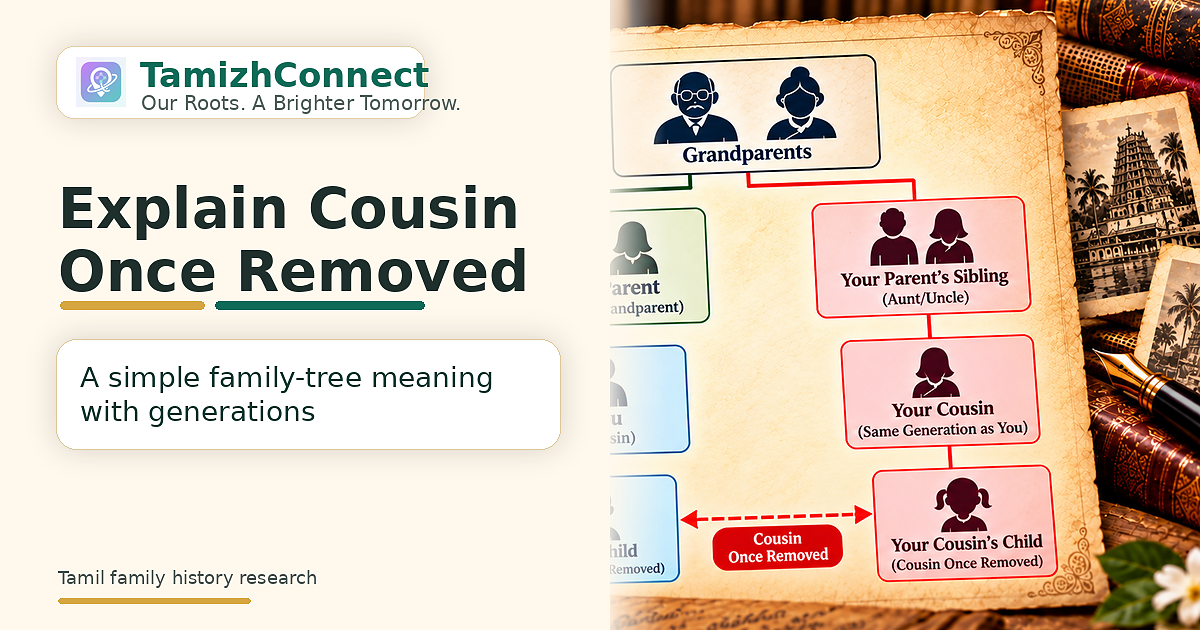
So “first cousin once removed” doesn’t mean a cousin who has been removed — it means someone who is a first cousin to a different generation of your family. Specifically: your first cousin’s child is your first cousin once removed. So is your parent’s first cousin.
The parent-child chain that produces “once removed”
Walk through a specific example. Let’s say your grandfather Muthusamy had two children — your father Perumal (parent A) and your father’s sister Rajammal (parent B, your aunt).
Rajammal has a child, Kannan. Kannan is your first cousin — same generation as you, both grandchildren of Muthusamy.
Kannan grows up, has a child, Meena. Meena is:
- Not your first cousin (she’s one generation below you)
- Not your niece (nieces are children of your siblings, not your cousins)
- Your first cousin once removed — first cousin at one generational remove
Symmetrically, Kannan’s parent Rajammal — your aunt — is not your first cousin (she’s one generation above you). She’s your parent’s first cousin’s mother, which is a different relationship. Kannan’s parent from YOUR perspective is your aunt.
But look at Rajammal in reverse. From Meena’s perspective (Kannan’s child), you (Meena’s parent’s first cousin) are Meena’s first cousin once removed. The “removed” relationship is symmetric — Meena is your first cousin once removed, and you are Meena’s first cousin once removed.
Second cousin once removed, and beyond
The same logic extends to second, third, and further cousins. A second cousin is a person whose grandparent was your grandparent’s sibling — you share great-grandparents. A second cousin once removed is your second cousin’s child (or your parent’s second cousin).
The full formula:
- Nth cousin: you and they share (N+1)th-great-grandparents, and you are the same number of generations from those ancestors.
- Nth cousin K-times removed: same shared ancestors, but you are K generations apart from each other in descent.
Third cousins share great-great-grandparents. Fourth cousins share great-great-great-grandparents. And so on. Every additional generation of shared ancestry adds one to the cousin number.
Tamil kinship words that make “removed” unnecessary
Tamil family vocabulary distinguishes many relationships that generic English lumps under “cousin.” For a Tamil family, the following terms are often more precise than the English “first cousin once removed”:
- Athai magal / magan — your father’s sister’s daughter / son (matrilineal cross-cousin)
- Mama magal / magan — your mother’s brother’s daughter / son (matrilineal cross-cousin from mother’s side)
- Chithappa / Periyappa magal / magan — your father’s younger / elder brother’s daughter / son (parallel cousin through paternal side)
- Chinnamma / Periyamma magal / magan — your mother’s younger / elder sister’s daughter / son (parallel cousin through maternal side)
The distinction between cross-cousin (aunt/uncle of opposite sex to your parent) and parallel cousin (aunt/uncle of same sex as your parent) matters in traditional Tamil families because marriage rules historically differed — cross-cousin marriage was permitted while parallel cousin marriage was not. English’s flat “first cousin” erases this distinction.
For “first cousin once removed” specifically, Tamil vocabulary continues to be more specific:
- Your athai’s grandchild is your athai peran / pethi — literally “athai’s grandson / granddaughter”
- Your father’s athai is your appa’s athai — literally “father’s athai”
Neither of these requires the “once removed” construction. The relationship is captured by naming the intermediate ancestor.
Why “removed” persists in English genealogy
English genealogy adopted “removed” terminology because Western nuclear-family structures don’t distinguish cross- and parallel-cousins the way South Indian kinship does. When English-speaking genealogists had to describe a cousin from a different generation, “removed” was the shortest available term. It has stuck through convention even when better vocabulary exists in other kinship systems.
For Tamil families building a family tree in English (or in software that uses English kinship labels), the practical approach:
- Use the English “Nth cousin K-times removed” as the software’s label
- Annotate the relationship with the Tamil kinship term for clarity (“first cousin once removed [athai peran]”)
- Include the intermediate ancestor’s name when labelling (“Muthusamy’s grandchild, cousin from Rajammal’s line”)
This layered approach preserves both the technical genealogy label and the cultural precision Tamil families need.
Common “once removed” mistakes
Five patterns that trip up cousin-labelling on Tamil family trees:
- Treating “once removed” as a distance metric. It’s a generation-gap metric. Distance in geography, closeness in relationship, and generation gap are three different things.
- Skipping the shared-ancestor check. Two people who share a great-grandparent aren’t automatically first cousins — first cousins share grandparents (one closer generation). Great-grandparent-sharers are second cousins.
- Forgetting the “removed” is symmetric. If X is Y’s first cousin once removed, Y is also X’s first cousin once removed. The relationship isn’t one-directional.
- Confusing first-cousin-once-removed with second-cousin. First cousin’s child = first cousin once removed (down one generation). Grandparent’s sibling’s grandchild = second cousin (same generation as you). Different relationships despite similar-sounding descriptions.
- Applying “removed” to direct-line relationships. Your grandfather is not your “father once removed” — he’s your grandfather. “Removed” only applies to cousin relationships, not direct-descent lines.
Placing “cousins once removed” on the family tree
On a visual family tree, first cousins once removed appear as follows:
- Draw the shared ancestor (grandparent generation) at the top.
- Draw both parents (the shared ancestor’s children) at the next level.
- Draw you and your first cousin (the shared ancestor’s grandchildren) at the next level.
- Draw your first cousin’s child at ONE level below you — that’s the first cousin once removed.
Software family-tree tools typically compute and label these relationships automatically once you place people on the tree. If yours doesn’t, the manual rule above works.
Understanding what “cousin once removed” means opens up the whole cousin-vocabulary. The same “shared ancestor + generation gap” logic explains “second cousin twice removed,” “third cousin thrice removed,” and every other combination. Once the pattern clicks, the terminology stops feeling like arbitrary jargon and starts feeling like a precise notation — which is what it was designed to be.