Tamil Family Tree: Build Your Family History
Create your Tamil family tree with voter records, Tamil relationship terms, and village connections
A Tamil family tree{/strong} preserves your heritage with culturally accurate relationships — not generic "uncle" or "aunt." Build your Tamil family tree online with proper Tamil kinship terms (Periyappa, Athai, Mama), search 50 million voter records to find living relatives, and trace your family back to ancestral villages in Tamil Nadu. Free to start, private by default.
Record Tamil family relationships with proper terms - periyappa, chithappa, athai, mama.
What Makes a Tamil Family Tree Different?
A Tamil family tree isn't just a chart with boxes and lines. It's a cultural document that preserves Tamil kinship terminology, village connections, and migration patterns that generic genealogy tools don't understand.
Tamil Relationship Precision
When you build a Tamil family tree, you use specific Tamil terms that English can't replicate. "Uncle" doesn't distinguish between Periyappa (father's elder brother), Chithappa (father's younger brother), and Mama (mother's brother). These distinctions matter for inheritance, naming conventions, and understanding family dynamics.
A proper Tamil family tree captures these relationships precisely so future generations understand exactly how everyone is related — not through vague labels but through culturally accurate terms that Tamil families actually use.
Tools Built for Tamil Genealogy
Creating a Tamil family tree requires specialized tools: voter record search across 50 million Tamil Nadu records, indenture record access for diaspora families (Mauritius, Fiji, Malaysia, South Africa), and name variation handling for Tamil names that change across documents (initials, father's name, village references).
Generic family tree software doesn't have these datasets. A dedicated Tamil family tree platform connects you to living relatives still in ancestral villages, traces indenture migration routes, and handles the complexity of Tamil naming conventions.
Why Tamil Families Need Digital Trees Now
Elders carry oral history that disappears when they pass. Third-generation Tamil diaspora families (in the U.S., Canada, UK, Australia) are losing connection to their heritage as Tamil language fluency declines. A digital Tamil family tree preserves this knowledge before it's lost.
Documenting your Tamil family tree isn't just nostalgia — it's preservation. When your children ask about their great-grandparents, you'll have photos, stories, village names, and relationship terms documented in one place, not scattered across WhatsApp threads and fading memories.
Who Should Build a Tamil Family Tree?
- Tamil diaspora families in Malaysia, Singapore, Mauritius, Fiji, South Africa, UK, USA, Canada
- Families who lost connection to ancestral villages in Tamil Nadu
- Second/third-generation Tamils who don't speak Tamil but want to preserve heritage
- Anyone researching Tamil indenture history (1840-1920)
- Families preparing for reunions and need to map relationships
- Anyone with aging elders — record their knowledge before it's lost
Common Problems When Creating a Tamil Family Tree
Relationships are not generic
"Uncle" and "Aunt" is not how Tamil families think. Without precise terms, the tree becomes confusing and the value collapses.
Names vary across documents
Initials, father's name patterns, village references, and transliteration differences create mismatch. A usable tree must handle this reality.
Oral history gets lost
Elders carry the relationships and stories. If you don't record them, they disappear. A digital tree is a preservation tool, not just a diagram.
Photos and notes are scattered
WhatsApp threads, albums, notebooks. A family tree becomes useful only when data is consolidated and searchable.
A Family Tree Designed for Tamil Families
Tamil relationship terms
Capture kinship precisely so younger generations understand relationships instantly.
Multiple name formats
Record Tamil name variants without breaking identity across generations and records.
Private by default
Share intentionally with permissions. Your family data should not be public by accident.
Built for Tamil families
Record Tamil family relationships with proper terms - periyappa, chithappa, athai, mama.
How to Create Your Tamil Family Tree
Step 1
Add yourself
Start with you, then add parents.
Step 2
Expand generations
Add grandparents, siblings, and branches.
Step 3
Label relationships
Use Tamil terms so the structure stays accurate.
Step 4
Share with permissions
Invite family members safely and collaboratively.
Step-by-Step: Building Your First Three Generations
Begin with your immediate family. Add yourself, your spouse (if applicable), and your children. This establishes the youngest generation and gives you a clear starting point.
Next, add your parents (Appa/Amma) and your in-laws if you're married. Record their birth years, marriage dates, and any village or district information you know. This becomes especially valuable when searching voter records or tracing migration patterns.
Expand horizontally by adding your siblings and your spouse's siblings. Use the correct Tamil relationship terms: Periyappa (father's elder brother), Chithappa (father's younger brother), Periamma (mother's elder sister), Chithamma (mother's younger sister), Athai (father's sister), Mama (mother's brother).
Finally, add your grandparents. If you know great-grandparents, add them too. Many Tamil families can trace back 4-5 generations through oral history. Document this now before the knowledge is lost.
Understanding Tamil Family Relationship Terms
Tamil kinship terminology is more precise than English. Where English uses 'uncle' for all father's and mother's brothers, Tamil distinguishes by birth order, paternal vs maternal line, and gender. This precision matters when documenting family trees.
Father's Side (Paternal)
- Periyappa: Father's elder brother
- Chithappa: Father's younger brother
- Athai: Father's sister
- Athimber: Father's sister's husband
- Thatha: Paternal grandfather
- Patti: Paternal grandmother
Mother's Side (Maternal)
- Mama: Mother's brother
- Mami: Mother's brother's wife
- Periamma: Mother's elder sister
- Chithamma: Mother's younger sister
- Thatha: Maternal grandfather
- Patti: Maternal grandmother
Siblings & Cousins
- Anna: Elder brother
- Thambi: Younger brother
- Akka: Elder sister
- Thangachi: Younger sister
- Machan: Brother-in-law (sister's husband)
- Maithunan: Brother-in-law (wife's brother)
Cross-Cousin Marriage Terms
Tamil culture traditionally allows cross-cousin marriage (Mama's daughter or Athai's daughter). Many families use Machan (brother-in-law) and Mami (mother-in-law) interchangeably with cousin terms when these relationships overlap.
Why This Precision Matters
When you use generic terms like 'uncle,' the next generation loses the actual relationship. Was he your father's brother or your mother's brother? Elder or younger? This affects inheritance patterns, naming conventions, and understanding family dynamics. Tamil terms preserve this knowledge.
How Tamil Families Are Using Digital Family Trees
Families across the Tamil diaspora are rediscovering their heritage through structured digital family trees. Here are anonymized examples of how different families use this tool.
Reconnecting Across Continents
A family split between Malaysia, Singapore, and India used the tree to map three generations. They discovered cousins they didn't know existed through voter record matches in Tamil Nadu. The shared tree became the planning document for a family reunion in 2024.
Preserving Oral History Before It's Lost
An 82-year-old grandmother in Mauritius documented her grandparents' indenture journey from Madras in 1885. Her grandchildren in London and Toronto now have the exact ship name, departure date, and original village - details that would have been lost within one generation.
Collaborative Tree Building
Seven siblings across the U.S. and Canada collaboratively built their family tree over six months. Each sibling contributed what they remembered. The collaborative editing resolved conflicting memories and created a single authoritative record for the next generation.
Bridging the Language Gap
Third-generation Tamil-Americans who don't speak Tamil used the relationship terms with English translations to understand their family structure. The visual tree with labeled relationships helped them learn kinship vocabulary they'd never been taught.
Common Use Cases
- Preparing for family reunions by mapping who's related to whom
- Documenting family stories before elders pass away
- Connecting with distant relatives discovered through DNA testing
- Teaching children about their heritage and Tamil culture
- Researching property inheritance and ancestral village connections
- Creating a permanent record for future generations who won't have direct access to elders
Preserving Tamil Family History Digitally
Tamil families often rely on elders and oral history to preserve lineage. Migration and time break that chain. A well-structured family tree is not just a chart - it is a practical archive that future generations can understand without guessing.
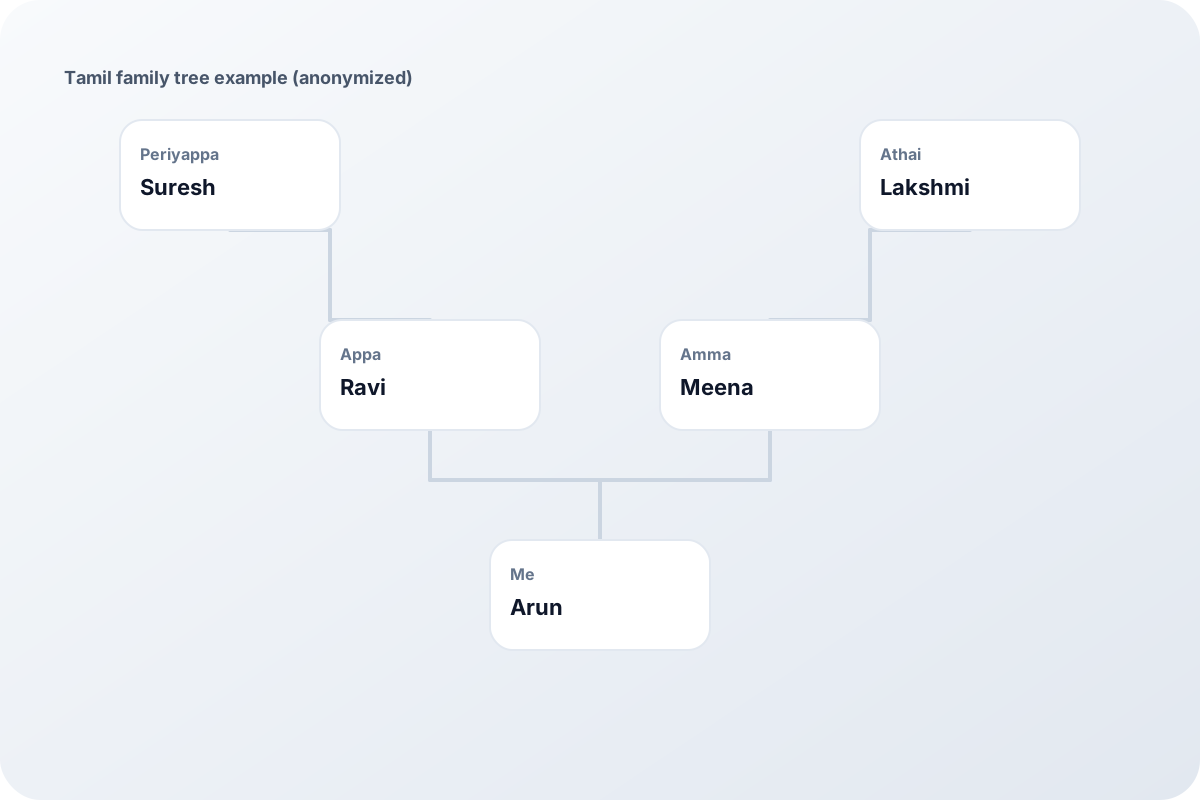
Example of a Tamil Family Tree
The preview above is anonymized so you can see Tamil relationship labels at a glance. Your real tree stays private and is shared only with people you invite.
What a clear tree includes
- 3 or more generations in view
- 6-10 visible nodes for clarity
- Tamil relationship terms clearly labeled
- Fictional or anonymized names
Helpful links
Explore more TamizhConnect pages related to building, sharing, and preserving your family history.
Frequently Asked Questions
What is a Tamil family tree?
A Tamil family tree is a record of your family members across generations, showing relationships the way Tamil families describe them (e.g., periyappa, chithappa, athai, mama) instead of generic labels. It preserves the cultural specificity of Tamil kinship terminology and helps future generations understand exact family relationships.
Can I use Tamil relationship terms like periyappa or athai?
Yes. The goal is to record relationships in culturally accurate terms so your family structure is clear to everyone in the family. Tamil kinship terms distinguish between paternal and maternal lines, birth order, and gender in ways that English terms like 'uncle' or 'aunt' cannot.
How do I start if I only know my parents' names?
That's enough to begin. Add yourself, then add your parents. From there, ask your parents about their siblings (your aunts and uncles) and their parents (your grandparents). Most families can trace back 3-4 generations through oral history alone. Start with what you know and expand gradually.
Is it free to start?
Yes. You can create a family tree and add members for free on the Explorer plan. The free plan includes up to 15 family members, which covers most immediate families. Paid plans unlock unlimited members, voter record search, indenture record access, and advanced collaboration features.
Can multiple family members contribute to the same tree?
Yes. The best family trees are collaborative. Invite siblings, cousins, parents, or children to add their knowledge. Use permissions so only approved family members can view or edit sensitive details. Collaborative trees are more complete because different family members remember different details.
What if family members disagree on dates or relationships?
This is common. Use the notes field to document conflicting information. For example: 'Birth year uncertain - Periyappa says 1965, Amma says 1967.' Collaborative editing helps resolve these conflicts by giving everyone visibility into what's documented and why.
Can I add photos and documents to the tree?
Yes. Upload photos, birth certificates, marriage records, and other documents directly to each person's profile. This makes the tree a living archive, not just a list of names. Photos are especially valuable for younger generations who may never meet distant relatives.
How do I handle name variations and initials?
Tamil names often vary across documents due to initials, transliteration, and village naming conventions. Record all known variations (e.g., 'R. Murugan', 'Ramasamy Murugan', 'Murugan s/o Ramasamy') so you can match records across different sources. The name search tools handle these variations automatically.
Is my family data private?
Your family information is private by default. You control who can see your tree. Share access only with trusted family members using permission-based invites. Your tree is never made public without your explicit consent. You own your data and can export or delete it at any time.
Can I trace my family back to a specific village in Tamil Nadu?
Yes. Many families can trace back to ancestral villages using voter records, oral history, and property documents. If you know your grandparents' village name or district, you can often find living relatives still in that area using the voter record search feature. Indenture records also list departure villages for diaspora families.
What if my family migrated as indentured laborers?
Indenture records from Mauritius, Fiji, South Africa, Malaysia, and the Caribbean are searchable. If your ancestors left Tamil Nadu between 1840-1920 under indenture, you can often find their ship name, departure date, and original village. This is powerful for diaspora families who lost connection to their Indian roots.
How far back can I trace my Tamil family tree?
Most families can document 3-4 generations through living memory (parents, grandparents, great-grandparents). With voter records and written documents, some families trace back 5-6 generations to the mid-1800s. Indenture records can push this to 6-7 generations for diaspora families. Beyond that, documentation becomes scarce without temple records or property deeds.
Start Your Tamil Family Tree Today
Keep the structure clear. Keep the relationships accurate. Keep the data private by default.
Related research across TamizhConnect
Common Tamil surnames with meanings, regional origins, and spelling variants from indenture-era records and the diaspora.
Country-by-country index of Tamil indenture records: Natal (152,273), Mauritius, Fiji, Jamaica, Suriname, Reunion.
Find your family's ancestral deity temple by community, village, or gotra. 1909 Thurston index + community records.
Convert between Gregorian and Tamil Panchangam. Daily Tithi, Nakshatram, Yogam, Karanam. Festival dates for 2026-2027.