TamizhConnect Blog
17 Sep 2026 · TamizhConnect Team · 8 min read
The £200 South African Tamil Roots Verification Project
Tamil genealogy article
TamizhConnect is offering £200 for every verified ancestral link between a South African Tamil descendant and a Tamil Nadu native village.
Document Digitisation
Turn documents into verified Tamil lineage.
Choose the depth you need. One-time service, results stay in your account.
Table of contents(6)
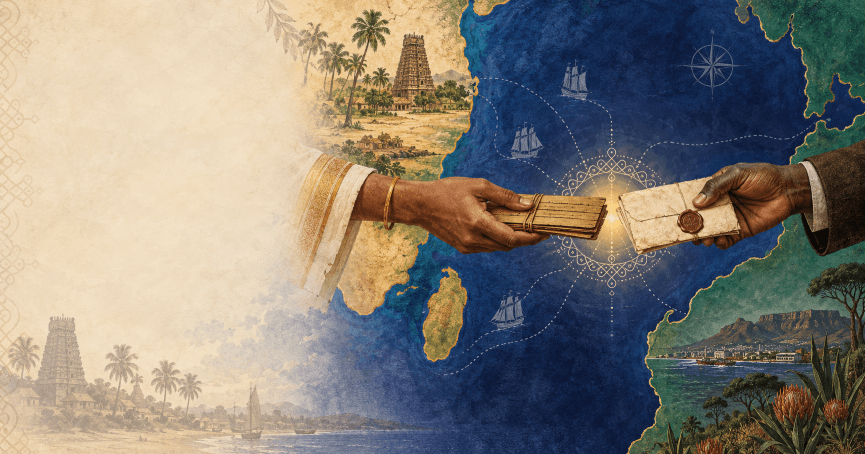
TamizhConnect has launched a specific campaign — the South African Tamil Roots Village Verification Project — to close one exact missing link: from the ship-manifest name of an indentured ancestor who arrived in Natal to the household in Tamil Nadu that person came from.
Most Tamil-diaspora research stalls at the ship record. The Natal arrival is often searchable in an afternoon. The village-side confirmation is not — it takes someone physically present in the village, checking a temple's palm-leaf records, a patta land register, or the lineage held by a koil trustee. That's what the £200 is for.
What's on offer
£200 for every verified ancestral link. If a local researcher or family member in your ancestral village helps document your family's connection using village-side evidence, they receive £200 once the match is confirmed. The pilot pool is £5,000 committed, which funds roughly the first 25 verified links, first-come-first-served. Pilot runs until 14 March 2027 or until the pool is exhausted, whichever comes first — the live status sits on the project page.
A confirmed match rests on five data points lining up between the Natal record and your Tamil Nadu evidence: Peyar (name), Thanthai Peyar (father's name), Kappal (ship name), Aandu (arrival year), and Ur (ancestral village). Not every submission needs all five, but three or more is the working threshold.
The village-specific verification map lives at /villages/south-african-roots. Enter a village name to see which Natal-side lineages already have descendant claims waiting for evidence from that side.
How the loop actually runs
TamizhConnect hosts the Natal indenture records (sourced via the Gandhi-Luthuli Documentation Centre) — name, father's name, ship, indenture number, and (where recorded) village of origin. You find your family's arrival and save it, which bookmarks the record and drops a probable-ancestor node into your tree. Save alone doesn't enrol the record in the verification pool though — you need to open the project page and use the "Submit for verification" link with the saved record ID, or email verification@tamizhconnect.com with the record ID and village name. The submission is what signals a descendant is actively looking for the village side.
Once submitted, contributors in Tamil Nadu — village researchers, temple trustees, someone's cousin — access the same village list and look for local evidence: temple records, land deeds, family memory that matches the household. TamizhConnect cross-checks the name variants, father's names and temple links, and you privately review whether the evidence lines up with what you already know. When both sides agree, the reward is paid, the link is locked in, and you can start pushing the tree past the pre-1860 wall using the village-side data the Tamil Nadu contributor unearthed.
If you already have contacts in India
You often will. Many South African descendants have made a temple visit or a village trip, or know an elder in the family who kept in touch. The project has three paths for that case, all documented under "Special cases" on the project page:
- Path A — nominate the elder. Ask the person you already met to submit the evidence under their own name. If the link is verified, the £200 goes to them.
- Path B — co-submission. Submit jointly with your contact, split the £200.
- Path C — waive the reward. If you already have the evidence yourself (photos of the visit, a recorded testimony) and want the link recorded without a payout, submit and note "waive reward". Nothing is drawn from the £5,000 pool.
What Tamil Nadu-side evidence looks like
To move past the fifth generation and start working back toward the tenth, the India-side submission needs hard proof rather than "our uncle said so." A few shapes it usually takes:
Documented kula deivam links — temple donor inscriptions, or historical lineage ledgers (vamsams) that record which branch of a family left for Thillana (the historical Tamil name for Natal/South Africa). Publishing your village and temple name on the portal is what lets local historians near your kula deivam find you.
Old revenue and land records — historical patta deeds or panchayat records listing successive generations of fathers and sons in the same household.
Recorded testimony from village elders remembering the specific household branch that left for South Africa, with names, dates, or landmarks that can be corroborated against the patta or the temple ledger.
To prepare your submission, you'll need three things ready: the exact spelling of your ancestral village (ur) or its district, the name or location of your kula deivam temple, and the earliest ancestor you know who lived in South Africa.
A note on spelling: indenture search matches the village string literally. Colonial spellings on the ship manifest ("Kokilimudu") often don't match today's Tamil Nadu spelling ("Kallimedu"). The database's village aliases are annotations attached after a match, not query-time synonyms, so run one search on the modern name and a second on the colonial variant, then merge.
Common questions
Is this a lottery? No. The reward is only paid on a documented, confirmed match — not a random draw. Evidence-based from both ends.
Who pays the £200? TamizhConnect, out of the pilot pool. Sponsors — Tamil diaspora foundations, temples, family trusts — can fund additional verifications; see the "Sponsor a specific village" section on the project page. Each additional £200 funds one more verified link.
What if I've already visited my family in Tamil Nadu? Path A, B, or C above. None of them ask you to duplicate work you've already done.
Why is the pool capped? The £5,000 pilot is a proof-of-concept. If the pilot demonstrates that descendants and village-side researchers can be reliably matched, the pool expands.
Where to start
South African descendants: search the Natal records and save the record that matches your family. Village-side contributors in Tamil Nadu: browse the village list to see which South African families are waiting on evidence from your village. The full project page — pool status, submission form, sponsor route — is at /villages/sa-tamil-roots-verification.
For context, 'Madras' was a port — your village is somewhere else explains why the origin field on colonial records so rarely names the actual village, and how to trace 10 generations of SA Tamil ancestry back to India is the longer walkthrough this project fits inside.
Ten generations back is where the Natal-side and the Tamil Nadu-side stop being two disconnected archives and start being one continuous family record. The £200 reward is the mechanism to actually close that link, once.
Share this article
TamizhConnect Team
TamizhConnect helps Tamil families worldwide trace their ancestry using voter records, indenture archives, and origin village matching. Our research team combines genealogy expertise with digitised Tamil Nadu datasets to help you discover your roots.
Ready to start your Tamil family tree?
Free account holds up to 15 people. Tamil Nadu voter records, double-ancestor village lookup, and 400K indenture records — all in one place.
Create your free TamizhConnect accountGo to my family treeDocument Digitisation
Have old documents? Upload them and we'll verify, trace, and add them to your tree.
Was this article helpful?
Get new articles in your inbox
Tamil genealogy tips, research guides, and new feature updates.
You might also like
South African Indenture Records: How to Search the Gandhi-Luthuli Archive (Step-by-Step) (English)
The Gandhi-Luthuli Documentation Centre at the University of KwaZulu-Natal holds ~152,000 Indian indenture records for Natal arrivals from 1860-1911. Here is how to search them by name, ship, native place, arrival year and estate — with tips for spelling variants, common mistakes, and how to cross-reference with the Tamil Nadu voter roll on TamizhConnect.
23 Sep 2026
South African Tamil Ancestry: The Complete Guide to Tracing Your Roots (2026) (English)
Over 1.5 million South African descendants trace their roots to Tamil indentured labourers who sailed from Madras to Natal between 1860 and 1911. This guide covers the 152,000 records in the Gandhi-Luthuli archive, the ships that carried your ancestors, how to search by native village, and how to cross-reference with the Tamil Nadu voter roll on TamizhConnect.
23 Sep 2026
Tamil Surnames in South Africa: Origins, Variants, and How to Trace Them (English)
Naidoo, Reddy, Chetty, Naicker, Pillai, Padayachi, Govender, Moodley — South African Tamil surnames trace back to indenture-era arrivals from specific Tamil Nadu regions. This guide covers the top 25 Tamil surnames in South Africa, where each originated, common spelling variants, and how to trace them back to a Tamil Nadu village using the GLDC archive and the TamizhConnect voter roll.
23 Sep 2026
Tamil Ancestry: Tracing Tamil Roots (2026) (English)
The most comprehensive guide to tracing Tamil ancestry — using colonial-era indenture records, voter rolls, native village mapping, ship registers, and family memory. Covers Tamil diaspora in South Africa, Mauritius, Fiji, Trinidad, Guyana, Reunion, UK, Malaysia, and Singapore.
04 Sep 2026
How to Trace 10 Generations of South African Tamil Ancestry Back to India (English)
For South African Tamil families: trace 10 generations (roughly 250-300 years) back to India.
05 Aug 2026
How to Trace Tamil Family History Online: The Four Anchors Method (2026 Guide) (English)
Tamil family history online: shift from Western surname-first methods to the Four Anchors — village, kula deivam, community, and migration route.
29 Jul 2026
Core topics
Tamil Naming Conventions: Patronymics & Caste (English)
Tamil surnames: Pillai, Mudaliar, Gounder, Naicker, Reddy, Iyer — caste or community indicators, patronymics, village markers. Here's how to read them.
26 Apr 2026
Unearthing Tamil Nadu Ancestry: A Comprehensive Guide (English)
Tracing Tamil Nadu ancestry requires navigating a rich tapestry of ancient history, diverse migrations, and a unique record-keeping landscape.
18 Apr 2026
Continue reading
Tamil Genealogy Records Search: The Complete Guide to Every Archive That Matters (English)
22 Jul 2026
Find Tamil Ancestors by Village Name: Voter Rolls, Migration Archives & Temple Registers (English)
15 Jul 2026
How to Trace Your Tamil Roots: Step-by-Step Guide for Beginners (English)
15 Apr 2026
Godwin Surname on Tamil Families: The Missionary Heritage and How to Trace It (English)
11 Apr 2026