TamizhConnect Blog
29 Jul 2026 · TamizhConnect Team · 9 min read
How to Trace Tamil Family History Online
Tamil genealogy article
Tamil family history online: shift from Western surname-first methods to the Four Anchors — village, kula deivam, community, and migration route. Full guide with the platforms, archives, and 1.5 million+ records that make it possible.
Document Digitisation
Turn documents into verified Tamil lineage.
Choose the depth you need. One-time service, results stay in your account.
To trace your Tamil family history online, you have to shift away from standard Western genealogy methods — which lean heavily on surnames — and focus instead on anchoring names to specific ancestral villages, family relationships, and migration routes. Traditional Tamil naming systems use patronymics (initials based on the father's name) rather than fixed clan surnames, meaning that names alone are rarely enough to find records.
Here is the complete guide to tracing your Tamil roots using digital platforms and records.
1. Leverage Tamil-specific genealogy platforms
Traditional platforms like Ancestry or MyHeritage can be useful for DNA matching or Western records, but dedicated regional databases are dramatically more effective for Tamil-specific searches.
TamizhConnect — the specialised platform designed around how Tamil families remember history, using terms like appa, amma, thatha, paatti. It hosts two distinct search surfaces:
- Voter search — over 50 million Tamil Nadu electoral roll records, the largest single searchable index of living Tamil families. Use this to find current households in a specific village or under a specific surname.
- Indenture search — 1.5 million+ colonial-era migration records across eight archives: the Mauritian III (240,000 records) and the South African GLDC (152,000 records) and the Fijian Girmitiya lists (12,000) are in the default scope, and the Suriname civil register (~905,000), the Suriname slavery registers (~161,000), the Curaçao emancipation index, the VOC seafarer records (~76,000), and the UK National Archives passenger lists sit behind the scope selector — tick them on when your ancestor may have travelled via those routes.
Both surfaces accept fragments of memory — a person's name, a relative's name, a village, or a family initial. Run them separately: voter search for living relatives, indenture search for the migration record.
FamilySearch — this free global archive has an extensive Tamil Nadu genealogy wiki that guides you through jurisdictions, religious archives, and civil registrations spanning the Madras Presidency. Best for orientation and for locating regional civil-record holders.
Kulvrikah — India's first dedicated ancestry archival platform allows you to map lineages, write family biographies, and preserve records digitally.
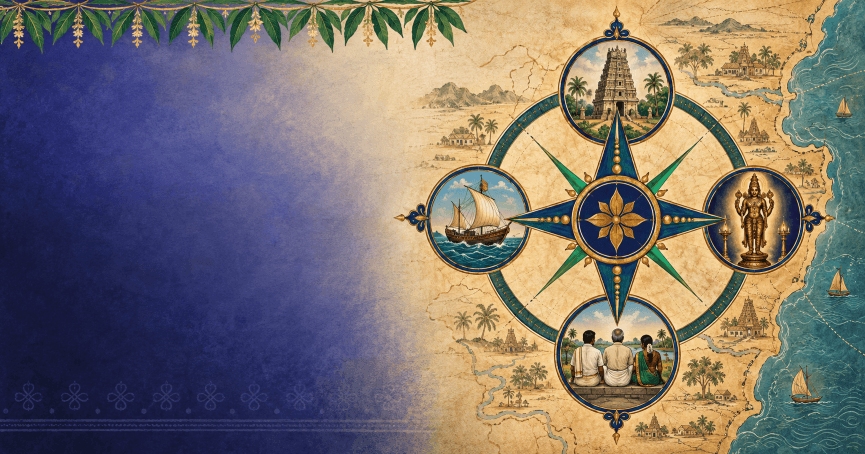
2. Triangulate the Four Anchors (when names aren't enough)
When your ancestor's name returns nothing — either because your ancestor migrated (a common story in diaspora Tamil families across Malaysia, Singapore, Sri Lanka, South Africa, Mauritius, and the Caribbean) or because a specific name has been lost — you can trace your lineage by triangulating four alternative anchors that Tamil families anchor identity to instead of surnames:
- Ancestral Village. Identifying the physical village narrows your search to local district land records (patta documents) and voter registers. TamizhConnect's voter search will surface every household currently registered in a specific Tamil Nadu village — often revealing branches of your family that never left. When you know the village, you can search by the village, not by the person.
- Kula Deivam (clan deity). Most traditional Tamil families belong to a single-village temple. Finding your kula deivam allows you to tap into temple trustee lists or historical donor inscriptions. The kula deivam affiliation is often the strongest evidence a lineage has of its village of origin.
- Community / jati. Caste and merchant guild associations (Chettiar community networks or regional sabhas) historically maintained independent, highly-meticulous family ledgers, especially the mercantile Nattukottai Chettiars.
- Migration route. Pinpointing where and how your family moved narrows down the search to specific historical logs — British colonial indenture passes and estate employment rolls, Cape Town's Natal arrival ledgers, Fiji's Girmitiya lists.
Any three of the four anchors converging on the same lineage is confirmed evidence. Only one is a starting point; two is a hypothesis.
3. Digitize home documents and oral history first
Before you hit online archives, compile the "living archive" within your own home to generate search terms — searching without your family's private context returns a hundred false matches for every real one.
- Interview elders. Record conversations with older relatives. Ask specifically for names, rough birth decades, occupations, and relationships using formal Tamil kinship terms (periyappa, chithappa, athai, mama) to prevent time confusion. The kinship term itself often disambiguates two people with the same name.
- Scan physical keepsakes. Upload and digitise old passports, land deeds, wedding invitations (which traditionally list multiple generations of family initials), and school-leaving certificates.
- Anchor the family's mobile identifiers. Write down every village name, every deity mentioned, and every occupation across three generations. That triad often produces the strongest matches against public records later.
For a systematic 30-day plan for this phase, see the Tamil genealogy starter kit.
4. Search digital civil and historical archives
Once you have targeted locations and names, search online governmental and historical repositories:
- Electoral rolls. Searching the Chief Electoral Officer of Tamil Nadu portal for older voter lists can reveal entire family households grouped by local street addresses. TamizhConnect provides fuzzy village + name matching across the same underlying data plus a Tamil-language patronymic-aware search that raw electoral portals do not.
- National and State Archives. The Tamil Nadu State Archives (Egmore, Chennai) and the British Library India Office Records (available online via partner sites) hold extensive land records, gazetteers, and military papers from the British Raj.
- Colonial passenger lists. If your ancestors migrated as plantation or railway workers, check online historical databases for colonial emigration passes, which often log the passenger's father's name and native village. TamizhConnect indexes these across all six major diaspora destinations under Indenture search.
- Church, baptism, and marriage registers. Tamil Christian families — Roman Catholic, CSI, Anglican, Lutheran — often have the deepest continuous records, some reaching the 1600s in Nagapattinam and Tranquebar (Tharangambadi). Contact the parish or the Franckesche Stiftungen digital archive (Halle, Germany) for the Danish Lutheran collections.
- Temple registers and kula deivam records. Most village temples maintain lineage records (paramparai) that pre-date every colonial archive. Use the kula deivam directory to identify your family's temple, then contact the trust directly — many now list WhatsApp numbers.
- Newspapers, obituaries, and colonial gazettes. The Madras Mail, The Hindu (from 1878), and diaspora newspapers (Trinidad Guardian, Fiji Times) all published birth-marriage-death notices. The Asylum Press Almanack 1919 corpus is indexed and searchable on TamizhConnect.
The two-search rule
For any Tamil genealogy question, the answer usually appears within two of the record types above — rarely just one, almost never more than three. If you've searched two and drawn a blank, the issue is nine times out of ten a spelling variant (village or name) between the colonial-era spelling and the modern one — try phonetic variants first before assuming the ancestor is missing.
- Kokilimudu and Kallimedu are the same village
- Saidapet and Saidapettai are the same village
- Anglicised 19th-century phonetic spellings drifted extensively; assume 2-3 variants for every place-name.
Start here based on what you know
| You have | Start with | |---|---| | A village name, no ancestor names | Find Tamil ancestors by village name | | An ancestor name, no village | How to find your ancestral village | | A diaspora ancestor, unknown Tamil Nadu origin | Trace your indenture roots | | The full record landscape | Tamil genealogy records search — complete guide | | Nothing yet — just interested | Tamil genealogy starter kit (30-day plan) |
Ready to search
- Living cousins: tamizhconnect.com/voters — 50 million+ Tamil Nadu electoral records, village-indexed
- Diaspora ancestors: tamizhconnect.com/indenture-search — 1.5 million+ colonial-era records across eight archives
- Family deity anchor: kula deivam finder
Tracing Tamil family history online works when you stop expecting Western surnames to carry the search — and start using the anchors Tamil families actually preserved: the village, the deity, the community, and the migration path. Three of those four converging on a single lineage is your ancestor.
Share this article
TamizhConnect Team
TamizhConnect helps Tamil families worldwide trace their ancestry using voter records, indenture archives, and origin village matching. Our research team combines genealogy expertise with digitised Tamil Nadu datasets to help you discover your roots.
Ready to start your Tamil family tree?
TamizhConnect helps you discover relatives, trace your origin village, and keep your family history alive for the next generation.
Create your free TamizhConnect accountGo to my family treeDocument Digitisation
Have old documents? Upload them and we'll verify, trace, and add them to your tree.
Was this article helpful?
Get new articles in your inbox
Tamil genealogy tips, research guides, and new feature updates.
You might also like
Tamil ancestry research: Complete guide for genealogical methods (English)
All our deep-dive guides on Tamil genealogical methods, records, ethnography, and heritage validation for TamizhConnect.
17 Sep 2026
தமிழ் மூதாதையர் ஆய்வு நூலகம் (Tamil)
TamizhConnect-க்கு தேவையான தமிழ் வம்சாவளி முறைகள், பதிவுகள், இனவியல் மற்றும் பாரம்பரியச் சரிபார்ப்புக்கான அனைத்து ஆழமான வழிகாட்டிகளும் ஒரே இடத்தில்.
17 Sep 2026
The £200 South African Tamil Roots Verification Project: How It Works, What to Submit (English)
TamizhConnect is offering £200 for every verified ancestral link between a South African Tamil descendant and a Tamil Nadu native village. Full guide to the 5 critical data points, the 7-step verification loop, and how to submit — for descendants AND for Tamil Nadu contributors.
17 Sep 2026
Smart-Matching & Voter Roll Search: How TamizhConnect Finds Your Tamil Family (2026) (English)
How TamizhConnect's Smart-Matching engine bridges the Tamil diaspora with living relatives in India — using 50M+ public voter records, patronymic-aware search, phonetic transliteration, and the unique 'Stayed-Behind' strategy.
04 Sep 2026
Tamil Ancestry: A Complete Guide to Tracing Tamil Roots (2026) (English)
The most comprehensive guide to tracing Tamil ancestry — using colonial-era indenture records, voter rolls, native village mapping, ship registers, and family memory. Covers Tamil diaspora in South Africa, Mauritius, Fiji, Trinidad, Guyana, Reunion, UK, Malaysia, and Singapore.
04 Sep 2026
Tamil Elder Interview Kit: Ready-to-Use Questions & Prompts (English)
A ready-to-copy interview kit for capturing Tamil family history from elders — grouped by topic, sequenced from easy to sensitive, with recording tips and follow-ups that unlock the stories behind the names.
21 Aug 2026
Core topics
What is Tamil, really? Language, identity, and where it comes from
A clear, human explanation of what Tamil is-language, identity, people, and history-plus how to talk about it without stereotypes.
4 Feb 2026
What Defines Tamil Identity Beyond Borders and Sub-Groups? (English)
Tamil identity is primarily defined by shared language and cultural heritage, rather than by geographic borders or internal sub-group affiliations. This core identity persists across the diaspora and within Tamil Nadu.
17 Apr 2026
Continue reading
Tamil Genealogy Records Search: The Complete Guide to Every Archive That Matters (English)
22 Jul 2026
Find Tamil Ancestors by Village Name: Voter Rolls, Migration Archives & Temple Registers (English)
15 Jul 2026
The Tamils of Dharavi: A Hundred Years from Tirunelveli to Mumbai (English)
15 May 2026
The Tamils of Karachi: Tracing Roots from Madrasi Para Back to Tamil Nadu (English)
15 May 2026