Tamil Ancestry Research | Family Tree Guide
Finding Your Ancestral Village: Tamil Genealogy Guide
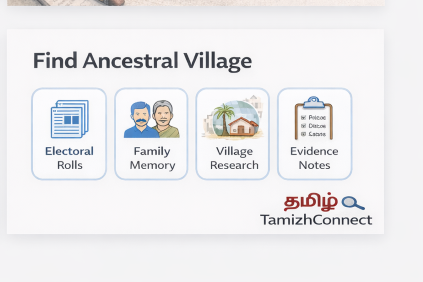
Finding your ancestral village means triangulating four clues: a partial place name from elders, surname patterns tied to specific regions of Tamil Nadu, temple or Kula Deivam associations, and household records (voter rolls, patta documents, school registers) that place relatives at a specific address. No single clue is enough — villages share names, spellings drift between English and Tamil, and families move within the same taluk across generations. Matching at least three of the four is what turns "somewhere in Tamil Nadu" into a specific pin on the map. TamizhConnect combines voter-record search, surname distribution maps, and a Kula Deivam finder so the triangulation happens in one workspace.
This guide is a structured playbook to find and verify an ancestral village even when:
- elders remember only partial place names,
- spellings differ across documents,
- families moved across districts, or
- “native place” is described via temples and nearby towns.
Step 1: Start with what people actually remember
Ask for:
- temple name and festival
- nearby market town
- “bus stop” / “railway station” reference
- local deity name
- surnames or community clusters in that area
These are often more reliable than a vague village spelling.
Step 2: Convert partial place names into candidate list
A partial string (e.g., “Thiru…”) can map to dozens of villages. Your job is to generate candidates using:
- district context (if any)
- known migration corridor (e.g., moved to Chennai for work)
- known community/occupation patterns
Keep a list of candidates; do not commit early.
Step 3: Use household documents as “place detectors”
Best sources:
- electoral rolls (house number + area name)
- wedding invitations (often mention native place and relatives)
- school certificates (native district / taluk references)
- property papers (villages and boundary descriptions)
You’re looking for repeated place fragments across independent documents.
Step 4: Validate via “temple circuits”
In Tamil regions, families frequently cluster around:
- a primary temple
- a village deity temple network
- annual festival routes
If your candidate village has a temple network consistent with family memory, you’re close. If not, discard the candidate.
Step 5: Confirm with relationships, not only place names
Village name matches are common. Relationship matches are rare.
Confirm village by finding at least one:
- consistent spouse/father name link
- sibling marriage connection
- repeated household cluster at an address
A practical “triangulation checklist”
A village is confirmed when at least 3 of these align:
- same place appears across 2+ independent documents
- address/area name remains consistent
- relationship (parent/spouse/sibling) matches
- timeline is plausible (age, migration period)
- temple/deity network matches family memory
Next steps
Once you confirm the village, build outward:
- nearby villages (marriage routes)
- taluk/district patterns
- temple committee networks
That’s usually where you find the next generation connection.