TamizhConnect Blog
19 Dec 2025 · TamizhConnect Team
Electoral Rolls for Tamil Ancestry
Tamil genealogy article
Practical guide to using electoral rolls for Tamil genealogy: household reconstruction, relationship validation, address tracking & research progress even when.

Document Digitisation
Turn documents into verified Tamil lineage.
Choose the depth you need. One-time service, results stay in your account.
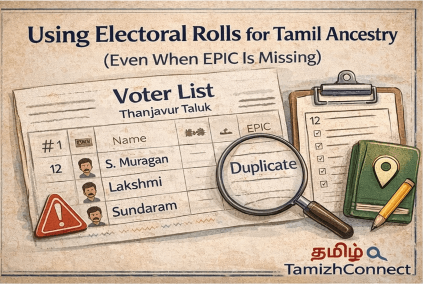
Electoral rolls are one of the most practical sources for reconstructing Tamil households because they capture names, ages, and addresses in a structured way.
Even when EPIC is missing or inconsistent, you can still use electoral rolls effectively by focusing on household clustering and address continuity.
Start with the hub: Tamil Ancestry.
What electoral rolls are best for
- identifying household members at a specific address
- confirming spouse relationships and adult children
- tracking migrations within the same city/town (address changes)
- discovering siblings/relatives in nearby door numbers
- resolving same-name confusion through household context
What electoral rolls are not good for
- deep ancestry beyond living memory (often limited by availability and coverage)
- exact birth dates (age is approximate)
- perfect spelling consistency
Method: household clustering (the most reliable technique)
Step 1 — Treat the address as the “primary key”
Start from:
- house number
- street/area/ward
- section name
Build a household list of everyone at that address.
Step 2 — Track continuity over time
If you have multiple years:
- does the same household cluster persist?
- do names age logically?
- do some members disappear (marriage/move/death) and others appear?
Continuity is stronger than spelling.
Step 3 — Use adjacency
Check nearby door numbers:
- relatives often live within a short radius
- marriage routes sometimes cluster by street
This is especially powerful when the same name appears multiple times in the region.
Handling missing EPIC (common in real datasets)
When EPIC is blank:
- rely on name + age band + address + relation context
- use household consistency across multiple rolls
- cross-check with spouse and parent names if available in any related document
Rule: do not over-merge two people because EPIC is missing. Use the merge rules from: Avoid Duplicate Ancestors.
A practical evidence note template
For each roll entry, capture:
- name as written
- age as listed
- gender
- address components
- section name
- document year/source
- household members list (for clustering)
Then write one sentence:
- “This person is likely the same as X because of Y and Z anchors.”
Common mistakes
Mistake 1: Using only name + age
Fix: always include address and household cluster.
Mistake 2: Merging across different streets too quickly
Fix: look for bridging evidence (same spouse, same parent, same sibling).
Mistake 3: Treating spelling differences as separate people
Fix: evaluate in household context; spelling often drifts.
Next steps
- If you don’t know the village yet, electoral rolls can still reveal family clustering by area.
- Then move to: Find Ancestral Village.
- For indenture-era migration research, see indentured-labour-records-find-roots-india: Indentured labour records: find your roots in India.
- For the full workflow: Tamil Ancestry.
Share this article
TamizhConnect Team
TamizhConnect helps Tamil families worldwide trace their ancestry using voter records, indenture archives, and origin village matching. Our research team combines genealogy expertise with digitised Tamil Nadu datasets to help you discover your roots.
Ready to start your Tamil family tree?
TamizhConnect helps you discover relatives, trace your origin village, and keep your family history alive for the next generation.
Create your free TamizhConnect accountGo to my family treeDocument Digitisation
Have old documents? Upload them and we'll verify, trace, and add them to your tree.
Was this article helpful?
Get new articles in your inbox
Tamil genealogy tips, research guides, and new feature updates.
You might also like
தமிழ் மூதாதையர் ஆய்வு நூலகம் (Tamil)
TamizhConnect-க்கு தேவையான தமிழ் வம்சாவளி முறைகள், பதிவுகள், இனவியல் மற்றும் பாரம்பரியச் சரிபார்ப்புக்கான அனைத்து ஆழமான வழிகாட்டிகளும் ஒரே இடத்தில்.
01 Mar 2026
Tamil Ancestry Research: Complete Guide for Genealogical Methods (English)
All our deep-dive guides on Tamil genealogical methods, records, ethnography, and heritage validation for TamizhConnect.
01 Mar 2026
How to Find Your Kula Deivam: A Guide to Tamil Ancestral Deities
Discover your Tamil Kula Deivam (family deity): understand gotra connections, village temples, caste traditions, and reconnect with ancestral spiritual heritage.
26 Feb 2026
How to Read Tamil Electoral Rolls: A Genealogy Research Guide
Learn to decode Tamil Nadu electoral rolls for genealogy: understand EPIC numbers, household clustering, address patterns, and extract maximum ancestry information.
26 Feb 2026
Trace Your Indenture Roots: A Complete Guide for Tamil Diaspora
Step-by-step guide to tracing Tamil indentured labourer ancestry: using immigration passes, depot registers, and return certificates to reconnect with Indian villages.
26 Feb 2026
What is Tamil, really? Language, identity, and where it comes from
A clear, human explanation of what Tamil is-language, identity, people, and history-plus how to talk about it without stereotypes.
04 Feb 2026
Core topics
Trace Your Tamil Ancestry: Complete Guide to Find Your Roots
Complete guide to discover your Tamil roots using TamizhConnect, family interviews, historical records, and community resources. Learn how to build your family tree and preserve your heritage.
17 Dec 2025
தமிழ் வேர்களை கண்டுபிடிப்பது: உங்கள் மூதாதையரை தேடுவதற்கான வழிகாட்டி
தமிழ் வேர்களை கண்டுபிடிப்பதற்கான எளிய வழிகள்: குடும்ப உரையாடல்கள், ஆவணங்கள் மற்றும் சமூக உதவி மூலம் உங்கள் வேர்களைக் கண்டறிய இந்த வழிகாட்டியைப் பயன்படுத்தவும்.
17 Dec 2025
Continue reading
Tamil Ancestry: How to Trace Tamil Roots Using Records, Villages, and Family Memory (English)
A practical guide to researching Tamil ancestry using records, naming patterns, villages, and migration routes to build your family tree without DNA.
19 Dec 2025
Tamil Diaspora Research Playbook (English)
Complete Tamil diaspora ancestry playbook: document collection, migration timelines, village anchoring, name normalization and validation methods when records..
19 Dec 2025
Tamil Genealogy Evidence Notes (English)
Complete evidence-notes system for Tamil genealogy: record sources, grade confidence, resolve conflicts & build ancestry trees that remain verifiable over time.
19 Dec 2025
Tamil Genealogy Starter Kit (English)
Complete 30-day plan for Tamil genealogy: collect home records, interview elders, normalize names, anchor villages, validate relationships & avoid duplicate...
19 Dec 2025
Tamil Initials Decoder: Safe Guide to Expanding Names Without Duplicate Ancestors (English)
Learn how to expand Tamil initials (patronymics) safely across documents, avoid duplicate people & validate identity using place, relationships & timelines for.
19 Dec 2025
Tamil Kinship Terms Guide: Relationship Mapping for Family Trees & Genealogy (English)
Complete guide to map Tamil kinship terms to genealogical relationships. Handle ambiguity and confirm meaning using evidence for genealogy.
19 Dec 2025
Tamil Naming System Guide: Understanding Initials, Patronymics & Transliteration for Genealogy (English)
Complete guide to Tamil naming patterns for genealogy: initials, patronymics, titles, spelling variations & safe name normalization to avoid duplicate...
19 Dec 2025
Tamil Place Name Variants: Normalizing Village Spellings Across Records (English)
Why Tamil place names appear differently across documents and maps—safe method to normalize spellings using district/taluk structure, nearby towns &...
19 Dec 2025
Multiple Document Linking: Building Evidence Graphs (English)
Birth cert, school record, passport, e-roll, patta, temple list – all for the same person, but all slightly different.
08 Dec 2025
பல ஆவண இணைப்பு — ஆதார கிராப் அமைத்தல் (Tamil)
பிறப்பு சான்று, பள்ளி பதிவு, பாஸ்போர்ட், வாக்காளர் பட்டியல், பட்டா, கோயில் பட்டியல் — அனைத்தும் ஒரே நபரைப் பற்றியவை, ஆனால் சற்று வேறுபட்டவை.
08 Dec 2025