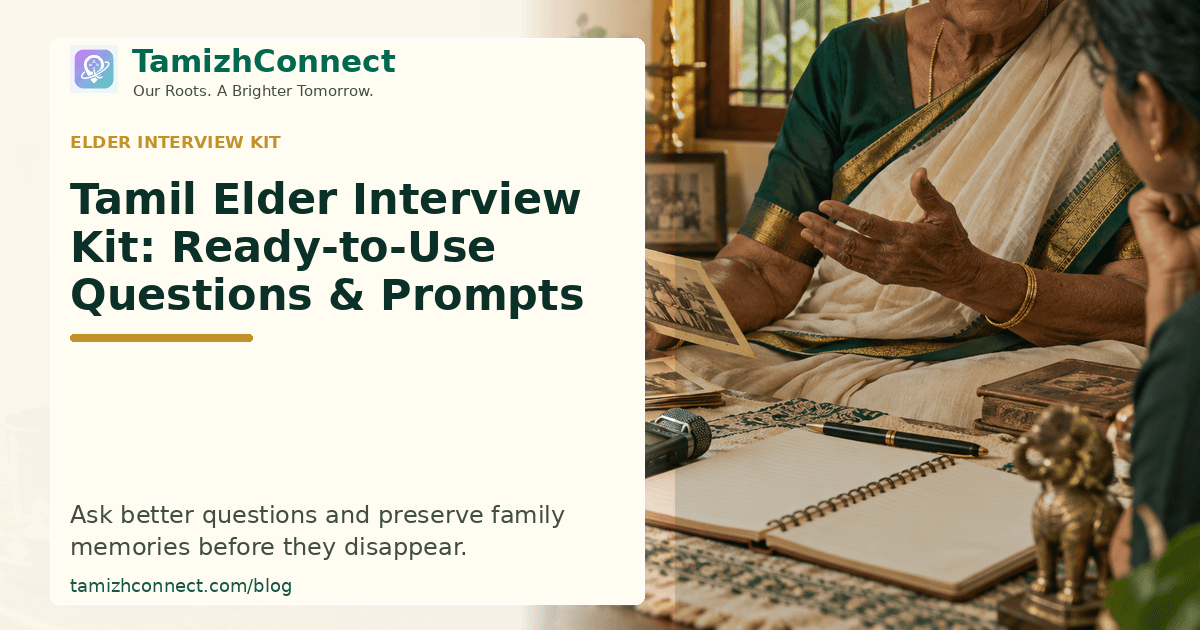
Tamil Elder Interview Kit
A practical, copy-paste question kit for one hour with your grandparent, uncle or aunt. Sequenced so the easy topics come first (names of the village, foods they grew up with) and the sensitive ones later (loss, migration reasons, difficult marriages). Every section has a short "why this matters for the tree" note so you can explain your interest if they ask.
Pair this kit with our longer guide on how to collect family history from Tamil elders — that piece covers why and how to record; this one gives you the what to say.
Before you sit down
- Record the audio. Voice memo on your phone is enough. You’ll want to revisit it — nobody catches every detail in real time. In TamizhConnect you can upload the recording to a person on your tree via Elder Audio Recordings so it stays with the family record forever.
- Bring paper and a pen too. Sketch the family as they speak. Circles for people, lines for marriages, arrows for children. Names go inside, villages go beside.
- Ask permission first. "Would it be okay if I recorded this? I want to be able to listen again." Almost every elder says yes.
- Turn off notifications. Even one ping breaks the flow of memory.
- Have chai / coffee ready. This is a conversation, not a form.
1. Warm-up (5-10 minutes)
Start with sensory memory. It relaxes the elder, wakes up the parts of the brain that hold childhood detail, and often surfaces material they never think to volunteer.
- What did your mother cook on Fridays?
- What smell reminds you of your grandmother’s house?
- What did the kitchen sound like in the morning when you were small?
- What was the first thing you saw when you walked out of the front door as a child?
Why this matters: the specifics they give here — a particular tree, a well, the temple bell at a certain hour — often anchor the exact village or hamlet in later research.
2. Origins & the ancestral village
- What is the name of the village you were born in? Is that different from the village your father / mother was born in?
- Do you remember the district? The taluk?
- What was the closest big town? How did people travel there — bus, cart, on foot?
- Did the family own land in the village? Which fields, and what did you grow?
- Was there a family temple? What was the deity called?
- Who still lives in the village today? Any cousin, uncle, temple priest we could reach?
Why this matters: the exact village + district lets you search voter rolls, ration rolls, and land records. A living contact in the village is the highest-value lead you can get — one phone call there often outperforms months of online searching.
3. Names — the ones that changed and the ones that didn’t
Tamil naming isn’t stable across a life. Nicknames, marriage renamings, initials that stand for a parent’s name — this section untangles it.
- What name did your parents call you at home? What was on your school certificate?
- Did your name change when you got married? What did people call you before?
- What did the initial in your father’s name stand for? Your mother’s initials?
- Were there other names in the family — a house name, a caste-title suffix, a name only used at temple?
- What were your grandparents called? By their given names, by their initials, and by the names their grandchildren used?
Why this matters: voter records, indenture ledgers, ship manifests, land deeds all use different naming conventions. A person appearing as S. Muthu in one record and Muthusamy Subramanian in another looks like two people until you know the initial. Elders usually remember this instantly — documents never do.
4. The household — who lived in each room
Draw as they talk. Ask them to walk you through the house they grew up in, room by room, and tell you who slept where.
- Who lived in the house when you were 10 years old?
- Grandparents on your father’s side — what were their names, and did they live with you or nearby?
- Grandparents on your mother’s side?
- How many siblings did your father have? Your mother? What order were they born in?
- Which cousins grew up in the same house?
- Did anyone die young? At what age, and do you remember why?
Why this matters: the household composition tells you what type of family structure you’re tracing (joint, nuclear, extended). Sibling order matters for property records. Early deaths often hide themselves in later documents as "not mentioned" — the elder is the only one who remembers them.
5. Migrations & moves
If the family has left the ancestral village at any point, this is the most valuable section of the whole conversation.
- When did the family first leave the ancestral village? Who went first?
- Where did they go? Why — work, marriage, war, drought, plantation contract, family dispute?
- What year, roughly? (Anchor to a known event: "was it before or after independence?", "was Amma married by then?")
- Who stayed behind? Do their descendants still live there?
- Did any relative go overseas — Malaysia, Sri Lanka, Singapore, Mauritius, Fiji, South Africa, the Gulf, the UK, North America? What was their name, and roughly when?
Why this matters: migration years unlock passenger lists, indenture records, and citizenship archives. "Overseas relatives you never met" are a common source of preserved documents — a cousin in Kuala Lumpur may have the family photo album your side lost.
6. Livelihood, land, and rituals
- What did your father do for a living? Your father’s father?
- Did the family own the land it worked, or work someone else’s?
- What temple did the family go to for major ceremonies (weddings, first-rice, coming-of-age)?
- What was the kula deivam — the family deity? Which village is that temple in?
- Was there a family teacher / priest / astrologer whose records the family relied on?
Why this matters: land ownership shows up in revenue records. Temple affiliations tie families to specific caste/community histories without you having to ask directly. Kula deivam is often the single most stable identifier across generations — even when everything else has changed.
7. Marriages — how the family grew
- How did your parents meet? Was it arranged, or something else?
- Which village did your mother come from? Do you remember her father’s or brother’s name?
- How was the marriage negotiated? Who arranged it — a temple priest, an uncle, a matchmaker?
- Were there any marriages that crossed community lines? Any that were opposed by the family?
- What surnames or house-names came into the family through marriage?
Why this matters: marriage patterns reveal geographic networks. Two villages that intermarry for generations are often connected by caste, temple, or land. Cross-community marriages are frequently under-documented and elders may be the only source.
8. Sensitive topics — save these for last
Only if the conversation is going well. Read the room. If the elder is tired or emotional, leave these for another day.
- Was there anyone in the family whose story was rarely talked about?
- Any early deaths, disappearances, or people who left and never came back?
- Any relative who took a different religion or a different community?
- What was the hardest year the family went through? What happened?
Why this matters: the missing stories are often where the real family history lives. But they cost the elder something to tell — never push. If they hesitate, thank them and change the subject. Come back next visit.
9. Closing — the pieces you want on record
Before you end the conversation, get these on tape explicitly. They’re small but they anchor everything else you recorded.
- Full name, as they’d like it spelt on a family tree.
- Date of birth (if not known, the year and season).
- Village of birth.
- Father’s full name and village.
- Mother’s full name and village.
- Names of siblings and their birth-order.
- Names and ages of their children.
Ask if there’s anyone else in the family you should also record while you’re doing this. There almost always is.
After the conversation
- Back up the recording — cloud, USB stick, and a copy sent to a family member in another country.
- Write a two-line summary while it’s fresh. "Grandma talked about the 1947 move from Karaikudi to Chennai. Named her father’s brother — Perumal, priest at the Kaligambal temple. Follow up: does he have descendants in Chennai?"
- Upload key names + places into your TamizhConnect family tree while the details are still specific.
- Share back — send the elder a printed one-page summary of what they told you. They will correct things they misremembered, add new details, and often remember more once they see it written down.
One hour with the right questions is worth a hundred hours of guessing later. Don’t wait for the "right time" — the right time is the next visit.