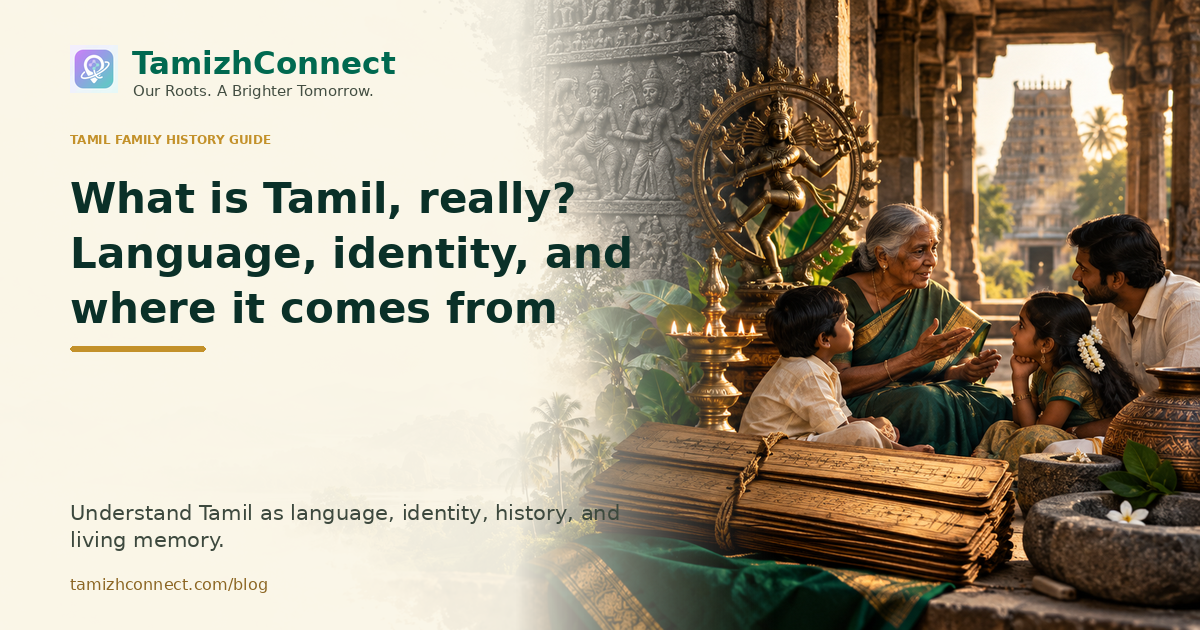
What is Tamil, really?
Tamil is a language, a living culture, and a global community-not just a checkbox on a form. It has a long written history, a rich oral tradition, and millions of people who identify with it across India, Sri Lanka, and the diaspora.
This guide answers a simple but often confusing question: What does "Tamil" actually mean?
1) Tamil is a language first
Tamil is one of the oldest living languages still spoken today. It has a distinct script, grammar, and literary tradition. If someone says "I am Tamil," the most direct meaning is "I speak Tamil" or "my family speaks Tamil."
But language alone doesn’t capture everything.
2) Tamil is also an identity
Over time, "Tamil" grew into a shared identity for people who:
- Speak Tamil at home.
- Trace family roots to Tamil-speaking regions.
- Participate in Tamil cultural life (festivals, music, food, customs).
That’s why you’ll see people identify as Tamil even when they are several generations away from India or Sri Lanka. The identity is carried through family, not just geography.
3) Tamil is a people and a diaspora
Tamil communities exist across:
- India (Tamil Nadu, Puducherry)
- Sri Lanka (Northern and Eastern provinces)
- Malaysia and Singapore
- The Gulf
- The UK, Canada, USA, Europe, Australia, and beyond
Each community has its own migration story. Some are recent, others go back generations. That means "Tamil" can describe very different lived experiences depending on where your family settled.
4) Tamil is not a religion, race, or nation
Tamil people can be Hindu, Christian, Muslim, or secular. Tamil is not a religion. It is also not a single race or nationality.
So if a form asks "race," "ethnicity," or "nationality," Tamil does not always fit neatly into those categories. It is a linguistic-cultural identity.
5) Tamil vs Tamizh
You may see "Tamil" and "Tamizh" used interchangeably. "Tamizh" is closer to the original Tamil pronunciation, while "Tamil" is the common English spelling. Both are acceptable.
6) How to talk about Tamil identity clearly
If you’re unsure how to explain your identity (or your family’s), try a phrase like:
- "My family is Tamil-we speak Tamil and come from Tamil-speaking regions."
- "We’re Sri Lankan Tamil."
- "We’re Tamil from Malaysia / Singapore / the UK."
Adding the region or migration context makes it clearer and avoids confusion.
7) Why this matters for family history
For genealogy and family history, "Tamil" shapes how you record:
- Names (Tamil forms vs English spellings)
- Villages and place names
- Kinship terms and relationships
- Migration timelines
A generic ancestry platform often misses these details. That’s why Tamil-first tools matter.
Start your Tamil family tree
If you want to document your family story with the right context, you can start for free:
- Create a free account on TamizhConnect
- Add your parents, grandparents, and villages
- Record names in Tamil and English
- Invite relatives to fill in the story
Your family’s Tamil identity deserves to be recorded accurately and respectfully.