TamizhConnect Blog
1 Feb 2026 · TamizhConnect
Tracing Influential Tamil Families: Beyond Public Records
Tamil genealogy article
Researching the genealogies of historically significant or influential families in Tamil Nadu often requires looking beyond conventional public records. This post explores the unique challenges and methods for uncovering such private histories.
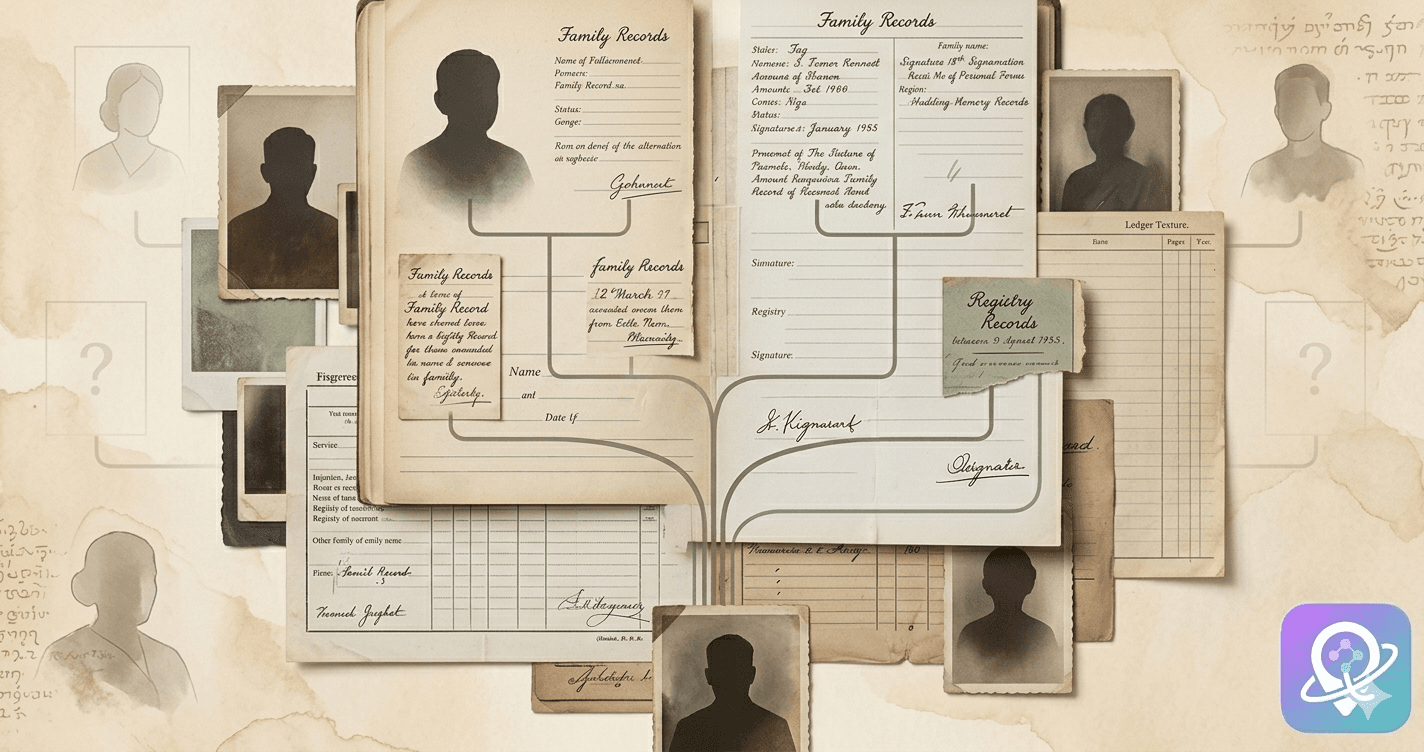
Document Digitisation
Turn documents into verified Tamil lineage.
Choose the depth you need. One-time service, results stay in your account.
Tracing influential Tamil family lineages — zamindars, Chettiar banking houses, Mudaliar landholding networks, temple trustees, political dynasties — usually bypasses public civil records entirely. The primary sources are private: family thombus (handwritten lineage books), temple donor inscription lists, estate paperwork from abolished zamindari accounts, Chettiar firm ledgers from overseas branches, and the archives of caste-community sabhas. Publicly accessible civil records (birth/death certificates, census returns) typically cover only the last 100 years at best, and the grant dates, land assignments, and matrimonial alliances that define influential-family history almost always live in materials held by the families themselves.
The Nature of 'Influence' and Record Keeping
Influential families, by their very definition, often operated within spheres that generated different kinds of records than those of the common person. Their activities might have involved significant landholdings, philanthropic endeavors, political appointments, or cultural patronage. These actions were frequently documented within family-managed estates, temple trusts, educational institutions, or private correspondence, rather than being consolidated in government archives. The challenge lies in identifying where such private documentation might reside and how to ethically access it. Unlike the general public, whose lives might be captured in birth, marriage, and death registers, the narratives of the prominent often appear in institutional histories, biographies, or even hagiographies, which require critical evaluation for genealogical accuracy.
Beyond Government Archives: Private Collections and Institutions
Public government archives in Tamil Nadu, while valuable for general administrative history, rarely contain comprehensive genealogical data for specific elite families. Instead, researchers should turn their attention to:
- Family Archives: The most direct, yet often hardest to access, are private family collections. These can include ancestral land deeds (patta, chitta), wedding invitations, photographs, diaries, letters, ledgers, and even family-commissioned histories or biographies. Such archives are typically held by the current heads of families or their descendants.
- Temple Records (Kovil Kanakku): Many influential families had deep connections to specific temples, often serving as patrons or trustees. Temple records, particularly those relating to endowments, donations, or special privileges granted, can sometimes contain genealogical clues, especially regarding names, relationships, and dates of significant events.
- Educational and Philanthropic Institution Records: Families that founded or heavily supported schools, colleges, or charitable trusts often had their involvement documented in institutional minute books, donor lists, annual reports, and commemorative publications. These can sometimes outline generations of family leadership or patronage.
- Estate Records: For families with large ancestral estates (zamindaris, palayams), the records of land administration, tax collection, and tenant management can be a rich, albeit complex, source of information. These might detail succession patterns, property divisions, and marital alliances.
- Private Libraries and Research Institutions: Some prominent families have established private libraries or endowed research centers that house their ancestral papers, which might be accessible to serious researchers by special permission.
The Role of Oral History and Community Knowledge
For families whose influence spans generations, oral traditions and community memory can be invaluable, especially when written records are scarce or fragmented. Elders within the family or the community associated with them (e.g., long-time employees, local historians, temple priests) may possess knowledge about ancestral names, relationships, migration patterns, and significant life events. However, oral histories must be approached with caution, cross-referenced where possible, and understood as subjective accounts. They often provide context and narrative that written records lack but may contain inaccuracies or embellishments over time. Engaging with these sources requires sensitivity, respect, and often, the mediation of trusted community members.
Navigating Access and Ethical Considerations
Accessing private family records is rarely straightforward. It often requires establishing trust, demonstrating legitimate research intent, and respecting privacy boundaries. Researchers may need to seek introductions through mutual acquaintances or community leaders. It is crucial to be transparent about research goals and to offer to share findings, where appropriate and agreed upon. Ethical considerations include:
- Respecting Privacy: Not all information, even if historically significant, is intended for public dissemination. Researchers must be prepared to honor requests for confidentiality.
- Verification: Information from private sources or oral histories should ideally be corroborated with other records whenever possible to ensure accuracy.
- Cultural Sensitivity: Understanding and respecting the cultural norms and family dynamics is paramount when approaching influential families. An outsider's perspective, no matter how well-intentioned, can sometimes be viewed with suspicion.
Limitations and Realistic Expectations
Despite diligent effort, a complete and perfectly documented family tree for every influential Tamil family is an unrealistic expectation. Gaps are common, records may be lost or intentionally destroyed, and some lines may simply fade from documented history. The goal of such research is often to reconstruct a plausible and well-supported lineage, rather than an exhaustive one. Researchers must be prepared for dead ends and embrace the fragmentary nature of historical evidence.
Ultimately, tracing the genealogies of influential Tamil families is a complex, often deeply personal endeavor. It moves beyond the readily available and into the realm of private stewardship, oral tradition, and careful negotiation. Success hinges on patience, persistence, and a deep respect for the families whose histories one seeks to uncover.
Share this article
TamizhConnect
TamizhConnect helps Tamil families worldwide trace their ancestry using voter records, indenture archives, and origin village matching. Our research team combines genealogy expertise with digitised Tamil Nadu datasets to help you discover your roots.
Ready to start your Tamil family tree?
TamizhConnect helps you discover relatives, trace your origin village, and keep your family history alive for the next generation.
Create your free TamizhConnect accountGo to my family treeDocument Digitisation
Have old documents? Upload them and we'll verify, trace, and add them to your tree.
Was this article helpful?
Get new articles in your inbox
Tamil genealogy tips, research guides, and new feature updates.
You might also like
Digitizing Tamil Family Records: OCR and Manual Strategies (English)
Unlock your family history by digitizing old Tamil documents. Learn practical tips for scanning, using OCR tools, and manual transcription techniques for challenging records.
21 Apr 2026
Tracing Your Tamil Roots: A Step-by-Step Guide to Ancestry (English)
Unlock your family's past with this comprehensive guide to researching Tamil ancestry, from oral histories to digital archives and DNA insights.
22 Mar 2026
Tracing Tamil Ancestry Without Names: Beyond the Family Tree (English)
Discover practical strategies for uncovering Tamil ancestry when specific names are unknown, focusing on migration stories, village names, and contextual clues for both diaspora and Tamil Nadu research.
19 Mar 2026
Tracing Tamil Ancestry: Beyond Five Generations (English)
Uncover advanced strategies for tracing your Tamil family tree beyond the commonly accessible five generations, exploring less-known records and the nuances of historical interpretation.
14 Mar 2026
தமிழ் மூதாதையர் ஆய்வு நூலகம் (Tamil)
TamizhConnect-க்கு தேவையான தமிழ் வம்சாவளி முறைகள், பதிவுகள், இனவியல் மற்றும் பாரம்பரியச் சரிபார்ப்புக்கான அனைத்து ஆழமான வழிகாட்டிகளும் ஒரே இடத்தில்.
03T07:45:33.999Z Sep 2026
Tamil ancestry research: Complete guide for genealogical methods (English)
All our deep-dive guides on Tamil genealogical methods, records, ethnography, and heritage validation for TamizhConnect.
03T07:45:33.998Z Sep 2026
Related by topic
Tracing Your Tamil Ancestry: A Beginner's Guide (English)
Embark on a journey to uncover your Tamil roots. This guide provides a starting point for genealogical research, addressing common challenges and relevant records for those in Tamil Nadu and the diaspora.
9 Apr 2026
Unearthing Roots: A Guide to Tracing Sri Lankan Tamil Ancestry (English)
Embark on a journey to discover your Sri Lankan Tamil heritage. This guide explores available records, research strategies, and common challenges in piecing together your family history.
3 Apr 2026
More from TamizhConnect
Tamil Elder Interview Kit: Ready-to-Use Questions & Prompts (English)
A ready-to-copy interview kit for capturing Tamil family history from elders — grouped by topic, sequenced from easy to sensitive, with recording tips and follow-ups that unlock the stories behind the names.
21 Aug 2026
The Tamils of Dharavi: A Hundred Years from Tirunelveli to Mumbai (English)
From the droughts of Tirunelveli to the tanneries and textile mills of Mumbai, the Tamil community of Dharavi has built one of the largest Tamil cities outside Tamil Nadu. With redevelopment underway, here's how families can preserve their migration story for the next generation.
15 May 2026
Core topics
What is Tamil, really? Language, identity, and where it comes from
A clear, human explanation of what Tamil is-language, identity, people, and history-plus how to talk about it without stereotypes.
4 Feb 2026
What Defines Tamil Identity Beyond Borders and Sub-Groups? (English)
Tamil identity is primarily defined by shared language and cultural heritage, rather than by geographic borders or internal sub-group affiliations. This core identity persists across the diaspora and within Tamil Nadu.
17 Apr 2026
Continue reading
Tracing Brahmin Ancestry in South India: Beyond North-South Migrations (English)
31 Jan 2026
India's Inter-State Water Disputes: A Legacy of Colonial Pacts and Shifting Needs (English)
30 Jan 2026
The Dravidian Language Family: Origins and Relationships (English)
29 Jan 2026
Tracing Deep Tamil Roots: Archaeology and Genetics (English)
28 Jan 2026