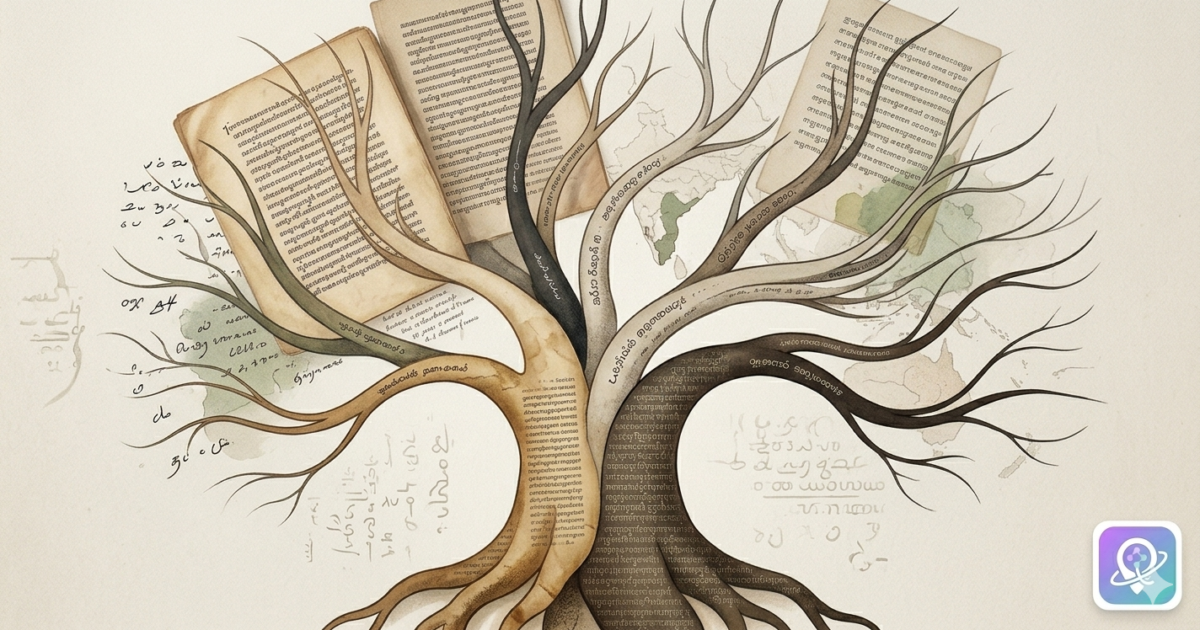
The Dravidian language family includes roughly 80 languages. The four largest have literary traditions and state-official status in South India (Tamil, Telugu, Kannada, Malayalam); mid-sized members include Tulu, Kodava, and Gondi; dozens of tribal languages (Kurukh in Jharkhand, Malto in Bihar, Brahui in Pakistan) mark the family’s northern and western geographic edges. All descend from reconstructed Proto-Dravidian through documented sound changes. The family is NOT related to Indo-European (Hindi, Sanskrit, etc.) at any provable level — the two are separate language families that have coexisted in India for at least 3,500 years.
The Proto-Dravidian Hypothesis
Linguistic reconstruction, a method used to infer features of an ancestor language from its descendants, points to Proto-Dravidian as the common source for all Dravidian languages. While no written records of Proto-Dravidian exist, scholars have meticulously identified shared vocabulary, grammatical structures, and phonetic patterns across modern Dravidian languages to reconstruct aspects of this ancient tongue. The consensus places the origin of Proto-Dravidian in the Indian subcontinent, with estimates for its divergence ranging from 4,000 to 6,000 years ago, though precise dating remains a subject of ongoing academic debate. This deep time-depth makes the Dravidian family one of the oldest extant language families in the world, with connections sometimes explored in relation to the Indus Valley Civilization, though this remains speculative and unproven.
Divergence and Early Development
The Proto-Dravidian language is believed to have first split into three main branches: South Dravidian, Central Dravidian, and North Dravidian. The major literary languages — Tamil, Malayalam, Kannada, and Telugu — belong to the South Dravidian branch, with Telugu sometimes classified as South-Central. This initial divergence set the stage for independent evolution, influenced by geographic separation, cultural exchange, and interaction with other language families, particularly Indo-Aryan languages from the north. Over centuries, these proto-languages developed distinct phonologies, morphologies, and vocabularies, eventually solidifying into the identifiable languages we recognize today.
Tamil: The Oldest Literary Tradition
Among the Dravidian languages, Tamil boasts the earliest attested literary tradition, with its earliest inscriptions dating back to the 3rd century BCE and its classical literature, the Sangam corpus, generally dated between 300 BCE and 300 CE. This remarkable antiquity and continuous literary history often lead to its recognition as the oldest living language in the Dravidian family. The grammatical structure of Old Tamil, as codified in works like Tolkāppiyam, reveals a language that is remarkably consistent with modern Tamil, demonstrating a relatively stable evolution over two millennia. This linguistic continuity is a significant source of pride for Tamil speakers, underscoring a heritage deeply rooted in ancient literature and culture.
Kannada and Telugu: Independent Trajectories
Kannada and Telugu, while sharing a common Dravidian ancestry, developed their own distinct literary traditions. The earliest known Kannada inscription, the Halmidi inscription, dates to around 450 CE, and its rich literary history includes significant works from the 9th century onward. Telugu, similarly, has inscriptions from the 6th century CE, with its literary golden age beginning around the 11th century with the work of Nannayya, who translated parts of the Mahabharata. Both languages evolved in regions that were frequently influenced by various kingdoms and cultural currents, leading to distinct linguistic features and a significant absorption of Sanskrit vocabulary, though they retained their core Dravidian structures. Their independent development showcases the dynamic nature of language evolution within a shared family.
Malayalam: A Later Offshoot
Malayalam’s development is particularly interesting as it is widely considered to have branched off from Old Tamil. While the exact timeline is debated, linguistic evidence suggests a divergence between the 9th and 13th centuries CE, gradually forming a distinct language by the 15th century. Geopolitical separation by the Western Ghats and unique cultural influences, including significant contact with Arabic and Syriac, contributed to its unique identity. Despite its later emergence as a distinct language, Malayalam shares a high degree of lexical and grammatical similarity with Tamil, reflecting their recent common ancestor and highlighting the concept of a linguistic continuum before formal separation.
Shared Features and Distinctive Paths
Despite their individual journeys, all Dravidian languages retain common linguistic features that attest to their shared heritage. These include agglutinative morphology (where suffixes are added to root words to express grammatical relations), a distinct set of phonemes not found in Indo-Aryan languages, and a common core vocabulary. However, each language has also developed its unique sound changes, grammatical innovations, and specialized vocabulary, enriching the overall diversity of the Dravidian family. The ongoing academic study of these languages continues to shed light on their intricate relationships, offering insights into the broader patterns of human language evolution.
The Dravidian language family stands as a testament to deep linguistic history and cultural resilience. While Tamil holds a special place due to its ancient literary tradition, the journeys of Telugu, Kannada, and Malayalam are equally compelling, each contributing unique threads to the vibrant tapestry of South Indian heritage. Recognizing their common ancestry alongside their individual achievements fosters a deeper appreciation for the linguistic diversity and interconnectedness of the region’ region’s past and present.