TamizhConnect Blog
28 Jan 2026 · TamizhConnect
Tracing Deep Tamil Roots: Archaeology and Genetics
Tamil genealogy article
Uncover how recent archaeological finds and genetic research are reshaping our understanding of Tamil origins, exploring both indigenous development and ancient migrations within Tamil Nadu.
Document Digitisation
Turn documents into verified Tamil lineage.
Choose the depth you need. One-time service, results stay in your account.
The question of whether Tamils are the original inhabitants of Tamil Nadu or migrated from elsewhere is being increasingly clarified by a combination of archaeological discoveries and genetic studies, pointing to a complex interplay of deep indigenous development and ancient migrations. These new insights challenge older theories and provide a more nuanced understanding of the long history of the Tamil people, suggesting a continuous cultural presence in the region spanning millennia, while also acknowledging ancient population movements that shaped the genetic landscape. This post will explore how findings from sites like Keeladi and advancements in genetic analysis are illuminating the deep past of Tamil identity.
Unearthing Ancient Civilizations: The Keeladi Revelations
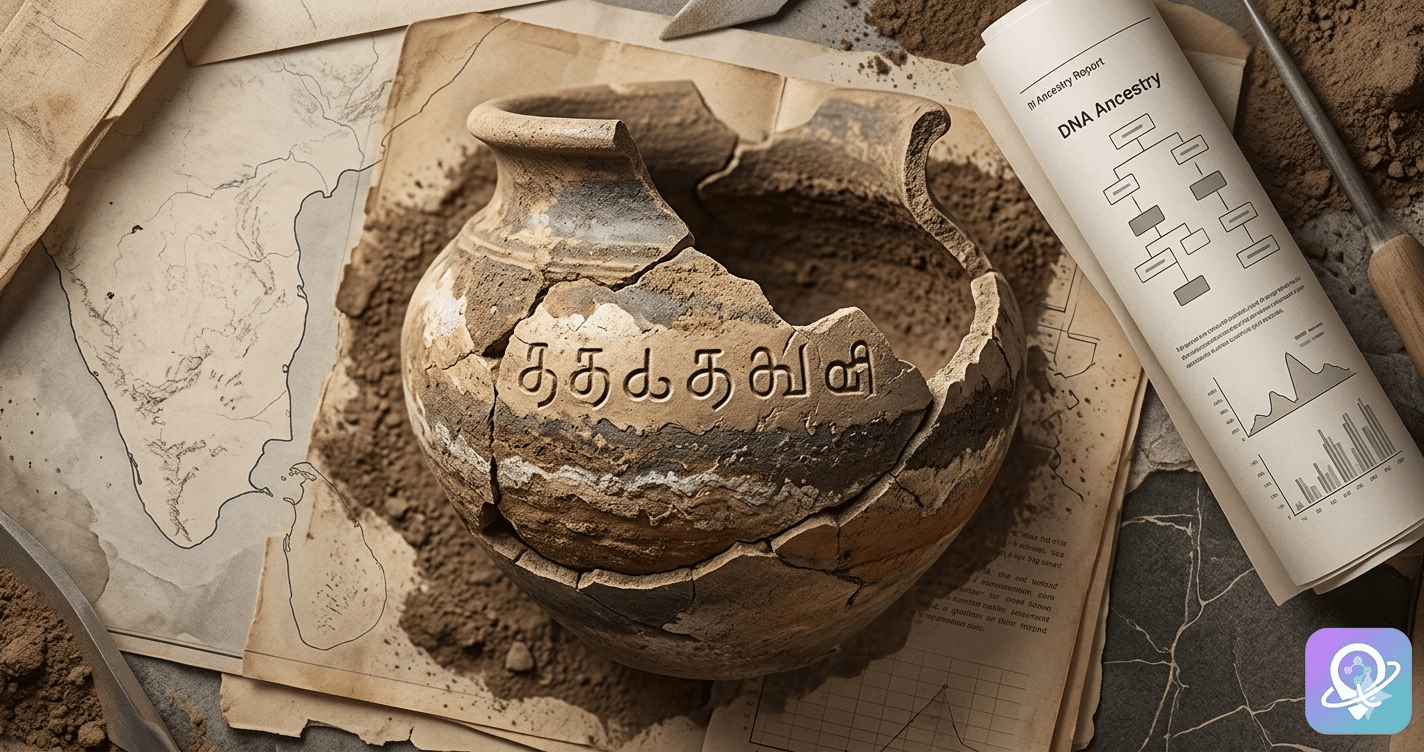
For decades, mainstream historical narratives often emphasized North Indian civilizations like the Indus Valley as the primary cradles of Indian culture, sometimes sidelining the deep antiquity of South Indian cultures. However, recent archaeological excavations, particularly at Keeladi in the Vaigai river valley near Madurai, are profoundly shifting this perspective. The Keeladi site has yielded remarkable evidence of a sophisticated urban settlement dating back to at least the 6th century BCE, pushing back the timeline for a literate, urban civilization in Tamil Nadu by several centuries. Discoveries include thousands of artifacts: pottery with graffiti marks resembling the Indus script, Tamil-Brahmi inscriptions, brick structures, intricate beads, and evidence of advanced water management and industrial activities like weaving and dyeing. The sheer volume and nature of these finds suggest a vibrant, independent urban culture that flourished contemporaneously with, or even predated, the second urbanization in the Gangetic plains. This challenges the notion of Tamil culture as a later development influenced solely by northern traditions, instead presenting it as a distinct and ancient civilization with its own trajectory.
The graffiti marks on Keeladi pottery are particularly intriguing. While not definitively deciphered as a direct link to the Indus script, their presence suggests a continuation of a symbolic or proto-writing tradition that could bridge the gap between the Indus Valley Civilization and the later Tamil-Brahmi script. This strengthens the argument for a deep historical connection between the Dravidian speakers and the Indus Valley people, a theory long debated but now gaining significant archaeological support.
Genetic Journeys: Tracing Ancestral Footprints
While archaeology provides material evidence of past cultures, genetic studies offer a biological lens into population movements and ancestral origins. Recent advancements in ancient DNA analysis and large-scale population genetic studies are providing crucial insights into the genetic makeup of present-day Tamils. These studies consistently show a deep genetic continuity within South India, suggesting that a significant portion of the ancestry of Tamils can be traced back to ancient indigenous populations that have inhabited the region for tens of thousands of years. This indigenous component is often referred to as the 'Ancient Ancestral South Indian' (AASI) component.
However, genetic research also reveals layers of ancient migrations that have shaped the South Indian gene pool. One prominent finding is the admixture event involving 'Ancestral North Indians' (ANI), who are thought to have migrated from the northwest, bringing with them a genetic component linked to steppe pastoralists and early agriculturalists. This admixture event, estimated to have occurred several millennia ago, contributed to the genetic diversity seen across India, including in Tamil Nadu. Crucially, while this migration introduced new genetic material, it did not entirely replace the pre-existing indigenous populations. Instead, it resulted in a complex blending, with varying degrees of ANI and AASI ancestry observed across different groups and regions.
More recent genetic studies are also exploring the extent and timing of these admixtures, refining our understanding of how different groups interacted and integrated over time. The picture emerging is not one of simple replacement but of long-term co-existence, cultural exchange, and genetic intermingling that has forged the unique genetic identity of Tamils.
The Dravidian Question: Language, Culture, and Genes
The relationship between the Dravidian language family and the ancient populations of India is a central theme in understanding Tamil origins. The prevailing linguistic theory suggests that Dravidian languages were once more widespread across the Indian subcontinent and may even have been spoken by the people of the Indus Valley Civilization. The archaeological evidence from Keeladi, particularly the pottery marks, lends support to this hypothesis by demonstrating a sophisticated urban culture in the Dravidian heartland that could have sustained a complex linguistic tradition.
Genetically, the distribution of certain Y-chromosomal and mitochondrial DNA haplogroups (which trace paternal and maternal lines, respectively) aligns broadly with linguistic boundaries, although the correlation is not always absolute. This suggests that while language shifts and cultural diffusions occurred, there was also a significant degree of continuity in the genetic lineages associated with Dravidian speakers. The interplay of linguistic spread, cultural development, and genetic flow paints a dynamic picture of how the Tamil identity, encompassing language, culture, and ancestry, evolved over millennia.
Synthesis: A Deep and Dynamic Heritage
The combined evidence from archaeology and genetics presents a compelling narrative of deep Tamil roots. While significant ancient migrations have undoubtedly occurred, introducing new genetic components and cultural influences, the core of Tamil identity appears to be rooted in a long-standing indigenous presence in South India. Sites like Keeladi demonstrate an independent and sophisticated urban civilization that flourished in the region thousands of years ago, challenging earlier Eurocentric or North-centric historical biases. Genetic studies, meanwhile, confirm a complex tapestry of ancient indigenous ancestry blended with contributions from later migratory waves, all contributing to the unique genetic profile of Tamils today.
This evolving understanding highlights that the Tamil people are not merely descendants of a single migratory wave or a static population. Instead, they represent the rich culmination of millennia of continuous cultural development, adaptation, and interaction within their homeland, shaped by both enduring indigenous traditions and the dynamic flow of ancient populations across the subcontinent. The story of Tamil origins is thus one of profound antiquity and dynamic evolution, constantly being enriched by new scientific discoveries.
Share this article
TamizhConnect
TamizhConnect helps Tamil families worldwide trace their ancestry using voter records, indenture archives, and origin village matching. Our research team combines genealogy expertise with digitised Tamil Nadu datasets to help you discover your roots.
Ready to start your Tamil family tree?
TamizhConnect helps you discover relatives, trace your origin village, and keep your family history alive for the next generation.
Create your free TamizhConnect accountGo to my family treeDocument Digitisation
Have old documents? Upload them and we'll verify, trace, and add them to your tree.
Was this article helpful?
Get new articles in your inbox
Tamil genealogy tips, research guides, and new feature updates.
You might also like
Dravidian Identity: History, Language, and Genetic Roots (English)
Explore the distinct historical, linguistic, and genetic evidence that defines the Dravidian identity, separate from Indo-Aryan cultures. Uncover the deep roots of Tamil people in South India.
16 Apr 2026
Tracing Tamil Roots: The Distinctive Dravidian Heritage (English)
Explore the historical, linguistic, and genetic evidence that defines Dravidian identity, distinct from Indo-Aryan cultures and deeply rooted in South India.
26 Mar 2026
Tracing Tamil Ancestry: Beyond Religious Narratives (English)
Uncover how modern research, from archaeology to genetics, sheds light on Tamil origins, moving beyond traditional religious accounts to explore a richer, evidence-based history.
20 Feb 2026
Who Are the Tamil People? A Foundational Overview (English)
The Tamil people are an ancient ethnolinguistic group with a rich history spanning millennia, primarily rooted in South India and Northeastern Sri Lanka.
19 Apr 2026
Tamil ancestry research: Complete guide for genealogical methods (English)
All our deep-dive guides on Tamil genealogical methods, records, ethnography, and heritage validation for TamizhConnect.
04T07:30:25.000Z Sep 2026
தமிழ் மூதாதையர் ஆய்வு நூலகம் (Tamil)
TamizhConnect-க்கு தேவையான தமிழ் வம்சாவளி முறைகள், பதிவுகள், இனவியல் மற்றும் பாரம்பரியச் சரிபார்ப்புக்கான அனைத்து ஆழமான வழிகாட்டிகளும் ஒரே இடத்தில்.
04T07:30:25.000Z Sep 2026
Related by topic
Unearthing Tamil Nadu Ancestry: A Comprehensive Guide (English)
Tracing Tamil Nadu ancestry requires navigating a rich tapestry of ancient history, diverse migrations, and a unique record-keeping landscape. This guide explores the distinct challenges and rewarding paths for uncovering your roots.
18 Apr 2026
Tracing Tamil Roots: Genetic & Linguistic Evidence for Indigenous Origins (English)
Explore the genetic and linguistic evidence supporting the indigenous origins of Tamil people in South India, differentiating their ancestry from Indo-Aryan groups.
30 Mar 2026
More from TamizhConnect
Tamil Elder Interview Kit: Ready-to-Use Questions & Prompts (English)
A ready-to-copy interview kit for capturing Tamil family history from elders — grouped by topic, sequenced from easy to sensitive, with recording tips and follow-ups that unlock the stories behind the names.
21 Aug 2026
The Tamils of Dharavi: A Hundred Years from Tirunelveli to Mumbai (English)
From the droughts of Tirunelveli to the tanneries and textile mills of Mumbai, the Tamil community of Dharavi has built one of the largest Tamil cities outside Tamil Nadu. With redevelopment underway, here's how families can preserve their migration story for the next generation.
15 May 2026
Core topics
What is Tamil, really? Language, identity, and where it comes from
A clear, human explanation of what Tamil is-language, identity, people, and history-plus how to talk about it without stereotypes.
4 Feb 2026
What Defines Tamil Identity Beyond Borders and Sub-Groups? (English)
Tamil identity is primarily defined by shared language and cultural heritage, rather than by geographic borders or internal sub-group affiliations. This core identity persists across the diaspora and within Tamil Nadu.
17 Apr 2026