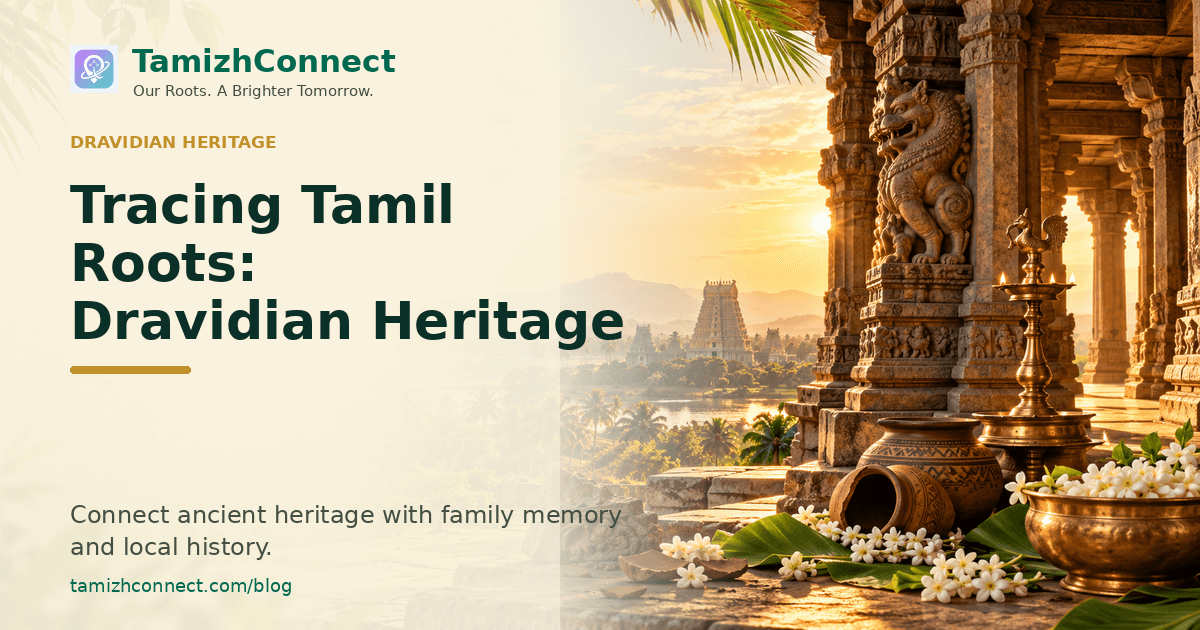
Tamil ancestry traces to Dravidian-speaking populations native to South India for at least the last 4,000–5,000 years, a distinct ethnolinguistic lineage that is NOT derived from the Indo-Aryan migrations of c. 1900–1500 BCE that shaped much of North India. The separation is supported by: genetic studies showing South Indian populations carry a majority Ancestral South Indian (ASI) component distinct from West Eurasian-related ancestry; linguistic reconstruction placing Proto-Dravidian’s origin within the Indian subcontinent rather than outside it; and archaeology showing continuous urban culture at Keeladi, Adichanallur, and related sites predating major Indo-Aryan presence in the south. The two ancestral streams mixed over time, but the deep roots are separate.
The Linguistic Tapestry: Dravidian Languages
The most prominent marker of Dravidian identity is the family of Dravidian languages, of which Tamil is the oldest and most widely spoken. Unlike Indo-Aryan languages (such as Hindi, Bengali, or Punjabi), which belong to the Indo-European family and share a common ancestor with European languages, Dravidian languages form an entirely separate linguistic phylum. Scholars generally agree that Dravidian languages were spoken across the Indian subcontinent before the arrival of Indo-Aryan speakers, suggesting an indigenous origin for these linguistic groups in India.
Tamil, in particular, boasts a literary tradition that stretches back over two millennia, with the earliest extant works, such as the Sangam literature, dating from the 3rd century BCE to the 3rd century CE. This ancient literary corpus is remarkably free from Sanskrit influence in its earliest layers, further underscoring its independent development and deep antiquity. The structural differences, phonological patterns, and unique vocabulary of Tamil and other Dravidian languages provide compelling evidence against an Indo-Aryan genealogical connection.
Archaeological Echoes: Pre-Aryan Civilizations
Archaeological discoveries across South India have consistently revealed sophisticated urban and cultural centers predating significant Indo-Aryan influence, aligning with the timeline and geographical distribution of early Dravidian speakers. The most famous of these is the Indus Valley Civilization (IVC), which flourished from around 2500–1900 BCE. While the language of the IVC script remains undeciphered, many prominent scholars propose a Dravidian affiliation for its inhabitants, based on linguistic reconstruction and the presence of Dravidian loanwords in early Indo-Aryan texts. The decline of the IVC coincided with the initial waves of Indo-Aryan migrations, and it is theorized that some IVC populations may have migrated southward, contributing to the genetic and cultural makeup of South India.
Beyond the IVC, archaeological sites in Tamil Nadu, such as Keezhadi, have unearthed extensive urban settlements dating back to the Sangam period, demonstrating a continuous and independent cultural evolution in the region. These sites reveal advanced pottery, sophisticated water management systems, and evidence of a thriving society that was contemporary with, yet distinct from, developments in North India. The material culture recovered from these excavations further supports the notion of an indigenous South Indian cultural continuum.
Genetic Journeys: Unraveling Ancestry
Modern genetic studies offer powerful insights into population movements and ancestral lineages, largely corroborating the linguistic and archaeological narratives of Dravidian distinctiveness. Research into Y-chromosomal (paternally inherited) and mitochondrial DNA (maternally inherited) markers has consistently shown that South Indian populations, including Tamilians, possess unique genetic signatures that differentiate them from North Indian populations with higher proportions of West Eurasian (associated with Indo-Aryan migrations) ancestry. While there has been some admixture over millennia, the predominant genetic components in Tamil populations point to ancient indigenous South Asian lineages.
Specifically, studies have identified ancient South Asian haplogroups (such as L, H, R2, and specific subclades of R1a) that are prevalent in Dravidian-speaking groups. While the R1a haplogroup is often associated with Indo-Aryan migrations, its presence in South India also includes ancient, indigenous South Asian subclades, suggesting a more complex and nuanced genetic history than a simple north-south divide. The overall genetic landscape indicates a deep-rooted population that has experienced limited, though notable, gene flow from various groups over time, but has largely maintained its distinct ancestral core.
Conclusion
The evidence from linguistics, archaeology, and genetics consistently points to a distinct Dravidian identity for Tamil people, separate from an Aryan genealogy. While cultural and genetic exchanges have occurred throughout history, the foundational elements of Tamil heritage—its ancient language, unique archaeological record, and predominant genetic markers—underscore a deep, indigenous lineage in South India. Understanding this rich and distinct history is crucial for appreciating the enduring cultural tapestry of the subcontinent.