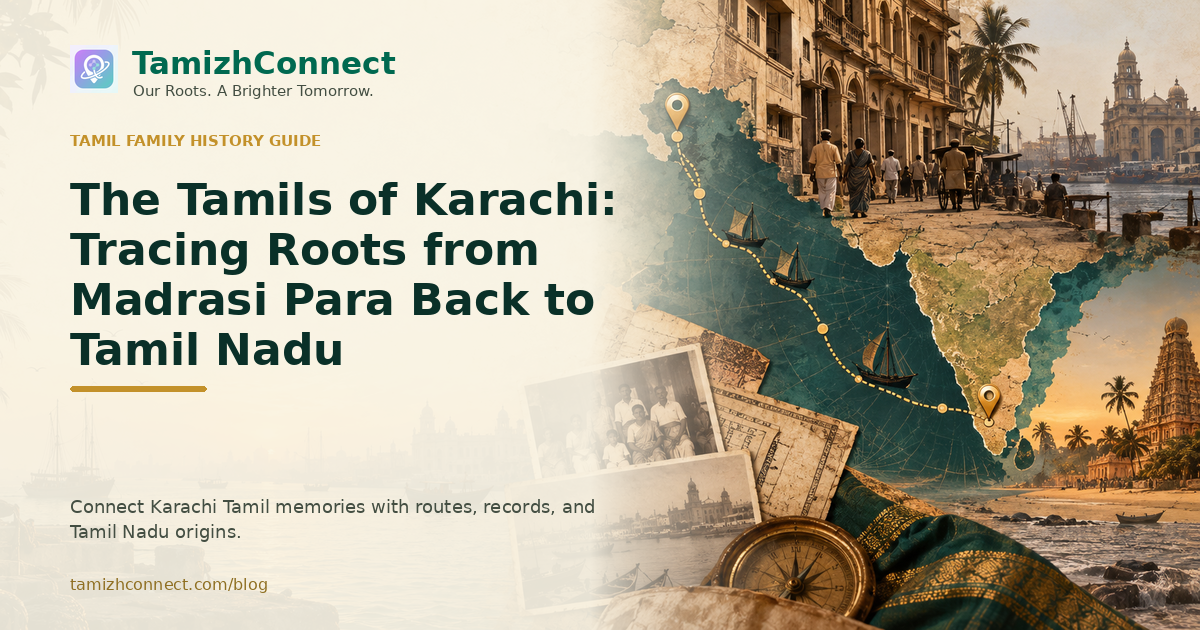
The Tamils of Karachi: Tracing Roots from Madrasi Para Back to Tamil Nadu
Behind the Jinnah Postgraduate Medical Centre in Karachi, in narrow lanes that don’t appear on most tourist maps, there is a neighbourhood called Madrasi Para — "the Madras quarter." Walk through it on a festival evening and you’ll smell sambar simmering in a courtyard, hear Tamil prayers drifting from a temple built in 1964, and see women in bright saris walking barefoot to fulfil vows their great-grandmothers brought with them from a village in Tamil Nadu more than a century ago.
This is the Tamil Hindu community of Karachi — one of the world’s least-documented Tamil diaspora groups. There are roughly 100 Tamil Hindu families in Madrasi Para itself, with more in Korangi, Drigh Road, and Lahore. Most have never set foot in Tamil Nadu. Many of the younger generation no longer speak Tamil. And almost none of them know the names of the specific villages their families came from.
This article is for them. And for the cousins and grandchildren of this community who now live in Karachi, Lahore, Dubai, London, Toronto, and beyond — who grew up hearing that their family was "originally from Madras" but never knew what that meant in any concrete sense.
How Tamils came to Karachi
The story begins in the early 1900s. Karachi, then a fast-growing port city under British rule, needed labour. The railways needed workers. The Karachi Port Trust needed dockhands. The municipal sanitation department needed staff. And the British administration recruited heavily from the Madras Presidency — a vast colonial province that covered modern-day Tamil Nadu, parts of Andhra Pradesh, Karnataka, and Kerala.
Tamil workers, many from rural districts in the area now known as Villupuram, Cuddalore, Tindivanam, and the broader northern Tamil Nadu belt, boarded trains and ships north. They were daily-wage labourers, sanitation workers, railwaymen, port operatives. They were not wealthy traders. They came with their families, their household deities, their songs, and very little else.
There were two further waves:
- The Partition wave (1947). When Pakistan and India separated, most South Indian Hindus had no ties to the violence in the north and continued their lives in Karachi. Some Tamil Hindus left; many stayed because they had no land, no money, and no relatives in Tamil Nadu to return to. Around 100 to 150 Tamil Hindu families remained in Madrasi Para through the post-Partition years, surviving as essential workers while wealthier Hindu communities migrated south.
- The Tamil Muslim wave (1947 onwards). A smaller group of Tamil Muslim families chose Pakistan during Partition. Over generations, most have integrated into the broader Urdu-speaking Muhajir community, but Tamil heritage still flows through some family lines.
A third, smaller group arrived later: Sri Lankan Tamils, primarily Hindu, who fled to Pakistan during the Sri Lankan civil war (roughly 1983–2009). Some settled in Karachi and Lahore.
Today, the total Tamil-origin population in Pakistan is estimated at around 5,000 people, with Karachi as the unmistakable centre.
The community today
Life in Madrasi Para has a rhythm that feels older than the city around it. Doors are often left unlocked. Children play in the lanes. Elders gather under neem trees. When something happens — a birth, a death, a festival — the whole neighbourhood shows up.
At the heart of it all stands the Sri Mariamman Temple, built in 1964. It is the largest Tamil Hindu temple in Pakistan, and it remains the spiritual centre of the community. The temple hosts the major Tamil festivals — Aadi Maasam for Mariamman, Aadi Krittikai for Lord Murugan, Pongal for the harvest, Deepavali for the new year. During the annual kaavadi procession, men carry decorated wooden arches barefoot under the Karachi sun from the Mariamman Temple to the Hanuman Temple about four kilometres away, fulfilling vows passed down for generations. The most striking of these rituals — Alagu — involves piercing the skin with fine spears as an act of devotion, performed exactly as it would be in a village in Tamil Nadu.
The rituals are led by Maharaj Kari Das, one of the last elders in the community who is fluent in Tamil and trained in traditional scripture. When elders like him are gone, the precise oral knowledge — village names, family deities, ancestral surnames, lineage stories — risks going with them.
The food has survived more visibly than the language. Idli, dosa, sambar, rasam, medu vadai, payasam — all are part of daily life in Madrasi Para. Festival meals are still served on banana leaves. A few stalls in Karachi sell dosa that takes three days of fermentation to prepare. South India is alive on these streets even when Tamil is not.
But the language is fading. Younger generations speak Urdu and English, occasionally a few Tamil words for ritual or kinship. The cultural identity remains; the linguistic connection is thinning. And along with the language, what is fading fastest is the most precious thing of all for genealogy: the names of the original villages.
What gets lost when the village name is lost
Here is the difficult truth about Tamil ancestry: knowing you are "from Madras" or "from Tamil Nadu" is not enough.
Tamil identity, especially in the lineage sense, is rooted in three things:
- The native village (சொந்த ஊர் / sonta ūr). Every Tamil family has one — the ancestral village from which the family originated, even if no one has lived there for generations.
- The Kula Deivam (குல தெய்வம்). The family deity. Almost always a deity associated with a specific village temple in Tamil Nadu. Your Kula Deivam is not just any god you pray to — it is the god of your family, tied to a specific place. When a Tamil family travels back to the native village to perform rituals for a wedding or a death, it is the Kula Deivam they go to.
- The caste/community lineage. Whether you choose to honour it or not, this often determines which village your family is associated with, which deities are traditionally yours, and which surnames recur in your line.
When a family loses the name of its native village, it doesn’t just lose a piece of trivia. It loses the anchor that connects every other piece of genealogical information. Without it, the family deity becomes ambiguous. Wedding and funeral rituals lose their proper place. The thread back to one’s ancestors becomes loose.
For the Madrasi Para community, this is the urgent problem. The grandparents who knew the village names are passing on. The parents heard the names once and forgot. The children never heard them at all.
How to begin tracing roots back to Tamil Nadu — even from Karachi
The good news is that more is recoverable than most people assume, even after a century. Here is a practical sequence we recommend at TamizhConnect:
Step 1 — Talk to the eldest living relatives, urgently
If anyone in your family — a grandparent, great-aunt, an elderly neighbour in Madrasi Para — was born before 1960, they are a primary source. Sit with them. Record. Ask in this order:
- What was the name of our village in Tamil Nadu? (சொந்த ஊர் என்ன?)
- Which district was it in? (Common answers for Karachi Tamils: Villupuram, Cuddalore, Tindivanam, Chengalpattu, Vellore, North Arcot, South Arcot.)
- What is the name of our Kula Deivam? Which temple?
- What was our family surname or pattaperu (பட்டப்பெயர்)?
- Do you remember any names of ancestors — great-grandfathers, great-grandmothers?
- What did our family do for work before coming to Karachi?
Even fragmentary answers — "I think it was somewhere near Pondicherry" or "my grandmother used to say Vellalar" — are enormous clues.
Step 2 — Look at the British-era migration patterns
Tamil migration to Karachi between roughly 1900 and 1947 was concentrated in specific occupations — railways, port operations, municipal services, public works — and the recruitment came from specific districts. If you know your great-grandfather worked on the Karachi railway, that is itself a clue: railway recruitment from the Madras Presidency drew heavily on certain Tamil districts. The British kept records, and some are still accessible through the India Office Records (British Library) and the Tamil Nadu State Archives.
Step 3 — Identify your Kula Deivam
This is one of the most powerful threads, because Kula Deivams are tied to specific village temples — and once you know your family deity, you can often narrow down the region of origin even if you’ve lost the village name. Edgar Thurston’s 1909 anthropological work Castes and Tribes of Southern India documented Kula Deivam associations for dozens of Tamil communities, and modern temple databases continue to map these. At TamizhConnect, we maintain a Kula Deivam Finder that helps trace family deities to ancestral regions.
Step 4 — Build a family tree, even with gaps
Start with what you know. Add your parents, grandparents, great-grandparents. Mark the gaps. Then begin the slow work of filling them — through conversations with relatives in Karachi, in Lahore, and in the diaspora. Family trees grow surprisingly quickly once two or three relatives from different branches start contributing.
Step 5 — Connect with other Tamil diaspora communities
The Karachi Tamils are not alone in this work. Mauritian Tamils, Malaysian Tamils, Sri Lankan Tamils, South African Tamils, Trinidadian Tamils, Surinamese Tamils — all have been doing this for years. Many of the genealogical resources, techniques, and even the ship-passenger records are shared across these communities. The Karachi diaspora has a real opportunity to join a global Tamil family-history movement that has been quietly building for two decades.
Why this matters now
The Madrasi Para community is at an inflection point. The elders who remember are aging. The young people who could ask questions are increasingly busy with their own Pakistani lives. Without an active effort in this generation, much of what is recoverable will be lost in the next.
But the opposite is also possible. If even ten or twenty families in Madrasi Para — and their relatives in the Gulf, the UK, Canada, and beyond — begin to document, ask, and trace, the entire community’s heritage map could be reconstructed within a few years. The Mariamman Temple could become a place not just of worship but of memory: a place where families know which village their deity originally came from, and why.
We at TamizhConnect would consider it an honour to help with this. Our platform is free to begin family-tree building and ancestral tracing. We’re already used by Tamil diaspora families in over 25 countries — including communities like the indentured Tamils of Mauritius, Suriname, and South Africa, whose situation a century ago was closely parallel to the Karachi Tamils’.
If you are from Madrasi Para, or your family was, or you simply know someone who is — please reach out. Sign up, build a tree, or just send us your grandmother’s village name. Every fragment helps.
The Tamils of Karachi have kept their culture alive for a hundred years against extraordinary odds. The next step is reconnecting it to where it began.
Start tracing your roots at tamizhconnect.com — free to sign up. Tools include family-tree building, Tamil voter records search (50M+ records from Tamil Nadu), indenture-ship records, and our Kula Deivam Finder.
If you are a researcher, journalist, or community leader working with Karachi Tamils, we’d love to collaborate. Email us, or reach out on Facebook and Instagram (@tamizhconnect).