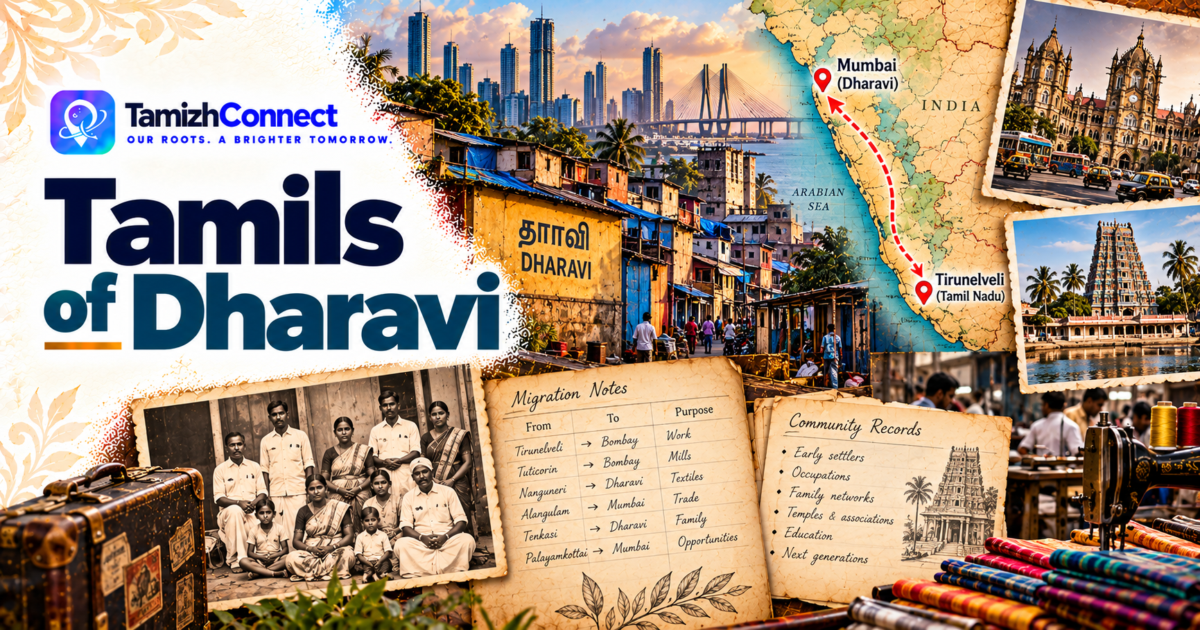
The Tamils of Dharavi: A Hundred Years from Tirunelveli to Mumbai
Walk through Dharavi on a Friday evening and you’ll hear Tamil before you hear Marathi. Vegetable sellers calling out vendakkai, kathirikkai. Cassette stalls playing old Ilaiyaraaja. The smell of curry leaves and mustard seeds tempering in coconut oil drifting out of one-room kitchens. Inside the Sundara Vinayagar Temple, built in 1939 by the Bombay South Indian Adi-Dravida Mahajana Sangha, families perform the same rituals their great-grandparents brought with them from villages in Tirunelveli district — sometimes more rigorously here than back home, because in Mumbai the rituals are also how you remember who you are.
Dharavi is one-third Tamil. Out of nearly a million residents, an estimated 300,000+ are of Tamil origin — making it, by population, one of the largest Tamil settlements anywhere outside Tamil Nadu itself. Add the Tamil populations of Matunga, Sion-Koliwada, Kurla, and Greater Mumbai, and the Tamil population of Mumbai approaches half a million people.
Unlike the Tamils of Mauritius or the Caribbean or Karachi, the Tamils of Dharavi did not lose the thread. Most families here still know the name of their native village. Many travel home every Pongal, every Aadi Maasam, for weddings and funerals. The COVID-19 lockdown of 2020 famously triggered a reverse migration of more than 10,000 Dharavi residents back to Tirunelveli in a matter of days — a movement only possible because everyone knew exactly where home was.
But the third and fourth generation is now growing up in Mumbai. Children who speak Hindi and English and Marathi fluently, and Tamil with their grandparents. Families whose grandfather knew his village, whose father has visited it twice, and whose son has never been. And Dharavi itself is being redeveloped — the Adani Group’s redevelopment project is currently displacing and rehousing residents across hundreds of acres. Communities that have lived together for a century are being scattered into vertical housing.
This is, in other words, an inflection point. The Mumbai Tamil community is one of the most successful internal migration stories in modern Indian history — and one of the least documented. This post is about that story, and about how families can preserve it for the generation that comes next.
How Tamils came to Mumbai
The migration began earlier than most people realise. There are records of Tamil speakers in Bombay from the late 1800s. The earliest waves came for two specific industries:
- Tanneries. Tamil Muslim leather workers from Madras and Adi Dravidar Tamil workers from Tirunelveli established the leather industry in Dharavi. As V Ashok Kumar, a second-generation Dharavi tannery owner, has said: "Tannery Dharavi la start pannunadhe namma Tamilargal thaan." ("Tamils were the ones who started the tanneries in Dharavi.")
- Textile mills. Bombay’s mill economy needed labour. Tamil workers from the southern districts — Tirunelveli, Thoothukudi, Madurai, Ramanathapuram — came in increasing numbers, particularly from the 1920s onwards.
But the major influx came in the 1950s, driven by two forces that pushed people out of Tamil Nadu and pulled them toward Bombay:
- Drought and agrarian distress in Tirunelveli and the southern Tamil districts. Failed monsoons made subsistence farming untenable for many landless and small-landholding families.
- Caste oppression. The Adi Dravidar community — formerly classified as "untouchable" by the caste system — faced systemic violence, exclusion from land ownership, and denial of basic services in many southern Tamil villages. Bombay offered something Tamil Nadu did not yet: anonymous urban work where caste mattered less in daily transactions, even if it never disappeared entirely.
Suresh Kumar, a second-generation Tamil Dharavi resident, has put it plainly in oral history interviews: "They say that the migration from Tamil Nadu to Dharavi was happening for the last two hundred years. There were no railways back then so people used to walk for more than a month to cover the distance."
A month on foot, from a Tirunelveli village to Bombay, in search of work and dignity. That is the story underneath Dharavi.
A third, parallel migration deserves mention: Tamil Christians from Tirunelveli, who established a distinct community and built churches in Mumbai from the early 1900s onward. There is now a documented history of this community — The Migrant Tamil Christians in Mumbai: A History by Ananda Maharajan, published in 2024 — that traces the connection from Tirunelveli Protestant Christianity to Mumbai’s Tamil congregations.
The Tamil city within the city
Dharavi today is sometimes described as a mosaic of nearly 100 distinct nagars — neighbourhoods organised by region, language, caste, and trade. The Tamil portion is enormous, and within it there are sub-distinctions: Adi Dravidar Tamils from Tirunelveli, Tamil Muslims from Madras, Tamil Christians, Nadar communities, smaller Telugu-speaking pockets that often get folded into the Tamil identity. Each has its own social networks, often its own chawls, sometimes its own temple or church.
The institutional anchors of the Tamil community include:
- Sundara Vinayagar Temple (Dharavi, originally a peepul-tree shrine, formal structure built 1939) — built by the Bombay South Indian Adi-Dravida Mahajana Sangha.
- The Mahim Mariamman Temple and other Mariamman shrines that follow the South Indian goddess-temple tradition, including kaavadi processions and Aadi Maasam observances.
- Tamil chawls across Dharavi, Matunga, Sion-Koliwada, and Kurla — often organised by district of origin, so families from a particular Tirunelveli taluk frequently live within walking distance of each other in Mumbai too.
- Tamil Sangams and community associations including the Mumbai Tamil Sangam, Bombay Adi Dravida Mahajana Sabha, and church-based groupings for Tamil Christians.
- Tamil schools like Kamban Vidyalayam, mentioned with affection by commenters under recent Mumbai Tamil videos online — "நாங்களும் தாராவியில் படிச்சது கம்பன் பள்ளியில்" ("We also studied in Dharavi, at Kamban school").
The cultural life is dense and continuous. Tamil cinema releases in Mumbai theatres. Tamil weddings are conducted with the full ritual sequence. Pongal is celebrated in chawls. Children watch Tamil television and eat sambar and rasam at home before going out to speak Hindi with their friends. This is what scholars have called multiple citizenship — Tamil and Mumbaikar at the same time, with no contradiction felt between the two.
Why this matters now: the redevelopment moment
Dharavi is currently undergoing the largest urban redevelopment project in India’s history. The Adani Group, in partnership with the Maharashtra state government, is rehousing residents into multi-storey vertical buildings across a multi-year programme. Whatever one thinks of the redevelopment itself, two things follow from it that matter for the Tamil community specifically:
- Communities will be physically scattered. A chawl that has held forty Tirunelveli-origin Tamil families for sixty years will, in many cases, no longer exist as a contiguous physical entity. Families will be allocated flats in different towers, sometimes different wings, sometimes different schemes. The proximity that has held the community together for generations is being engineered out.
- The institutional memory of place will weaken. When a chawl is demolished, the Anjuman notice boards, the photographs in temple walls, the older residents’ shared knowledge of who came from which village in 1952 — all of it is at risk. Some of it ends up in the trash during the move.
This is happening now. Not in a decade. Now.
For a community whose primary inheritance is who — whose family, from which village, in which generation — losing the physical container of that knowledge means losing pieces of the knowledge itself. The good news is that there is still time to capture it. The bad news is that no one is going to do this for the community except the community itself.
What we’d suggest for Mumbai Tamil families today
The Mumbai Tamil situation is the opposite of the lost-diaspora situation. You don’t need archives to find your village name — your grandmother probably tells you the village name every time you visit. What you need is documentation, organisation, and transmission to the next generation. Practically:
1. Build the family tree, now, while the elders are still here
The single most valuable thing your family can do in the next twelve months is sit with the eldest living members and document the family tree, in writing or digitally. Specifically:
- All four grandparents’ names, native villages, dates of birth (even approximate), dates of arrival in Mumbai
- Names and villages of great-grandparents wherever recoverable
- Names of all uncles, aunts, and cousins on each side
- Migration story: who came first? Who followed? Which chawl did they live in? What work did they do?
For a typical Dharavi Tamil family, you can usually reconstruct four to six generations of clear lineage — going back to roughly the 1880s — within an afternoon, if you ask the right questions of the oldest relative.
TamizhConnect offers free family tree building specifically for this. You can add what you know, share it with relatives in Mumbai and in Tamil Nadu, and let them fill in gaps.
2. Connect with extended family still in the native village
This is one of the most powerful but underused things our platform does. We index over 50 million Tamil Nadu voter records. If you know your ancestral village in Tirunelveli (or Thoothukudi, Madurai, Ramnad, Virudhunagar — wherever your family is from), you can often find living relatives still in the village through the voter rolls — uncles, cousins, distant family members your parents have lost touch with.
This works especially well for Dharavi Tamil families because most still know the village. Many readers of this post can find a cousin they’ve never met within fifteen minutes.
3. Identify your Kula Deivam
Even families who know their native village often don’t know their Kula Deivam (குல தெய்வம்) — the specific family deity, usually associated with a specific village temple. This matters for weddings, funerals, and major life rituals. For Adi Dravidar families especially, where some lineage knowledge was suppressed by caste oppression for generations, the Kula Deivam can be a meaningful recovery. TamizhConnect’s Kula Deivam Finder helps with this.
4. Document the Mumbai story, not just the Tamil Nadu story
The migration itself is part of your family history. Which year did your grandfather come to Mumbai? Which chawl did the family first live in? Which factory or tannery did they work at? Who else from the village came with them, or followed?
This part of the story will be the first thing lost once the original migrant generation passes. Future generations will know they are "Tamil" and "from Tirunelveli" but the texture of how the family actually made the journey, who supported whom, what was hard and what was joyous — that disappears within two generations if not written down.
5. Preserve the community story, especially during redevelopment
If you live in a chawl that is being redeveloped, the chawl itself has a story. The photographs on the wall, the names of past residents, the founding of the local Sangam, the early years of the temple — these are community archives. Even informal documentation by residents — phone photos of old notice boards, recorded conversations with elderly residents — captures something that the official redevelopment process will not.
We’d encourage Tamil chawl committees and Sangam organisers across Dharavi, Matunga, Sion, Kurla, and beyond to think of TamizhConnect as a free tool for community-level heritage documentation, not just family-level. Reach out and we’ll help.
A note on the Adi Dravidar history specifically
A significant share of the Dharavi Tamil community is Adi Dravidar — descendants of families who faced caste oppression in Tamil Nadu and built lives in Mumbai under the leadership of community institutions like the Bombay South Indian Adi-Dravida Mahajana Sangha. This is a community with a distinct, proud history of organisation, mutual aid, religious assertion (the building of the 1939 Sundara Vinayagar Temple was itself an act of community self-assertion), and political consciousness.
The Tamil filmmaker Pa. Ranjith’s Kaala (2018), starring Rajinikanth, was a popular telling of part of this story. Books and oral history projects continue to document it. We at TamizhConnect approach this history with respect and care — we don’t try to flatten the distinctive Adi Dravidar narrative into a generic "Tamil diaspora" frame. The community’s history of resistance, migration, and survival is its own, and we want our platform to support its documentation, not absorb it.
What the next generation deserves
A child born in Dharavi today, or in the new tower their family is being moved to next year, deserves to know more about their inheritance than just "we are Tamil, from Tirunelveli." They deserve the names of their great-grandparents. The name of the village. The name of the Kula Deivam. The story of how their family got from a drought-stricken village in the 1950s to one of the world’s most extraordinary urban communities in 2026.
That information exists. It’s in your mother’s memory. Your great-uncle’s photo album. The temple committee’s notice board. The chawl elder’s handwritten records.
It just hasn’t been written down anywhere it will survive.
We’ve built TamizhConnect to be the place where it can be.
Start at tamizhconnect.com — free family tree building, 50M+ Tamil Nadu voter records to find relatives still in your ancestral village, Kula Deivam Finder for tracing family deities, and free community tools for chawl and Sangam-level documentation.
For Tamil community organisations, Sangam leaders, and chawl committees in Dharavi, Matunga, Sion-Koliwada, Kurla, and across Mumbai — we offer free institutional tools for community-level heritage documentation. Email or message us on Instagram (@tamizhconnect).