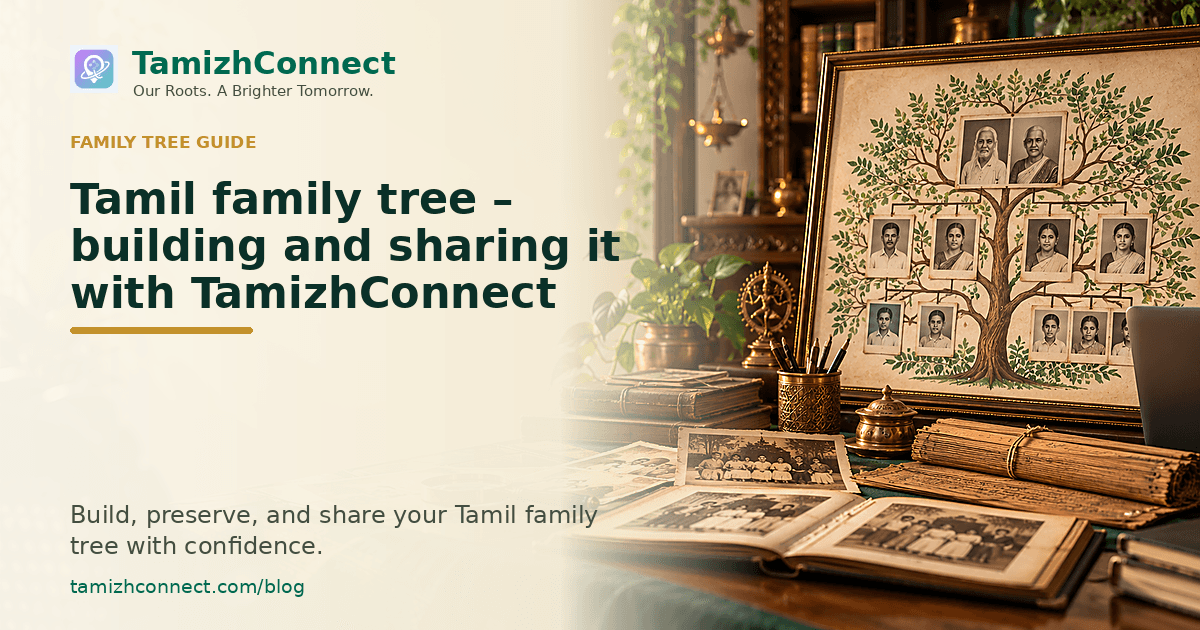
Tamil Ancestry Research | Family Tree Guide
In this article:
- What a Tamil family tree really is (beyond names on a chart)
- What to collect first from your family members
- How to record names, kinship and places in a Tamil context
- How to build and share your tree inside TamizhConnect
1. What a “Tamil family tree” actually means
When most people hear “family tree”, they imagine:
- a big diagram,
- some boxes,
- names and dates written inside.
For Tamil families, that picture is too simple.
Our family networks are:
- extended over many generations in the same village,
- spread across multiple districts and sometimes countries,
- full of strong kinship terms (periappa, chittappa, athai, periammā, maama, etc.),
- mixed with house names, initials, nattu / ooru names, caste and clan identities.
So a Tamil family tree is not just:
- Father → Son → Grandson.
It should also show:
- sibling groups and who is elder / younger,
- marriage links between different villages or jātis,
- migrations for work, politics, or education,
- stories that explain why someone moved or how a relationship changed.
A good Tamil family tree answers questions like:
- “From which exact village in Thanjavur side did we come?”
- “Which branch went to Sri Lanka / Malaysia / Singapore?”
- “How are we related to that family who lives in the next street?”
Your goal is not a perfect diagram on day one.
Your goal is a living map of people, places and stories.
2. What to collect first (before opening any app)
If you start typing randomly into a tool, you will get a messy tree.
First, collect structured information offline.
2.1. Start with four core people
Pick one person as “root”. Usually:
- yourself, or
- your father/mother, or
- your grandparent who is central in family stories.
From that root, you want four lines:
- father’s side – paternal grandparents, their siblings
- mother’s side – maternal grandparents, their siblings
- spouse’s side – if you are married
- in-laws and close affines – people you often meet at functions
Write them down by hand first:
- Root person (name, initials, birth year, village).
- Their father and mother.
- Their siblings.
- Spouses of each sibling.
Do not obsess about exact dates now.
Approximate years are better than empty spaces.
2.2. Interview elders the right way
Elders will not talk in tables. They speak in stories.
When you talk to them:
- Ask open questions:
- “Who lived with us in that old house in …?”
- “Who all came for your wedding? Which side?”
- Listen for:
- nicknames,
- village names replacing surnames,
- clues like “big flood time”, “before the War”, “after Emergency”.
Always note down:
- relationship (“father’s younger brother’s son”),
- village / street / ooru,
- any landmarks (“near Perumal kovil”, “behind taluk office”),
- occupation (“railway employee”, “coffee estate coolie”, “school teacher”).
You can later convert stories into structured nodes in TamizhConnect.
2.3. Cross-check with documents
Where possible, try to confirm:
- ration cards
- school certificates
- property documents
- passports, voter IDs, death certificates
- temple donation lists, marriage invitations, obituaries
You will quickly see spelling differences for the same person.
That is normal. Note every variant.
3. Recording Tamil names, kinship and places clearly
Tamil family data has specific problems that Western tools often mishandle.
You need a consistent method.
3.1. Names and initials
Typical patterns:
- Initial + personal name – “R. Natarajan”
- Double initials – “R.M. Natarajan” (grandfather + father)
- No surname – village or caste name used socially, not officially
Suggested rules:
- Store full personal name in one field (“Natarajan”).
- Store initials separately (“R”, “M”).
- Add alternative forms:
- “RM Natarajan”,
- “Natarajan R”,
- “Natarajan RM”.
This way search will still work even if future generations forget the exact style.
3.2. Kinship terms → standard relationships
Tamil terms are rich but can be confusing across dialects.
Examples:
- periappa / chittappa → father’s elder / younger brother
- mama → mother’s brother or paternal aunt’s husband (context matters)
- athai → father’s sister
- periammā / chinnammā → mother’s elder / younger sister
When you enter data:
- Always convert kinship terms into precise links:
- “father’s brother”, “mother’s sister”, “paternal aunt”, etc.
- Use notes to preserve the Tamil word:
Called “chittappa” in the family.
This keeps the tree machine-readable while still preserving culture.
3.3. Places and migration
For each person, try to capture:
- birth village / town
- ancestral ooru (if different)
- important migration points – first job city, marriage move, overseas move
Write places in a consistent hierarchy:
- village / town – taluk – district – state – country
Example:
- Alangudi – Alangudi taluk – Pudukkottai district – Tamil Nadu – India
If a place changed district, note:
- “Then in Thanjavur district, now in Pudukkottai district.”
This is crucial when you later connect your tree with records, maps or gazetteers.
4. Turning all this into a clear tree in TamizhConnect
Once you have rough notes, you can use TamizhConnect to:
4.1. Create people as profiles, not just boxes
For each person:
- enter personal name + initials
- add known dates (even approximate: “c. 1935”)
- attach village / ooru and migration notes
- add a short story snippet (“Worked in Burma rice mills before WWII”)
Your tree stops being a dull chart and becomes a story network.
4.2. Link relationships carefully, generation by generation
Best order:
- Create grandparent generation profiles.
- Add their children and spouse links.
- Add your generation and cousins.
Each time you add someone:
- immediately connect them as child / spouse / sibling of someone already in the tree.
- avoid “floating” profiles with no links.
If you are not sure about an exact connection:
- still create the person,
- link them in the closest confirmed way,
- add a note: “Connection to X side not fully confirmed; told by Y in 2023”.
4.3. Attach evidence and sources
Where TamizhConnect allows notes or attachments, use them to store:
- photos of old ration cards / pattas
- scans of invitation cards, obituaries, temple receipts
- short audio clips from elders telling a memory
Future you (and future researchers) will be able to see:
- not only what you recorded,
- but why you believed it.
4.4. Use tags and notes for sensitive details
Some information (jāti, conflicts, adoptions, second marriages, caste conversions, political clashes) may be sensitive.
Practical approach:
- Record the facts clearly.
- Use internal notes / tags where you don’t want something public.
- Decide who can see what before sharing externally.
A realistic tree is more useful than a “clean” but false story.
5. Next steps – growing your Tamil tree over time
Building a Tamil family tree is not a weekend project.
Think of it as a long-term habit.
Concrete next steps:
- Pick your “root” person and write down their immediate family.
- Speak to at least two elders and record:
- their sibling lists,
- their marriage connections,
- their village histories.
- Enter the first 20–30 people into TamizhConnect with:
- names + initials,
- basic relationships,
- at least one place each.
- Attach at least one document or photo for each older generation if possible.
- Revisit your tree every time:
- someone marries,
- a child is born,
- an elder passes away,
- a new story is remembered.
Over a few years, this slow, steady work will give you:
- a solid Tamil family tree,
- anchored in real places and documents,
- rich with language and stories your grandchildren can still understand.
TamizhConnect is there to help you keep it all together.
Your job is to start and not stop.