Trace Your Tamil Ancestry: Complete Guide to Find Your Roots
To trace Tamil ancestry you combine three record sources: 50 million Tamil Nadu electoral rolls, indenture ship manifests from the colonial diaspora, and family interviews for names and village details. TamizhConnect is a Tamil genealogy platform that pulls all three into one searchable workspace — voter records across Tamil Nadu and Puducherry, indenture records from Mauritius, Trinidad, Fiji, Guyana, and other destinations, plus Kula Deivam and surname-map tools for the cultural side. This guide shows the order to work through them so one clue becomes a provable line back to a specific village.
Tamil genealogy is also a cultural tradition documented from the Sangam period (c. 300 BCE onwards), and the workflow below respects that by anchoring every record against a known village, household, or lineage.
Use this comprehensive guide to:
- Discover relatives in Tamil Nadu, Sri Lanka, Malaysia, Singapore, Gulf countries, and global Tamil communities
- Reconnect with ancestral villages and learn about your family’s historical place
- Build a comprehensive family tree that accurately shows your family connections
- Preserve your heritage for future generations
Tamil Ancestry Research | Family Tree Guide
Step 1: Gather Information from Living Family Members
Begin your genealogy journey by collecting information from family members who are still alive. This foundational step provides the essential details that will guide all your future research.
Conduct Meaningful Family Interviews
Schedule dedicated time to speak with your parents, grandparents, and other older family members. Approach these conversations with patience and genuine interest. Many elders need time to recall specific details about their past.
Essential information to gather:
- Full names and variations – Complete names, Tamil names, English names, nicknames, and name changes over time
- Ancestral village details – Village name, district, taluk, nearby landmarks, and temple names
- Approximate birth years – Even rough estimates provide valuable timeline context
- Extended family connections – Where relatives live, their relationships to you, and their current status
- Migration stories – Reasons for moves, dates, and destinations of family relocations
- Occupations and employers – Career details often provide clues for finding records
- Religious and cultural ties – Temple affiliations, religious practices, and cultural traditions
- Family skills and traditions – Inherited talents, crafts, and cultural practices passed down
Document Information Systematically
Create a structured approach to collecting and preserving family information:
- Develop standardized family forms that all relatives can complete with consistent formatting
- Record conversations (with permission) to preserve voices, stories, and emotional context
- Maintain detailed notes of each conversation with dates, participants, and sources
- Digitize physical documents – Scan old papers, letters, photos, certificates, and other family artifacts
Add this foundational information to TamizhConnect as your starting family tree framework.
Step 2: Utilize Historical Records and Documentation
Historical records serve as crucial evidence to verify family stories and fill in missing details. TamizhConnect provides valuable tools for accessing and interpreting public records.
Electoral Rolls and Voter Records
Voter records are particularly valuable for Tamil genealogy research because they often capture entire households:
- Household composition – Reveals family members living together at specific times
- Address verification – Provides exact locations where families resided
- Age approximations – Helps establish birth years and family timelines
- Family clustering – Shows how extended families lived in proximity
- Migration tracking – Documents when and where families moved
TamizhConnect enhances this research by:
- Cross-referencing names and locations to identify potential family connections
- Verifying information against official government records
- Providing historical context about places where ancestors lived
- Identifying research locations where additional records may exist
Additional Record Types to Explore
- Land and property records – Patta, chitta, and survey records showing ownership and family relationships
- Census records – Dating from the 1870s, these documents show household compositions and locations
- Marriage certificates – Government and religious records providing spouse and parent information
- Educational records – School enrollment, college records, and professional qualifications
- Temple records – Donation records, ceremony participation, and community involvement
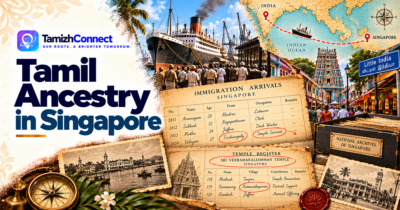
- Immigration and travel documents – Passports, travel permits, and migration records
- Military records – Service records for family members who served in armed forces
- Newspaper archives – Birth, death, and marriage announcements, obituaries
Step 3: Collaborate with Extended Family
Successful genealogy research benefits significantly from family collaboration, which increases accuracy and expands the research network.
Establish Your Foundation Family Tree
Create an initial family tree based on your initial interviews:
- Create detailed profiles for known family members with birth years, places, and relationships
- Verify relationship accuracy by cross-referencing information from multiple sources
- Include personal details that provide context and help identify individuals
- Add media files – photos, documents, and audio recordings when available
Expand Through Family Collaboration
After establishing your basic tree:
- Engage extended family – siblings, cousins, and distant relatives to contribute information
- Distribute research tasks – assign different family lines or geographic areas to different researchers
- Create family research groups – use TamizhConnect to facilitate collaborative research
- Verify information collectively – have multiple family members review and confirm details
- Organize family information sessions – regular meetings where relatives can share discoveries
Maintain Information Quality
Implement quality control measures for your research:
- Cross-reference information from multiple family members and sources
- Flag uncertain information until it can be verified through documentation
- Distinguish between facts and family stories to maintain research integrity
- Regularly update information as new evidence emerges
Step 4: Understand Tamil Migration Patterns and Historical Context
Understanding historical migration patterns provides crucial context for knowing where to search for records and how families moved across regions.
Major Migration Periods and Patterns
19th Century Plantation Era (1800s-early 1900s)
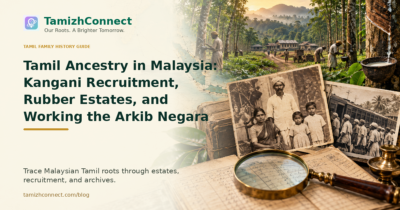
- Tamil families migrated to Malaysia, Singapore, Sri Lanka, and Mauritius for rubber and tea plantation work
- Primarily from South Tamil Nadu under the Kangani recruitment system
- Established lasting Tamil communities with strong cultural ties to their villages of origin
Early 20th Century Urban Migration (1900s-1940s)
- Movement to major Indian cities like Chennai, Madurai, and Coimbatore for industrial opportunities
- Development of urban Tamil communities while maintaining village connections
Post-Independence Movement (1950s-1970s)
- Migration to newly developed cities and government centers
- Educational migration to major university towns
Gulf Migration Era (1970s-1990s)
- Large-scale movement to Middle Eastern countries for employment
- Often temporary but frequently led to permanent settlement
- Created new Tamil diaspora communities in Gulf states
Civil War Displacement (1983-2009)
- Sri Lankan Tamil families dispersed globally due to conflict
- Settlement in Canada, UK, Australia, and other Western countries
- Resulted in fragmented family networks across continents
Modern Tech and Professional Migration (1990s-Present)
- Movement to Indian metropolitan areas like Chennai, Bangalore, Hyderabad
- International migration for technology and professional opportunities
- Creation of new Tamil settlement patterns in global cities
Understanding these patterns helps you identify where to search for records and what types of documentation might exist.
Step 5: Preserve and Share Cultural Heritage
Genealogy research extends beyond building family trees to preserving cultural heritage for future generations.
Digital Preservation Strategies
Implement comprehensive digital preservation methods:
- Create complete digital archives – Names, dates, stories, photos, and documents
- Add multimedia content – Audio recordings, video interviews, and visual documentation
- Organize chronologically and geographically – Structure information for easy navigation
- Maintain consistent naming conventions – Prevent confusion and ensure searchability
- Backup information securely – Use multiple storage locations and cloud services
Cultural Heritage Documentation
Preserve the cultural aspects of your family’s heritage:
- Collect family recipes – Traditional dishes and cooking methods passed down through generations
- Document songs, prayers, and stories – Oral traditions from past generations
- Record cultural practices – Special traditions unique to your family or community
- Preserve language variations – Family dialects, regional speech patterns, and linguistic traditions
- Document skills and crafts – Traditional arts, crafts, and professional skills from your family
- Capture family photographs – Historical images that tell your family’s visual story
Step 6: Advanced Research Techniques and Resources
As you advance in your genealogy research, employ sophisticated techniques and resources to overcome challenging research obstacles.
DNA Testing and Genetic Genealogy
Consider DNA testing as a powerful tool for genealogy research:
- Identify unknown relatives – Connect with distant family members who may have additional information
- Verify relationships – Confirm or challenge relationships suggested by documentary evidence
- Discover unexpected origins – Reveal ancestral connections not documented in family records
- Connect with diaspora relatives – Link with family members who preserved different aspects of family history
- Break through brick walls – Use genetic matches to identify missing family connections
Professional Research Services
For particularly challenging cases, consider professional assistance:
- Local researchers in ancestral areas who can access records not available online
- Professional genealogists specializing in Tamil family history and regional records
- Cultural experts who can interpret naming conventions, traditions, and historical context
- Translation services for documents in Tamil, other Indian languages, or colonial languages
Community and Network Resources
Connect with Tamil genealogy and heritage preservation communities:
- Local Tamil associations in your area and ancestral regions
- Heritage preservation organizations that collect and maintain similar family stories
- Academic institutions studying Tamil migration, culture, and history
- Online Tamil genealogy forums where researchers share resources and collaborate
- Regional archives and libraries that maintain local historical records
- Religious institutions that may have maintained historical records
Step 7: Overcome Common Research Challenges
Genealogy research encounters predictable obstacles. Understanding these challenges helps you develop effective strategies to overcome them.
Name Variations and Spelling Challenges
Tamil names present unique challenges due to various factors:
- Historical spelling variations – Names spelled differently in different time periods and by different clerks
- Regional differences – Tamil Nadu vs Sri Lankan Tamil vs Malaysian Tamil spelling conventions
- Religious and social changes – Names modified for religious conversion or social acceptance
- Government standardization – Name changes due to administrative requirements
- Patronymic systems – Father’s name used as surname, creating complexity in tracking
Record Availability and Accessibility Issues
Different time periods and regions have varying record quality:
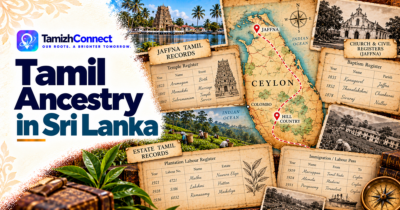
- War and conflict periods – Records destroyed during conflicts, particularly affecting Sri Lankan Tamil records
- Natural disasters – Floods, fires, and other events that destroyed historical documents
- Political changes – Administrative changes affecting record-keeping practices
- Economic factors – Some communities had better record preservation than others
- Colonial administrative changes – Different record systems under various colonial administrations
Language and Translation Barriers
- Multiple language records – Documents in Tamil, English, Telugu, Malayalam, or other regional languages
- Script variations – Different Tamil script styles and historical writing conventions
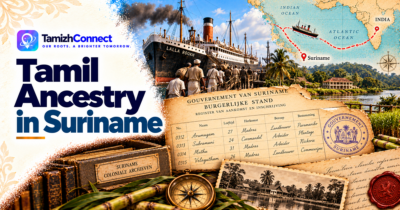
- Colonial language records – Documents in Dutch, Portuguese, French, or British administrative language
Step 8: Technology and Tools for Modern Genealogy
Leverage modern technology to enhance your research efficiency and accuracy:
Digital Family Tree Platforms
- TamizhConnect – Specialized for Tamil genealogy with cultural context and regional records
- Collaborative features – Enable family members to contribute and verify information
- Record integration – Connect with historical records and documentation
- Mobile accessibility – Access and update information from anywhere
Research Tools and Databases
- Historical record databases – Access digitized government, religious, and community records
- Geographic tools – Maps and location services to identify ancestral villages and migration routes
- Translation tools – For interpreting documents in various languages and scripts
- Photo and document management – Organize and preserve visual family history
Final Thoughts: Your Tamil Ancestry Journey
Tracing your Tamil roots connects you to a rich heritage — from Sangam-era poetry and Chola-period inscriptions through to living traditions today. This journey requires patience, persistence, and cultural sensitivity, but the rewards of understanding your family’s unique place in Tamil history are immeasurable.
With systematic research, collaboration with family members, and tools like TamizhConnect, you can build a comprehensive family history that preserves your heritage for future generations. This work connects you with Tamil communities worldwide and helps maintain cultural traditions that might otherwise be lost.
Remember that genealogy is an ongoing journey. New discoveries, documents, and family connections will continue to emerge over time, so maintain your research with regular updates and verification.
Continue your research with these related guides:
- How to collect family history from elders
- Finding your ancestral village
- Tamil migration patterns
- Documenting family stories
- Tamil Ancestry: Complete Guide
- Tamil Naming System Explained
- Avoid Duplicate Ancestors in Tamil Genealogy
- Using Electoral Rolls for Tamil Ancestry Research
Our family tree builder provides the tools you need to organize your discoveries and build lasting family connections.
Visual Enhancement Suggestions
To further improve this guide, consider adding these visual elements:
- Interactive family tree examples showing proper relationship mapping
- Detailed migration route maps showing Tamil movement across the world
- Historical timeline graphics illustrating major migration periods and historical events
- Document comparison examples showing original records versus interpreted genealogy data
- Step-by-step infographics outlining the key phases of Tamil ancestry research
- Sample forms and templates for collecting family information systematically
- Historical photo collections showing examples of documents, records, and cultural artifacts
Start your journey today! Create your free TamizhConnect account and begin tracing your Tamil ancestry with confidence and cultural understanding.