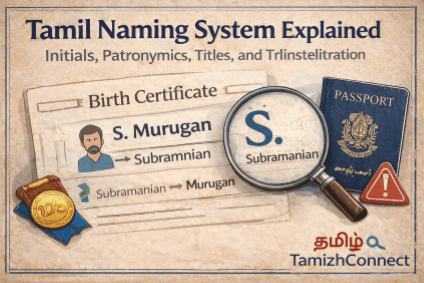
Tamil Naming System Guide
A Tamil name traditionally has three parts in this order: father’s initial (patronymic), given name, and optionally a caste title or village reference — for example, "R. Kumar Pillai" reads as "Kumar, son of R., of the Pillai community." Tamil naming never really used Western-style fixed family surnames until modern passport systems forced the issue. Your Tamil great-grandparents probably didn’t have a "surname" the way a passport form expects — they had a father’s name, a village, maybe a title — and it shifted depending on who was writing it down.
This guide shows you the common patterns and how to handle names without accidentally merging two different people or creating duplicates.
If you are starting from scratch, begin with the hub guide: Tamil Ancestry.
The core patterns you will see in Tamil names
1) Patronymic initials (father’s name)
A very common pattern:
- S. Murugan = Murugan, son of Subramanian (example)
- The “S” may be written as an initial, a full father name, or incorrectly forced into “last name”
Where it appears: school records, electoral rolls, employment forms, passports.
2) Place-based identity
Some people use the village/town name as part of the identity:
- “Kumbakonam” or “Madurai” used as a prefix in local context
- Sometimes only implied through address and temple networks
Where it appears: community circles, temple networks, wedding invitations.
3) Titles and honorifics
These may be:
- religious honorifics
- occupational titles
- community titles
These are often mistaken as “surnames” by modern forms.
Rule: treat titles as attributes, not identity keys.
Why the same person appears differently across documents
Common reasons:
- A form requires “last name,” so the initial becomes the last name.
- A clerk expands the initial incorrectly.
- Spelling varies by transliteration style (British/modern/phonetic).
- Names reorder across cultural contexts (Tamil → English form order).
Expected outcome: you will see multiple spellings and formats for one person. That is normal.
A safe method to normalize Tamil names (without creating duplicates)
Step 1 — Store the raw name exactly as written
For each document, keep:
- raw name
- raw initials formatting
- document date and source
Do not “correct” spelling at this stage.
Step 2 — Create one canonical “display name”
Choose the name the family recognises most often. This is for readability only.
Step 3 — Separate name components into fields
Track these as independent fields:
- given name
- initials as written
- possible patronymic expansion (if any)
- place hints (village/town)
- titles/honorifics
Step 4 — Expand initials only with evidence
Before expanding an initial, anchor identity using:
- place (village/town/district)
- relationships (parent/spouse/sibling)
- timeline (birth year, marriage period, residence)
Then expand and record a confidence level:
- Confirmed
- Probable
- Possible
Step 5 — Keep variants linked to one person (until proven otherwise)
Do not create separate people for each spelling. Use variants as evidence.
Transliteration: why spellings drift (and how to manage it)
Tamil sounds often map to multiple Latin spellings:
- “Thiru” vs “Tiru”
- double consonants vary
- “zh” often becomes “l” in some records (“Tamizh” vs “Tamil”)
Practical approach:
- store variants
- use place + relationships to confirm identity, not spelling similarity alone
Quick checklist
Use this checklist before merging two records into one person:
- Same village/town or consistent address cluster?
- Same spouse/parent/sibling names?
- Timeline plausible (age, marriage period)?
- Initial patterns compatible (even if reordered)?
- Only spelling differs (no relationship conflict)?
If you answer “no” to any of the first three, pause and treat as separate until proven.
Next steps
- If initials are your blocker, use: Tamil Initials Decoder (publish next)
- If duplicates are your blocker, use: Avoid Duplicate Ancestors (below)
- For the broader workflow, return to: Tamil Ancestry Research Guide