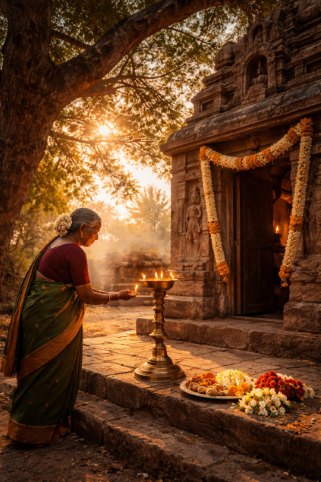
How to Find Your Kula Deivam: A Guide to Tamil Ancestral Deities
A Kula Deivam (குல தெய்வம், "family deity") is the specific village temple and deity tied to a Tamil family’s ancestral lineage, passed down through the paternal line. Each Tamil family typically has one Kula Deivam — identifiable by ancestral village, caste (jati) and/or gotra, and historical ritual practice. Finding yours means one of three things: asking elders, visiting the paternal ancestral village, or matching caste + village + gotra against a temple index. TamizhConnect’s Kula Deivam Finder does the third — a free search across documented South Indian temple traditions to narrow your family deity from the first search.
Beyond ritual, knowing your Kula Deivam connects you to your ancestral village, community history, and cultural identity — the anchor most Tamil genealogy research starts from.
This guide helps you discover and understand your Kula Deivam, even if that knowledge was lost through migration or generations.
Related: Ritual Anchors | Tamil Family Tree
What Is Kula Deivam?
Kula Deivam (குல தெய்வம்) literally means "family deity" or "clan god/goddess." It’s the divine protector of your lineage, passed down through generations.
Key Concepts
| Term | Meaning |
|---|---|
| Kula Deivam | Family/clan deity protecting the lineage |
| Gothram | Patrilineal clan, often linked to Vedic sages |
| Nakshatram | Birth star, used in astrology and rituals |
| Sthala Deivam | Village/temple deity of ancestral location |
| Ishta Deivam | Personal chosen deity for individual worship |
Why Kula Deivam Matters for Genealogy
Your Kula Deivam reveals:
- Ancestral village – Often linked to a specific temple location
- Community origins – Different communities worship different deities
- Migration patterns – Families carry deity worship to new locations
- Family identity – Part of traditional naming and ritual systems
Common Tamil Kula Deivams
Goddess Forms (Most Common)
| Deity | Regions | Communities |
|---|---|---|
| Mariamman | Statewide | Multiple communities |
| Angalamman | Northern TN | Various |
| Kaliyamman | Western TN | Kongu regions |
| Sellandiyamman | Central TN | Various |
| Draupadi Amman | Statewide | Multiple |
| Meenakshi | Madurai region | Multiple |
| Kamakshi | Kanchipuram | Multiple |
| Periyachi | Southern TN | Multiple |
Lord Forms
| Deity | Regions | Communities |
|---|---|---|
| Munishwaran | Statewide | Multiple |
| Madurai Veeran | Southern TN | Multiple |
| Karuppuswamy | Western/Central TN | Multiple |
| Ayyanar | Rural TN | Multiple |
| Shiva forms | Various | Specific communities |
| Vishnu forms | Various | Specific communities |
How to Discover Your Kula Deivam
Method 1: Ask Elder Family Members
Start here. The simplest approach:
- Ask parents, grandparents, or elder relatives
- Questions to ask:
- "What is our Kula Deivam?"
- "Which temple do we visit for family rituals?"
- "Do we have a family deity in our ancestral village?"
- "What rituals do we perform for our ancestors?"
Tip: Even if elders don’t know the deity name, they may remember temple visits or family rituals.
Method 2: Check Family Documents
Look for deity references in:
- Horoscope charts (Jathagam) – Often list Kula Deivam
- Marriage records – Gothram and deity mentioned
- Death ceremony records – Rituals reference family deity
- Temple donation records – Family contributions to specific temples
- Old letters or diaries – Mentions of temple visits
Method 3: Trace Your Ancestral Village
Your Kula Deivam is often the main deity of your ancestral village:
- Identify your ancestral village (see: Find Ancestral Village Guide)
- Research the village’s main temple
- Contact village residents or temple authorities
- Visit if possible and speak with elders
Example: If your village is near Madurai, Meenakshi may be your Kula Deivam.
Method 4: Community/Caste Traditions
Different communities traditionally worship specific deities:
| Community | Common Kula Deivams |
|---|---|
| Chettiar | Bhadrakali, Shiva forms |
| Pillai | Meenakshi, Murugan |
| Mudaliar | Mariamman, Shiva |
| Gounder | Kongu deities, Ayyanar |
| Nadar | Bhadrakali, Murugan |
| Thevar | Mariamman, Munishwaran |
Note: These are general patterns, not rules. Family traditions vary.
Method 5: Gothram Connection
Some Kula Deivams are linked to gothrams (Vedic lineages):
- Bharadwaja – Often Shiva or Vishnu forms
- Kashyapa – Various goddess forms
- Gautama – Shiva forms
- Vashishta – Vishnu forms
Your priest or family astrologer can help connect gothram to deity.
Method 6: Temple Records
If you know your ancestral village:
- Contact the village temple
- Ask about historical donor families
- Check for family names in donation records
- Some temples maintain family worship records
See: Temple Records Guide
Kula Deivam Worship Traditions
Common Rituals
| Ritual | Occasion |
|---|---|
| Kula Deivam Pooja | Annual family worship |
| Pradosham | For Shiva-linked deities |
| Amavasai | Ancestor worship with deity connection |
| Pongal | Harvest festival with deity offerings |
| Family festivals | Specific to deity |
Temple Visits
Traditional practices include:
- First rice feeding (Choroonu) – At Kula Deivam temple
- Head tonsure – At deity temple
- Before marriage – Seek deity blessings
- After death – Ritual offerings to deity
Lost Knowledge: What If You Don’t Know?
Many diaspora families have lost Kula Deivam knowledge through:
- Migration without return visits
- Generational gaps in communication
- Conversion to other religions
- Urbanization breaking village connections
Recovery Strategies
- Start fresh: Choose a deity connected to your ancestral region
- Research: Study your community’s traditional deities
- Connect: Reach out to relatives still in Tamil Nadu
- Visit: If possible, visit ancestral village and temple
- Document: Record whatever information you find for future generations
Alternative Approaches
If Kula Deivam cannot be determined:
- Worship Ishta Deivam (personal chosen deity)
- Connect with village deity (Sthala Deivam) of ancestral location
- Follow family tradition of whichever deity you feel connected to
Kula Deivam and Modern Life
For Diaspora Tamils
Living abroad doesn’t break the connection:
- Set up home altar with Kula Deivam photo
- Perform annual poojas on significant dates
- Teach children about family deity and its stories
- Plan visits to ancestral temple when possible
Documentation for Future Generations
Record your findings:
Family Kula Deivam Record:
- Deity Name: ________________
- Temple Location: ________________
- Ancestral Village: ________________
- Community Tradition: ________________
- Worship Practices: ________________
- Important Dates: ________________
- Family Stories: ________________
Add this to your family tree documentation.
Common Misconceptions
Myth: "Kula Deivam is only for religious people"
Truth: It’s about cultural heritage and family identity, not just faith.
Myth: "You must know the exact deity name"
Truth: Many families reconnect through village temples or community traditions.
Myth: "Kula Deivam worship is outdated"
Truth: It’s a living tradition connecting generations and preserving history.
Myth: "Only elders can know this information"
Truth: Research and community connections can recover lost knowledge.
Research Workflow
1. Interview elder family members
2. Check family documents (horoscopes, marriage records)
3. Identify ancestral village
4. Research village temple and deity
5. Investigate community traditions
6. Check gothram connections
7. Contact temple authorities
8. Visit ancestral village if possible
9. Document findings for future generations
Tools and Resources
- TamizhConnect – Document Kula Deivam in family tree
- Tamil Nadu Temple Database – Online temple information
- Community associations – Caste/community groups with traditional knowledge
- Family priests – May have historical records
- Village elders – Oral history keepers
Connecting Kula Deivam to Genealogy
Your Kula Deivam research complements other genealogical work:
- Electoral rolls – Locate ancestral village (Guide)
- Temple records – Find family worship history (Guide)
- Family documents – Cross-reference deity information
- Oral history – Record elder memories
Next Steps
After identifying your Kula Deivam:
- Document the information with sources
- Learn the associated rituals and stories
- Share with family members
- Plan a temple visit if possible
- Add to your family tree records
- Teach younger generations
Continue your heritage research:
Your Kula Deivam is a thread connecting you to countless generations. Rediscovering it honors those who came before and preserves heritage for those who follow.