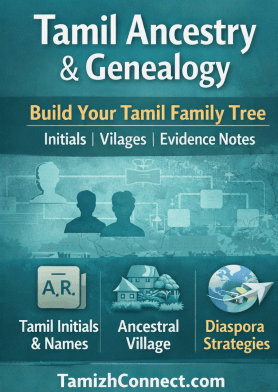
Tamil Ancestry & Genealogy
Tamil ancestry research rests on a single principle: anchor every person to at least two of place (village/household), relationship (parent/spouse/child), and time (year of event) — never just a name. Names alone don’t work for Tamil genealogy because initials aren’t surnames, spellings drift across English and Tamil records, and the same given name repeats across generations in the same village. A record-first workflow — collecting evidence before drawing the tree — is what keeps a Tamil family tree from collapsing into duplicate ancestors and false matches.
This hub collects the most practical Tamil genealogy guides — use it as your starting point and return whenever you get stuck.
Start here (fast path)
If you’re starting today, do these in order:
- Create one household first (spouse/children/elders) and confirm internal links.
- Anchor to place (village/town candidates) before expanding initials.
- Track evidence notes so your tree stays credible over time.
Common challenges in Tamil genealogy (and the right fix)
Initials / patronymics
Tamil initials often represent a parent’s name or identity marker, not a fixed surname. Expanding initials too early creates false merges.
- Read: Tamil Initials Decoder
- Read: Tamil Naming System Explained
Name and spelling variants
Spelling drift is normal. Identity should be proven by anchors, not spelling similarity.
Ancestral village uncertainty
Families often remember a temple name or nearby town, not the exact village spelling. Use triangulation.
Evidence and credibility
A strong tree is a tree that can explain "why this is true."
Diaspora research complexity
Diaspora research involves two systems: origin place networks and destination civil records. A timeline prevents wrong matches.
The record-first workflow (overview)
Step 1: Collect sources and build a timeline
Start with home records:
- wedding invitations
- school/employment records
- old letters/envelopes (post office clues)
- IDs and address proofs
- property papers (if available)
Create a simple timeline:
- birth year estimate
- marriage period
- migration events (if any)
- key addresses
Step 2: Place-first anchoring
Write down:
- temple/deity references
- nearby town/market/railway clues
- district/taluk guesses
- relatives’ villages (often cluster)
Then keep a shortlist of candidate villages until you have proof.
Step 3: Household mapping
Confirm relationships within one household before building older generations. Household anchors reduce same-name collisions.
Step 4: Name normalization (safe method)
Store:
- raw name as written (per source)
- canonical display name
- initials as separate field
- aliases and confidence level
Step 5: Expand initials only with anchors
Require at least two anchors (place + relationship, relationship + timeline, or place + timeline) before expansion.
Step 6: Evidence notes + merge discipline
Use confidence levels (Confirmed / Probable / Possible). Only extend generations from Confirmed/Probable links.
Tamil genealogy guides (supporting pages)
Core workflow guides
- Tamil Family Tree Guide (supporting page)
- Tamil Genealogy Starter Kit
- Tamil Initials Decoder
- Tamil Naming System Explained
- Avoid Duplicate Ancestors
- Find Your Ancestral Village
- Electoral Rolls for Tamil Ancestry
- Tamil Place Name Variants
- Tamil Diaspora Research Playbook
- Tamil Genealogy Evidence Notes
FAQ (quick answers)
Is "Tamil ancestry" different from "Tamil genealogy"?
In practice they overlap. "Tamil ancestry" is the discovery goal; "Tamil genealogy" is the method: identifying people, proving relationships, and documenting sources.
Do I need DNA to build a Tamil family tree?
No. A record-first approach can produce a credible tree using place anchors, relationship validation, and evidence notes.
Why do Tamil names look different across records?
Because of initials/patronymics, transliteration, clerical spelling differences, and form-forced surname fields.
Build your Tamil family tree
If you want to start now: create one household, attach 3–5 sources as evidence notes, and expand only when anchors are confirmed.