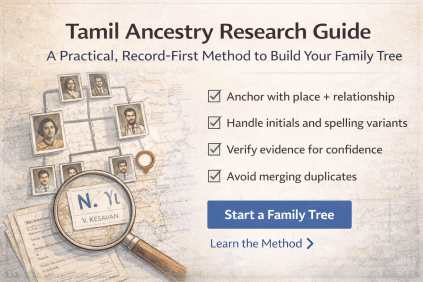
Tamil Ancestry Research Guide
Tamil ancestry research becomes much easier once you treat it like a verification problem, not a memory test. Names can change across documents, initials can represent a parent’s name, and villages can appear under multiple spellings—so the winning approach is record-first: anchor identity using place + relationships + timeline, then build outward.
If you want to start building immediately, you can create your family tree on TamizhConnect and add notes and sources as you go.
What “Tamil ancestry” means in practice
For most families, Tamil ancestry research usually comes down to answering three questions:
- Which village / town did we come from?
- Which relationships are proven vs assumed?
- How do we reconcile name format differences across documents?
This guide gives you a workflow that works for both India-based and diaspora families.
Common Tamil ancestry challenges (and what to do instead)
Initials and patronymics (not fixed surnames)
Many Tamil naming systems use initials that reflect a parent’s name or other identity markers. Expanding them too early can create duplicate ancestors.
Use: Tamil Initials Decoder and Tamil Naming System Explained.
Spelling variance across documents
Transliteration and clerical spelling differences are normal. Don’t treat spelling differences as “different people” without anchors.
Use: Tamil Place Name Variants.
Missing village clarity
Families often remember a temple name, a nearby town, or an old post office name—rarely the exact village spelling.
Use: Find Ancestral Village.
Duplicate ancestors (false merges)
Same-name collisions happen frequently within village clusters. The fix is merge discipline, not guesswork.
Use: Avoid Duplicate Ancestors.
The record-first workflow (step-by-step)
Step 1: Create a “source folder” before you create a tree
Collect and organize:
- Wedding invitations
- School certificates / employment records
- IDs and address proofs
- Old letters / envelopes (post office clues)
- Property papers (if available)
- Family photos with inscriptions
Tip: Keep each item’s date (or estimated time period). A timeline is a powerful filter.
Step 2: Start with place anchoring (because names repeat)
Write down everything you know about place—even partial:
- Temple name and deity
- Nearby town / market / bus stand / railway station
- District or region guesses
- “Native place” phrases used by elders
Then build a shortlist of candidate villages rather than committing to one immediately.
Next: How to find your ancestral village
Step 3: Build a household map (relationships before generations)
Instead of jumping back generations, do this:
- Identify one household cluster (spouse + children + elders)
- Confirm links within the household using documents
- Only after that, extend upward (parents) and sideways (siblings)
If you have electoral roll data, household clustering is especially effective:
Step 4: Normalize names safely (keep variants, don’t overwrite)
For each person:
- Store the name exactly as written in each record
- Keep a canonical “display name” for readability
- Store initials separately from the given name
- Add alias spellings rather than replacing the name
Next: Tamil naming system guide
Step 5: Expand initials only after you have anchors
Before expanding an initial, require at least two anchors:
- Place + relationship, or
- Relationship + timeline, or
- Place + timeline
Next: Decode Tamil initials
Step 6: Use evidence notes so your tree stays credible
For every claim (identity, relationship, place), write a short evidence note:
- What you claim
- Which sources support it
- Which anchors confirm it
- Confidence level (Confirmed / Probable / Possible)
Next: Tamil Genealogy Evidence Notes
Step 7: Apply merge rules to prevent duplicates
Use strict merge rules:
- Never merge on name similarity alone
- Merge only when you have at least two anchors
- Treat “Possible” links as leads, not final facts
Next: Avoid Duplicate Ancestors
Record checklist for Tamil ancestry research
High-yield items
- Wedding invitations (native place + relationships)
- School records (often contain parent names)
- Address-based documents (household clustering)
- Letters/envelopes (post office locality clues)
Helpful supporting items
- Photos with handwritten notes
- Community/temple event references
- Family diaries or notebooks
How TamizhConnect fits into this workflow
TamizhConnect is designed for the realities of Tamil ancestry research:
- Handling initials/patronymics and name variants
- Place-first anchoring and village verification
- Relationship validation mindset (avoid false merges)
- Evidence notes and confidence tracking
If you want a structured start, begin with one household and build outward:
- Start a family tree
- Add 3–5 documents as “evidence notes”
- Confirm one village candidate using triangulation
FAQs
Where do Tamils originate from?
Tamil identity is historically rooted in South India (especially Tamil Nadu) and Sri Lanka, with large diaspora communities across many countries. For ancestry research, the practical starting point is usually village/town anchoring rather than broad origin debates.
How has Tamil culture evolved over time?
Tamil culture spans literature, language, local traditions, and temple networks that vary by region. For family history work, cultural evolution is most actionable when it helps interpret place clues, community practices, and migration routes.
What language family does Tamil belong to?
Tamil is part of the Dravidian language family. In research terms, language matters because transliteration differences and record-keeping conventions affect how names and places are represented across documents.
What religions are associated with Tamil communities?
Tamil communities include multiple religious traditions. For ancestry work, the most practical element is often temple network geography (deity, festival routes, nearby shrine clusters), which can help confirm place identity.
How can I preserve Tamil heritage for future generations?
The most effective preservation is:
- capture oral history now (record interviews)
- attach stories to people and places
- store documents with source notes
- keep confidence levels (what is proven vs assumed)
Do I need DNA to research Tamil ancestry?
No. A record-first approach using documents, place anchors, and relationship verification can build a credible family tree. DNA can be complementary, but it is not required.
Next guides to read
- Tamil Genealogy Starter Kit
- Indentured labour records: find your roots in India
- Find Ancestral Village
- Tamil Naming System Explained
- Tamil Initials Decoder
- Tamil Place Name Variants
- Tamil Diaspora Research Playbook
- Tamil Genealogy Evidence Notes