Tamil Ancestry Research | Family Tree Guide
Tamil Initials Decoder: Safe Guide to Expanding Names
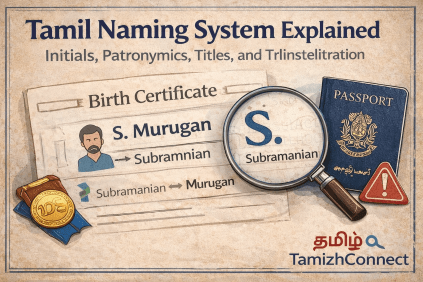
Tamil initials in names like "R. Kumar" or "S. A. Rajan" are usually patronymic — the first letters of the father’s, grandfather’s, or ancestral village name — not abbreviated surnames. Expanding them wrong is the single most common source of duplicate ancestors in Tamil genealogy: one letter can stand for a father’s given name, a grandfather’s name, a village name, a house name, or an inherited title. Across passports, school records, voter lists, and wedding invitations the same person appears with initials switched ("A. S." vs "S. A."), dropped entirely, or expanded in inconsistent ways.
This guide gives you a safe, evidence-first method to expand initials across documents without guessing.
Why Tamil initials exist (and why they change)
In many Tamil naming conventions, what looks like a “surname initial” is frequently:
- Father’s name initial (patronymic)
- Mother’s name initial (less common but present)
- Village/town initial (especially in formal contexts)
- Honorific or title abbreviation (rare but possible)
Across passports, school records, voter lists, and wedding invitations, the “same person” may appear with:
- initials switched (A. S. vs S. A.)
- initials dropped entirely
- father name written fully in one record and initialed in another
- anglicised spellings
The golden rule: never expand initials until you anchor identity
Before expanding, you should establish identity anchors:
- Place anchor: village/town + district/taluk
- Relationship anchor: spouse/parent/child names in at least one record
- Timeline anchor: approximate birth year, marriage period, residence changes
If you have at least two anchors, expansion becomes a verification task—not a guess.
A safe 5-step method to expand initials
Step 1 — Collect all name variants first
Create a small list:
- Name as spoken in family
- Name as in each record (exact spelling)
- Initial pattern as seen (e.g., “S. Murugan”, “Murugan S.”, “S Murugan”)
Do not “normalize” too early. Keep the raw data.
Step 2 — Identify what the initial could represent
Use the record context:
- School records often use father-name initial
- Property documents may preserve full father name
- Community/temple records sometimes reflect village identity
- Modern online forms may force a “last name,” which distorts the original convention
Step 3 — Use relationships to test expansions
If “S.” might be “Subramanian,” check:
- does any record show father name as Subramanian?
- do siblings share the same initial pattern?
- does the spouse record or marriage invitation reveal the father’s name?
Expansions must be supported by at least one relationship-based proof.
Step 4 — Use place to eliminate false matches
A correct expansion that belongs to the wrong village is still wrong.
Ask:
- do address lines match across records?
- do nearby villages/temples align?
- do the household members in the same address make sense?
Place is the best filter against “same-name” collisions.
Step 5 — Record confidence levels (avoid over-commitment)
Use a simple confidence model:
- Confirmed: supported by a record explicitly showing full name
- Probable: supported by multiple indirect signals (siblings + place + timeline)
- Possible: plausible but not proven (keep as a note, not as a final claim)
Common mistakes (and how to avoid them)
Mistake 1: Treating the initial as a fixed surname
Fix: store initials as separate fields. Do not hardcode as “last name.”
Mistake 2: Expanding based on what “sounds right”
Fix: use documentary evidence and relationships.
Mistake 3: Merging two people because initials match
Fix: always confirm with place + relationships + timeline.
A practical template you can use
For each person, capture:
- Display name:
- Initials seen:
- Possible expansions:
- Confirmed expansion (if any):
- Anchor place(s):
- Key relationships:
- Evidence list: (document name + date + where it was found)
Next steps
If you’re building a Tamil family tree and initials are blocking progress, start with:
- siblings
- spouse line
- household/address-based documents
Those three usually reveal the missing father name far faster than direct ancestor searches.