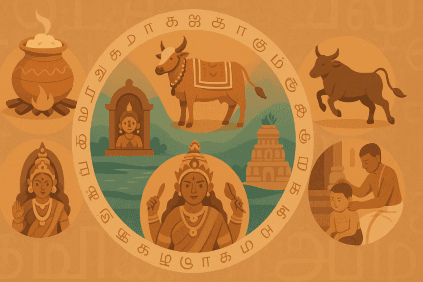
Tamil Ancestry Research | Family Tree Guide
In this article:
- Why these rituals matter for genealogy, not just “culture”
- Ven pongal for ancestors – household srardham in disguise
- Mattu Pongal – cattle, land and who did the real work
- Jallikattu – village power, caste lines and male status
- Mariamman worship – fever, rain, caste walls and women’s vows
- Periyachi worship – childbirth, fear and erased goddess stories
- Meenakshi temple – city devotions, marriage circuits and caste queues
- Adiperukku – rivers, canals and who got to celebrate water
- Temple tonsure – hair, vows, shame and migration
- How to model all of this cleanly in TamizhConnect
1. Why these rituals matter for genealogy, not just “culture”
Quick reality check:
- Ven pongal for ancestors – says how you remember the dead and who hosts.
- Mattu Pongal – exposes land vs labour roles and which branch owned cattle.
- Jallikattu – pure status politics: which men, which castes, which villages.
- Mariamman / Periyachi – show who handled sickness, childbirth and fear.
- Meenakshi temple – reveals pilgrimage routes, marriage networks, city caste layout.
- Adiperukku – ties your line to specific rivers, canals, anicuts.
- Temple tonsure – marks vows, crises, and migration journeys.
If you ignore these, your TamizhConnect archive will look like:
- births, deaths, marriages, migration – and a massive empty space where everyday religion, fear, disease, status and gender actually lived.
So yes, you store them. But you store them as data, not just “nice memories”.
2. Ven pongal for ancestors – household srardham in disguise
2.1. What’s actually going on
Ven pongal (plain savoury pongal) cooked and offered:
- for ancestors – often on Pongal day or specific tithi / amavasya,
- at home or at a specific temple,
- usually handled by:
- one branch,
- one key house,
- one main cook/priest/elder.
It encodes:
- who is ritual head of the line,
- which ancestors are given a formal slot,
- which house still acts as the kootu veedu / central ancestral home.
2.2. What to record in TamizhConnect
Per recurring practice:
ritualType:"ven-pongal-ancestors"location:- home, village temple, city temple, etc.
frequency:"annual","tithi-based","Pongal-day-only"lineageFocus:- paternal only, maternal too, specific sub-branch, etc.
responsibleHouseholdId:- which household still hosts this.
Event examples:
“Annual ven pongal offering for paternal ancestors at [village temple/home]; led by eldest son of Line A from at least 1970–present.”
You’re tracking who remembers whom, not just the dish.
3. Mattu Pongal – cattle, land and who did the real work
3.1. What it signals
Mattu Pongal:
- the day of honouring cattle,
- washing, decorating, feeding them special food,
- formerly linked heavily to:
- plough cattle,
- landholding,
- irrigation cycles.
Patterns:
- Landholding castes: big show, decorated animals, photos, social capital.
- Landless families: participation as workers or not at all; or separate style of honouring cattle they tend but don’t own.
3.2. What to record
Per branch / village:
ritualType:"mattu-pongal"cattleRole:"owner-farmer","cowherd/labour","no-cattle"
landLink:- which patta lands these cattle served (if known).
statusNotes:- e.g. “Our branch used to be cattle-labour for X family; only later bought own cow.”
You can attach:
photoEvidenceyearRangewhen Mattu Pongal died out in that line, if it did.
This lets you see exactly when your family:
- left cattle farming,
- or moved into it.
4. Jallikattu – village power, caste lines and male status
4.1. Strip away the romance
Jallikattu participation tells you:
- which men were allowed near the bulls,
- which castes controlled the arena,
- which villages had bull lines and fame,
- who put prizes and whose names were announced.
It’s about status and courage under a caste and village structure.
4.2. What to record
Per participant or supporting role:
ritualType:"jallikattu"role:"bull-owner","player","organiser","sponsor","spectator-only"
villageArena:- exact village/event name.
period: decade or year range.
Per branch:
jallikattuInvolvement:"high","medium","none".
casteAccessNotes:- “Branch X excluded from arena; attended only as spectators until year Y.”
Don’t glorify; just log the reality of who could stand where.
5. Mariamman worship – fever, rain, caste walls and women’s vows
5.1. What it encodes
Mariamman temples and festivals:
- centred around:
- fever, pox, epidemics,
- rain, fertility of land and people,
- village-level protection.
They tell you:
- which caste streets went to which Mariamman,
- who was allowed into which prakaaram,
- who carried kavadi / paal kudam / maavilakku,
- which branch runs or funds specific parts of the festival.
5.2. What to record
Per temple:
deity:"Mariamman"village/ area.festivalMonthand key vows.
Per person/branch:
ritualType:"mariamman-vow"vowReason:"fever","childbirth","exam","migration","court-case", etc.
vowAct:paal-kudam,alagu,maavilakku,walking,fasting, etc.
genderRoleNotes:- “Women of branch took lead; men only did funding / heavy work.”
You’re documenting who dealt with crisis and disease through this goddess, not just listing festivals.
6. Periyachi worship – childbirth, fear and erased goddess stories
6.1. What’s usually hidden
Periyachi (Periyachi Amman):
- protective goddess around pregnancy, childbirth, infants,
- historically linked to:
- midwives,
- devadasi / performer lines in some places,
- village women’s fears and control.
Modern families often:
- quietly drop or dilute her,
- sanitise goddesses into “respectable” forms,
- forget the raw childbirth imagery.
6.2. What to record
Per branch:
ritualType:"periyachi-worship"period:- when it was active, and when it faded.
setting:- small shrine, inside big temple, corner of home, etc.
whoLed:- usually elder women, midwives, certain sub-castes.
Notes:
- record exact phrases elders use,
- record any taboos: who can/can’t do the ritual.
This shows how your line handled birth danger and which goddess got sidelined as families “modernised”.
7. Meenakshi temple – city devotions, marriage circuits and caste queues
7.1. Why it matters beyond piety
Meenakshi Amman (Madurai) visits encode:
- pilgrimage routes,
- how often your family went to Madurai at all,
- who had money for that travel,
- caste-based queues and special access (archanai tickets, special darisanam).
- marriage circuits:
- many alliances arranged or blessed in that orbit.
7.2. What to record
Per branch:
ritualType:"meenakshi-visit"frequency:- once in a lifetime, annual, festival-based, whenever passing through.
travelPattern:- from which village/city, by what mode (train, bus).
familyRole:- any relatives in temple services, shops, lodges.
Per event:
visitReason:"marriage-blessing","first-child","business-trip", etc.
co-travellers: list of relatives who went together (good for relationship mapping).
This lets you see whether Meenakshi was just a name-sake deity or an actual anchor in your migration and marriage story.
8. Adiperukku – rivers, canals and who got to celebrate water
8.1. What it encodes
Adiperukku:
- tied to rivers and canals rising,
- especially Cauvery and delta / canal regions,
- families go to riverbanks, anicuts, bridges, offer food/flowers, float lamps.
It marks:
- which water-bodies your people depended on,
- which places they treat as sacred: banks, bunds, check-dams, locks.
8.2. What to record
Per event or tradition:
ritualType:"adiperukku"waterBody:- river, canal, tank name; exact spot if possible.
landLink:- is this where your irrigation comes from?
picnicPattern:- did multiple branches meet here yearly?
If Adiperukku stops after certain decade:
- log that too – often aligns with:
- migration,
- loss of land,
- canal going dry or polluted.
This connects festivals to infrastructure and land, not just manjal/kumkum photos.
9. Temple tonsure – hair, vows, shame and migration
9.1. What’s going on under the blade
Mundan / tonsure at temples (Tirupati, Palani, local Amman temples):
- used for:
- child hair offering,
- healing vows,
- recovery from surgery,
- exam/job/marriage promises,
- gratitude after migration/visa.
Also carries:
- gendered expectations (boys vs girls),
- modesty/shame issues (who had to hide at home after shaving),
- economic logic (hair sold, temple income).
9.2. What to record
Per person event:
ritualType:"temple-tonsure"temple:- which one – Tirupati, Palani, local Mariamman, etc.
ageAtTonsurereason:"child-first-hair","vow-illness","exam","migration","court-case", etc.
whoDecided:- parents, grandparents, self, in-laws.
follow-up:- did they repeat later, or only once?
This gives you concrete, time-bound datapoints on:
- crises,
- answered prayers (according to the family),
- and who was forced into visible religious acts.
10. How to model all of this cleanly in TamizhConnect
10.1. Generic ritual event schema
For each of these practices, you can use one generic ritual event model:
ritualEventIdritualType:"ven-pongal-ancestors","mattu-pongal","jallikattu","mariamman-vow","periyachi-worship","meenakshi-visit","adiperukku","temple-tonsure", etc.
dateApprox/yearRangelocationId(temple, village, water-body, house)participants[]:personId,role("lead","support","priest","donor","subject","child", etc.)
reason/intent(where applicable)lineageFocus(which branch/ancestors if relevant)notes:- caste/gender access, exclusions, conflicts.
10.2. Link ritual events to:
- Land parcels (Mattu Pongal, Adiperukku).
- Temples (Mariamman, Periyachi, Meenakshi, tonsure).
- Migration/marriage events (vows before/after turning points).
- Health events (Mariamman vows, tonsure for illness).
You’re building a network where:
- rituals aren’t floating “culture”,
- they are edges connecting:
- people,
- places,
- land,
- health,
- migration,
- caste/gender power.
10.3. Don’t romanticise; use rituals as diagnostic tools
For each branch, your summary should be able to say:
- which rituals are central,
- which deities actually mattered,
- when certain practices died out,
- which caste/gender lines were enforced or broken through these rituals.
If your TamizhConnect data can’t answer those, you’re not modeling the rituals – you’re just sentimental about them.
Use Ven Pongal, Mattu Pongal, Jallikattu, Mariamman/Periyachi worship, Meenakshi visits, Adiperukku and temple tonsure as hard evidence about:
- who had land,
- who had status,
- who carried fear,
- who handled illness and childbirth,
- and how your people actually negotiated with gods, nature and power.
Anything softer than that is just decoration.