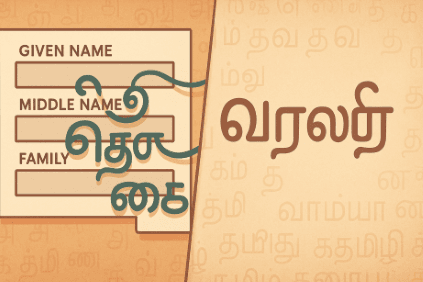
Tamil Ancestry Research | Family Tree Guide
In this article:
- Two completely different naming logics
- Common Tamil name patterns you should recognise
- How Western forms distort Tamil names
- Practical rules for filling “first name / last name” fields
- How to store Tamil names properly in TamizhConnect
- Cleaning up old, mangled name data
1. Two completely different naming logics
Most Western systems assume:
- First name – stable, personal, used daily
- Middle name – optional
- Last name / surname – inherited family name, passed down unchanged
This logic expects:
- the surname to stay the same for generations,
- siblings to share a surname,
- “Mr / Ms Surname” to make sense,
- sorting by surname to be meaningful.
Tamil naming logic is usually patronymic and contextual, not fixed-surname:
- Initial(s) often come from father’s or ancestor’s name,
- People may not have a family surname at all,
- The “last word” in the name is not a stable family name,
- Married women may change patterns (adopt husband’s initial, etc.),
- Different documents for the same person may show different sequences.
If you force Tamil names into Western boxes naïvely, you will:
- break family links,
- create fake “family names”,
- make it hard to search, match and trace people across systems.
You need to understand the patterns first.
2. Common Tamil name patterns you must recognise
Not every region or caste does this the same way, but these are typical:
2.1. Single initial + personal name
Example: R. Natarajan
R= father’s name (e.g., Ramasamy) or ancestral village / family initialNatarajan= personal name
Spoken:
- “Natarajan” (friends, colleagues)
- “R. Natarajan” in formal contexts
- “Ramasamy Natarajan” in expanded form
2.2. Double initials + personal name
Example: R.M. Natarajan
R= grandfather / ancestral nameM= father’s name (e.g., Muthusamy)Natarajan= personal name
Expansions might vary, but the key point:
- Initials are not surnames.
- They are compressed ancestry.
2.3. Father’s name as “last name” for children
Example:
- Father: R. Muthukumar (Ramasamy Muthukumar)
- Son: M. Arjun (Muthukumar Arjun)
- Daughter: M. Kavya (Muthukumar Kavya)
Here:
- siblings do not share a fixed surname,
- each child’s initial = father’s personal name.
If a Western form forces you into a surname, you usually end up locking:
- “Muthukumar” as the child’s family name, even though it’s patronymic.
2.4. Village / caste / house names in play
People may carry:
- ooru (village) names:
Tiruchy,Pollachi, - caste / sub-group names,
- house names.
Sometimes they appear:
- as initials,
- as the first word,
- or as a pseudo-surname in English documents.
3. How Western forms distort Tamil names
Standard form: First name / Given name / Forename and Last name / Surname / Family name.
Here’s what typically goes wrong:
3.1. Initials turned into fake surnames
Example:
- Original: R. Natarajan
- Many systems demand
First nameandLast name. - User enters: First name =
Natarajan, Last name =R.
Result:
- System calls him “Mr R”.
- Sorting puts him under “R”, which is meaningless.
- Matching to other datasets fails (
Rcould be anything).
3.2. Father’s given name frozen as “family name”
Example:
- Father: R. Muthukumar
- Child: M. Arjun
On a Western form for the child, people often do:
- First name =
Arjun - Last name =
Muthukumar
Now the father’s personal name looks like a permanent family surname.
- Next generation may copy it mindlessly,
- genealogical logic gets destroyed.
3.3. Splitting long given names incorrectly
Example:
- Name: Lakshmi Narayanan S
Likely pattern:
S= father or ancestral initialLakshmi Narayanan= full given name
Western form user sometimes enters:
- First name =
Lakshmi - Middle name =
Narayanan - Last name =
S
So now the main given name is broken and the initial is abused as surname.
3.4. Mononyms forced to invent surnames
Some people genuinely have one-word names:
- “Kumar”, “Selvi”, “Kannan” etc.
Western systems often:
- reject single-word names,
- force users to duplicate:
First = Kumar,Last = Kumar, or - force creation of a fake surname.
All of this pollutes your data.
4. Practical rules for filling “first name / last name” fields
You are not going to redesign every foreign system.
You can choose a consistent, defensible strategy when forced.
4.1. Basic principles
When a form forces you into Western structure:
- Protect the full given name first.
- Do not treat initials as true surnames unless you intentionally adopt one.
- Be consistent across documents; random variation is worse than a slightly artificial rule.
- Document your logic somewhere (e.g., in TamizhConnect notes).
4.2. Suggested strategy
This is not “perfect”, but it’s stable and explainable.
Case A: Initial(s) + given name (e.g., R. Natarajan)
- First / Given name:
Natarajan - Middle name (if available): expand initial if possible:
Ramasamy - Last / Surname: either:
- leave as
Natarajan(repeated), or - use expanded father name
Ramasamyiff your family decides to stabilise it as surname.
- leave as
For official / foreign systems, many families deliberately adopt:
RamasamyorNatarajanas a formal surname for consistency.
Just make the decision explicit and note original form:
“Original Tamil form: R. Natarajan (Ramasamy Natarajan).”
Case B: Double initials + given name (R.M. Natarajan)
Options:
- First name:
Natarajan - Middle name:
Ramasamy - Last name:
Muthusamy
OR if you want a single stable surname:
- Pick one ancestral name (often the father’s) as surname for all siblings,
- Document the choice in TamizhConnect.
Case C: Child with father’s name as initial (M. Arjun)
- First name:
Arjun - Last name: either:
Muthukumarif the family is consciously adopting it as a surname, orArjunagain if you want to keep the system happy but not freeze a surname.
If multiple siblings are going abroad / into systems that require surnames,
practically it is easier to adopt a surname intentionally and keep it.
5. How to store Tamil names properly in TamizhConnect
TamizhConnect is your place. Here, you don’t need to bend to Western logic.
Minimum fields you should track:
- personalName – the main given name in full (e.g.,
Natarajan,Lakshmi Narayanan) - initials – in order, as used in Tamil (e.g.,
R,R.M,S) - expandedLineage – expanded form where known:
R. Natarajan→Ramasamy NatarajanR.M. Natarajan→Raman Muthusamy Natarajan
- nameInTamilScript – exactly as written in Tamil if available
- nameInLatinScriptVariants – all important spellings:
Natarajan,Nadarajan,Natarajan R
- officialWesternForm(s) – how the name appears in:
- passport,
- PAN,
- school records,
- overseas documents.
For each officialWesternForm, store:
- the exact text,
- where it’s used,
- the date it was first issued.
This prevents confusion when matching records later.
5.1. Example record
For someone written as R. Muthukumar:
personalName:Muthukumarinitials:RexpandedLineage:Ramasamy Muthukumar(if known)nameInTamilScript:ராமசாமி முலுகுமாரு(example)nameInLatinScriptVariants:R. MuthukumarRamasamy MuthukumarMuthukumar R
officialWesternForms:passport:MUTHUKUMAR RAMASAMY(surname first, machine-readable)schoolCertificate:R MUTHUKUMAR
Now you can search and match regardless of which distorted version appears.
6. Cleaning up old, mangled name data
If you already have messy data in spreadsheets or old systems, fix it gradually, not by guesswork.
6.1. Identify obvious pattern errors
Look for:
Last name = single letter(probably an initial abused as surname)First name = just initials, no word- siblings with totally different surnames despite same parents
Flag these for review, don’t auto-correct.
6.2. Bring in family-level context
You cannot clean names row by row in isolation. For each family:
- reconstruct the intended Tamil pattern,
- compare across all siblings and documents,
- decide on:
- how to record canonical Tamil form,
- how to map each official form to it.
Document everything in TamizhConnect as notes:
“Family uses patronymic system. Officially adopted ‘Muthukumar’ as surname for children in overseas documents from 2005 onwards.”
6.3. Accept some ambiguity
Sometimes you genuinely cannot know:
- whether
Narayananwas meant as part of given name or as a surname, - whether an initial stands for father, grandfather or village.
In those cases:
- record all plausible interpretations in notes,
- mark the uncertainty clearly,
- don’t invent a fake “family name” just to make software happy.
Western forms are not neutral; they encode a specific naming culture.
Tamil naming traditions are different and they are not “wrong” – they just follow another logic.
Your job, especially inside TamizhConnect, is to:
- preserve authentic Tamil forms,
- keep a clear mapping to whatever Western forms were forced on you,
- stay consistent and explicit so future generations can untangle the mess.
If you do that, your family’s names remain readable both in your own world
and in the bureaucratic systems you’re forced to use.