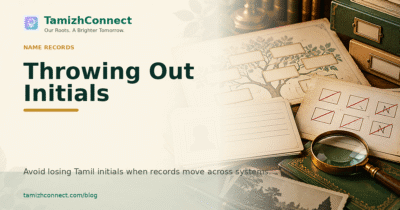
Initials confuse most people. They’re not random abbreviations — they’re compressed family history. Here’s how to read them.
- What Tamil initials really are (and what they are not)
- Common patterns: single, double, triple initials
- The usual chaos: R., R, RM, R.M., S K, S.K. – are they the same?
- How to store initials cleanly in TamizhConnect
- Handling unknown or disputed expansions
- Cleaning old data where initials got mangled
1. What Tamil initials really are (and what they are not)
Let’s be blunt: most outside systems treat initials as a joke. Single letter in the "surname" field, random dots, whatever.
But in a Tamil context, that single letter carries real meaning. R. isn’t just "R" — it’s a father’s name, a village, or a lineage marker that connects you to a specific branch of a specific family. Get it wrong and you merge two unrelated people. Get it right and you unlock a whole generation.
From a Tamil perspective, initials are compressed ancestry, usually encoding:
- father’s name (most common),
- sometimes grandfather’s name,
- sometimes village / house / clan name,
- occasionally a mix of these.
This compression of ancestral information into initials is a sophisticated system that preserves family history in a concise format. However, this system can be easily misunderstood by those unfamiliar with Tamil naming traditions.
Important points to remember:
- Initials are not guaranteed to be a stable, inherited surname.
- Different siblings can have different initials when patterns change across generations.
- The last word in the name (e.g., Natarajan) is not automatically the "family name".
So if you’re logging "R. Natarajan" as:
- First name: Natarajan
- Last name: R
and then forgetting what R stands for, you’re destroying information.
You must treat initials as structured data, not punctuation.
2. Common patterns: single, double, triple initials
There isn’t one uniform rule, but some patterns show up again and again. Understanding these patterns is crucial for genealogical research as they reveal the rich tapestry of Tamil family structures and naming traditions that have been passed down through generations.
2.1. Single initial + given name
Example: R. Natarajan
Hidden structure:
R= father’s name (e.g., Ramasamy) or sometimes a place/house nameNatarajan= personal name
The single initial pattern is perhaps the most common form of Tamil naming that outsiders encounter. This seemingly simple structure actually carries significant genealogical information, connecting the individual to their immediate paternal lineage. The initial ‘R’ in ‘R. Natarajan’ represents not just a person’s father, but potentially a whole branch of a family tree.
Variants you’ll see:
R. NatarajanR NatarajanRamasamy NatarajanNatarajan R
If you store these as separate people, you’re doing it wrong. They’re the same person with different levels of expansion.
2.2. Double initials + given name
Example: R.M. Natarajan
Hidden structure (one common pattern):
R= grandfather / ancestral nameM= father’s name (e.g., Muthusamy)Natarajan= personal name
The double initial pattern adds another layer of ancestral information, typically connecting the individual to both their grandfather and father. This creates a three-generation connection that preserves more family history within the name itself. When we see ‘R.M. Natarajan’, we’re seeing a compressed record that indicates both the grandfather’s name (Ramasamy) and the father’s name (Muthusamy), creating a direct link to two previous generations.
Variants:
R.M. NatarajanR M NatarajanRM NatarajanRamasamy Muthusamy Natarajan
Again, all of those might appear on different documents for the same person.
2.3. Initials encoding place / house
Sometimes the first letter(s) are:
- village name (e.g., K for Kallidaikurichi, T for Tirunelveli),
- house name or street used as a kind of family label.
This geographic element in Tamil naming adds another dimension to understanding family origins. When initials represent village or house names, they connect individuals not just to their immediate family lineage, but to specific geographic locations and community identities that may have been important to their ancestors. These place-based initials often indicate family origins or long-standing community connections that are just as important as paternal lineage in understanding family history.
Example:
T.K. Rajanmight be:T= town/village,K= father’s name,Rajan= given name.
You won’t always know this from the outside. That’s fine. Just don’t pretend it’s a Western-style surname.
3. The usual chaos: R., R, RM, R.M., S K, S.K. – are they the same?
Short answer: usually yes, but you don’t get to assume blindly. You have to look at context.
The variations in how Tamil initials appear in records reflect the challenges of preserving traditional naming systems in digital formats. When different documents, created at different times and by different organizations, record the same person’s name in various formats, it creates a complex puzzle for genealogical researchers. These variations aren’t errors – they’re evidence of how Tamil naming conventions have been adapted to different systems and contexts over time.
Things you’ll see in real data:
R. NatarajanR NatarajanR.Natarajan(no space)RNatarajan(squashed by some badly designed system)R M NatarajanR.M. NatarajanRM NatarajanS K KumarS.K. KumarS. K. Kumar
They might all represent:
- initials:
["R"]or["R", "M"]or["S", "K"] - givenName:
Natarajan/Kumar - spacing/punctuation noise.
Your job:
- strip out dots and silly spaces when you normalise,
- keep the original string as a raw variant,
- store the initial letters as a clean array:
["R"],["R","M"],["S","K"].
Stop letting punctuation decide who someone is.
4. How to store initials cleanly in TamizhConnect
If you try to bury initials inside one "full name" field, you’re asking for a mess.
Proper storage of Tamil initials requires a systematic approach that preserves both the cultural significance and genealogical value of these naming elements. When initials are properly structured in databases, they become powerful tools for connecting family members across generations and identifying relationships that might otherwise be lost in translation between different record-keeping systems.
The key to successful storage is recognizing that Tamil initials are not just abbreviations but contain valuable ancestral information that should be preserved in structured formats that allow for both historical accuracy and modern genealogical research.
Minimum structure per person:
- personalName
- the main given name(s):
Natarajan,Lakshmi Narayanan,Kumaravel
- the main given name(s):
- initialsRaw
- exactly as seen in the most common Tamil-style form:
"R.","R.M.","S. K."
- exactly as seen in the most common Tamil-style form:
- initialsNormalized
- array of clean letters with no dots / extra spaces:
["R"],["R","M"],["S","K"]
- array of clean letters with no dots / extra spaces:
- initialsExpandedCandidates
- array of possible expansions with evidence:
[ { "value": "Ramasamy", "confidence": "high", "source": "father profile" }, { "value": "Raman", "confidence": "low", "source": "vague elder memory" } ] - same for second initial if present.
- array of possible expansions with evidence:
- fullTamilForm
- the standard written version in Tamil script if known.
- latinVariants
- all relevant variations that appear in documents:
"R. Natarajan""R Natarajan""Natarajan R""Ramasamy Natarajan"
- all relevant variations that appear in documents:
If TamizhConnect lets you define custom fields, this is roughly what you want. If not, you can still emulate this structure in notes and tags.
4.1. Example person
Let’s take R. Muthukumar:
personalName:"Muthukumar"initialsRaw:"R."initialsNormalized:["R"]initialsExpandedCandidates:[ { "initial": "R", "value": "Ramasamy", "confidence": "high", "source": "father profile + school record" } ]
fullTamilForm:ராமசாமி முருகுகுமார்(if you know it)latinVariants:"R. Muthukumar""R MUTHUKUMAR""Muthukumar R""Ramasamy Muthukumar"
This structured approach to storing Tamil initials allows researchers to maintain the cultural and genealogical integrity of naming traditions while making the information accessible in modern digital systems. By separating the various components of a Tamil name, we preserve the ancestral connections that initials represent while enabling accurate searching and matching across different document formats.
This lets you:
- match across badly formatted documents,
- still know what
Rstands for, - handle search properly.
5. Handling unknown or disputed expansions
You will not always know what R or S.K. really stand for. You’ll also get fights:
- one elder insists
R=Ramasamy, - another says it’s
Rangasamy.
The reality of genealogical research is that memory fades, records are lost, and family histories can have multiple versions of the truth. This is particularly true for Tamil naming traditions, where oral history has often been the primary means of preserving ancestral information. When faced with uncertainty about what initials represent, it’s important to document this uncertainty rather than make assumptions that could lead to incorrect genealogical connections.
You can pretend you know and lie to yourself, or you can store the doubt properly.
5.1. Unknown initials
If you have no clue:
initialsRaw:"R."initialsNormalized:["R"]initialsExpandedCandidates:[]- Note:
"Expansion unknown as of 2025; no documents showing full form."
Later, if you find a school record or patta:
- add a candidate with
confidence: "medium"or"high".
5.2. Multiple candidates
When there are conflicting stories:
- store both versions with confidence and source:
initialsExpandedCandidates:
- initial: "R"
  value: "Ramasamy"
  confidence: "medium"
  source: "Told by P. Meenakshi (b. 1943) in 2023"
- initial: "R"
  value: "Rangasamy"
  confidence: "low"
  source: "Guess by S. Ramesh (b. 1965) – not sure"
Handle uncertainty explicitly and keep the raw strings. TamizhConnect can store both the clean initials array and the original variants so you never lose context.
Related Articles
Understanding Tamil initials is a crucial step in preserving the rich genealogical heritage embedded in Tamil naming traditions. These compact forms of ancestral information represent centuries of cultural continuity and family connection. By properly documenting and preserving the meaning behind these initials, we ensure that future generations can trace their lineage and understand their place within the broader tapestry of Tamil family history. Whether you’re beginning your genealogical journey or deepening your understanding of Tamil naming conventions, recognizing the significance of initials like R., S.K., and others opens up new pathways to discovering your ancestral connections.