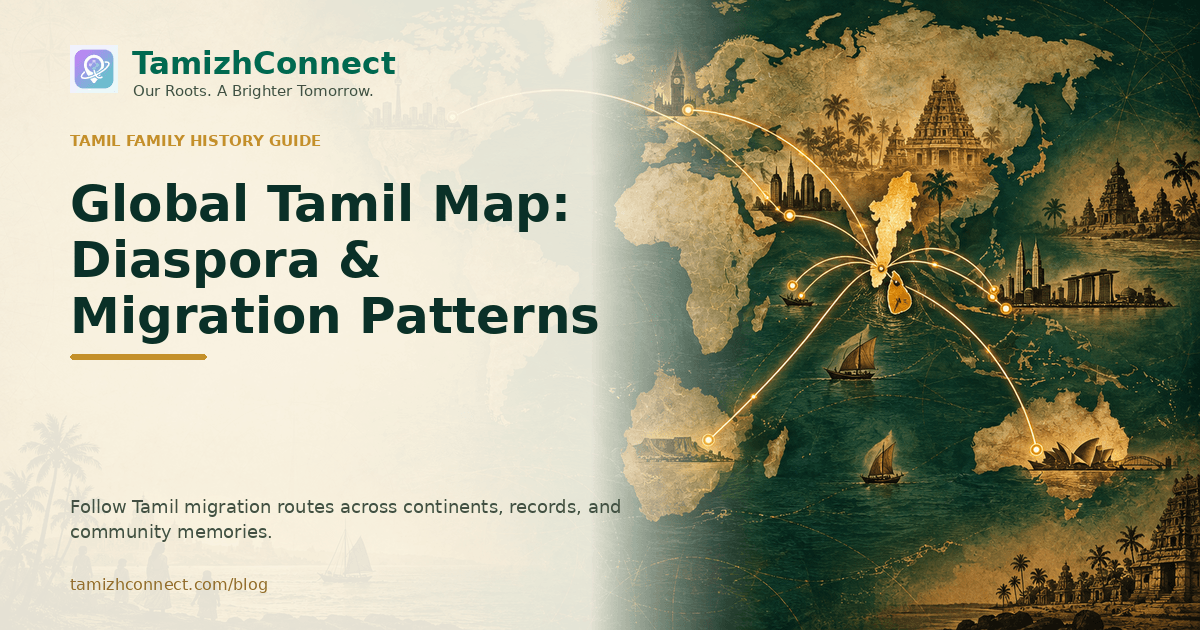
Overview: Global Tamil Map: Diaspora & Migration Patterns
The Tamil diaspora spans multiple continents, representing one of the most significant migration stories of the 20th and 21st centuries. While many think of Tamils as living primarily in India or Sri Lanka, the reality is far more complex. Tamil communities today live across Malaysia, Singapore, the Gulf countries, Western nations, and many other regions, each with unique migration histories and cultural adaptations.
Understanding the global distribution of Tamil communities is crucial for genealogical research, cultural identity, and connecting with relatives across generations. This comprehensive guide explores where Tamil communities live worldwide, explains how migration shaped these communities, and shows how this affects genealogical research and cultural preservation.
Before reading more, explore our guide to Tamil language and identity. This helps you understand "Tamil" beyond "a language in South India."
Understanding Tamil Migration: A Historical Perspective
Tamil migration occurred in distinct waves over centuries, each with different motivations, destinations, and outcomes:
- Ancient maritime connections (pre-1800s): Tamil traders established communities across Southeast Asia
- Colonial-era estate labor (1800s-1950s): Systematic recruitment for rubber and tea plantations in Malaysia and elsewhere
- Post-independence professional migration (1960s-present): Education and professional opportunities in Western countries
- Gulf employment boom (1970s-present): Contract-based labor and professional opportunities
- Refugee resettlement (1980s-present): Displacement due to conflict, particularly in Sri Lanka
Understanding these migration patterns helps explain the geographic distribution of Tamil communities today and provides context for genealogical research.
Tamil Homelands: Tamil Nadu and Northeastern Sri Lanka
The global Tamil community started in these traditional homelands. Millions of Tamils have kept their cultural identity here for thousands of years.
Tamil Nadu: The Main Tamil Region
Tamil Nadu is India’s main Tamil-speaking state. It has over 65 million Tamil speakers. This is about 85% of the state’s population.
This region is the historical center of Tamil civilization. It was the starting point for most migration waves. These waves reached every corner of the globe.
Major Cities in Tamil Nadu:
- Chennai (Madras) – The largest urban Tamil center. It’s a major hub for global Tamil cultural influence
- Coimbatore – Major industrial center with Tamil business networks
- Madurai – Historic cultural capital with ancient temple traditions
- Tiruchirappalli (Tiruchi) – Strategic central location with strong educational institutions
- Salem – Industrial hub in central Tamil Nadu
- Tirunelveli – Southern district center with distinctive cultural traditions
- Erode – Textile industry center with commercial connections
- Vellore – Educational and medical hub with growing urban population
Rural and Town Communities:
- Agraharams – Traditional Brahmin settlements with strong cultural preservation
- Oorus – Village communities keeping traditional caste and temple networks
- Coastal fishing communities – Distinct cultural practices and maritime traditions
- Chettinad region – Merchant communities with historical trading networks to Southeast Asia
- Chola Nadu – River delta agricultural communities with rich cultural heritage
- Pandya Nadu – Southern regions with distinctive dialects and cultural practices
- Kongu Nadu – Western Tamil Nadu with unique cultural practices
Each region has distinct dialects, cultural practices, and traditional networks. These continue to influence migration patterns and community connections worldwide.
Northeastern Sri Lanka: A Different Tamil Identity
The Tamil community in Sri Lanka is in the Northern and Eastern Provinces. This represents a distinct historical community with its own identity markers:
Main Areas:
- Jaffna Peninsula – The cultural and educational hub of Sri Lankan Tamils
- Batticaloa District – Coastal region with fishing and agricultural communities
- Trincomalee District – Eastern port city with historical trading connections
- Vavuniya District – Central Northern Province location
- Mannar District – Island district with unique cultural traditions
- Mullaitivu District – Northern region with traditional farming communities
- Kilinochchi District – Northern interior region
Different Identity Markers:
- Sri Lankan Tamil accent – Different from Tamil Nadu pronunciation patterns
- Unique vocabulary – Influenced by Sinhala and other regional languages
- Different cultural practices – Adapted to Sri Lankan context while keeping Tamil traditions
- Historical experience – Shaped by different colonial experiences (Portuguese, Dutch, British)
- Political experience – Distinct from Tamil Nadu political movements
- War and displacement trauma – Unique experience of conflict and diaspora from the 1980s onwards
For genealogical researchers and family tree builders, Sri Lankan Tamil communities represent distinct family branches. These have specific regional origins, migration patterns, and cultural practices. These differ from Tamil Nadu families. They share the same language and basic cultural framework.
Southeast Asia: Colonial-Era Migration and Settlement
The colonization period brought the first major waves of Tamil migration to Southeast Asia. These communities became important parts of these nations’ populations.
Malaysia: The Largest Overseas Tamil Population
Malaysia has the world’s largest Tamil diaspora community. It numbers nearly 2 million people. Their presence goes back to the 19th century.
Historical Migration Waves:
- 19th Century Plantation Workers – Primarily from South Tamil Nadu under the Kangani recruitment system for rubber estates
- Early 20th Century Professionals – Educated Tamils filling administrative positions under British rule
- Post-Independence Professionals – Skilled workers in expanding Malaysian economy
- Contemporary Migration – Students, professionals, and skilled workers
Where Tamils Live in Malaysia:
- Kuala Lumpur Metropolitan Area – Largest Tamil concentration in the capital region
- Penang – Historical settlement area with strong cultural institutions
- Selangor – Industrial centers with significant Tamil workforce
- Negeri Sembilan – Rubber estate areas with early Tamil settlements
- Perak – Mining and agricultural areas with Tamil communities
- Johor – Southern state with connections to Singapore
- Perlis – Northern state with smaller Tamil populations
Community Features:
- Third and Fourth Generation Settlements – Many families with centuries of Malaysian history
- Multicultural Identity – Blended Tamil-Malay-Chinese identities in many families
- Educational Institutions – Tamil-medium schools and cultural organizations
- Religious Networks – Extensive temple networks and religious practices
- Economic Integration – Significant representation in business, professional services, and skilled trades
Singapore: Official Recognition and Cultural Continuity
Singapore’s Tamil community is smaller in size (around 120,000). But it’s important due to Tamil’s official status. It’s one of the country’s four national languages.
Community Features:
- Official Language Status – Tamil is taught in schools and used in government communication
- Strong Political Representation – Active participation in Singaporean governance
- Professional Concentration – High representation in civil service, business, and professional fields
- Cultural Institutions – Museums, cultural centers, and festivals celebrating Tamil heritage
- Educational Excellence – Strong academic achievement and professional success
Family Composition Patterns: Modern Singaporean Tamil families have complex ancestry patterns:
- Branches tracing back to Tamil Nadu through early colonial migration
- Lineages from Sri Lanka due to historical connections between both territories under British rule
- Multiple generations holding Singaporean passports while maintaining cultural ties
- English dominance in daily communication with Tamil preserved in religious, cultural, and familial contexts
Gulf Countries: Circular Migration and Transnational Impact
The Gulf states represent perhaps the most dynamic segment of the global Tamil map. They are characterized by circular migration patterns. These patterns create transnational families and complex identity formations.
Where Tamils Live in the Gulf
United Arab Emirates (UAE):
- Dubai – Largest Tamil community concentration with extensive business networks
- Abu Dhabi – Administrative capital with significant Tamil professional presence
- Sharjah – Cultural center with Tamil cultural activities
- Ajman, Ras Al Khaimah, Fujairah – Smaller emirates with Tamil communities
Saudi Arabia:
- Riyadh – Capital with large Tamil professional community
- Jeddah – Major port city with diverse Tamil populations
- Dammam and Khobar – Eastern province oil industry centers
- Medina and Mecca – Religious cities with Tamil service providers
Other Gulf States:
- Qatar – Doha with growing Tamil community
- Kuwait – Historical Tamil community with established networks
- Oman – Muscat and Salalah with Tamil workers
- Bahrain – Smaller but established Tamil presence
Migration Characteristics and Family Patterns
Gulf migration follows distinct patterns that create unique family structures:
Cyclical Migration Model:
- Temporary Worker Status – Most Tamils keep Indian, Sri Lankan, or Malaysian citizenship
- Extended Temporary Status – Many families spend decades in Gulf countries without path to citizenship
- Remittance Economy – Significant financial flows back to origin countries
- Educational Choices – Children often attend international schools with English as primary language
Transnational Family Structures:
- Split Families – Parents working in Gulf while children study in home countries
- Multi-Generational Patterns – Grandparents raising children whose parents work abroad
- Educational Investments – Significant resources dedicated to children’s education
- Property Ownership – Investment in properties in home countries
- Cultural Maintenance – Efforts to keep Tamil identity while adapting to Gulf contexts
Impact on Identity Formation: Children raised in the Gulf often develop complex identity formations:
- Cultural Identity: Primarily Tamil cultural values and practices
- Citizenship Identity: Hold Indian, Sri Lankan, or Malaysian nationality
- Residential Identity: Born and raised in Gulf countries
- Educational Language: Often primarily English-educated
- Future Orientation: Uncertainty about long-term residence
Western Hemisphere: Professional Migration and Refugee Resettlement
The Western hemisphere communities represent a newer phase of Tamil migration. This is characterized by professional migration and refugee resettlement following the Sri Lankan civil conflict.
United States: Scattered Professional Communities
The US Tamil community is geographically dispersed. But it is highly concentrated in areas with strong professional opportunities:
Major Metropolitan Concentrations:
- Greater Boston Area – High concentration of medical professionals and academics
- New York Metropolitan Area – Financial sector and professional services
- Washington DC Metro – Government contractors and technology professionals
- Chennai of the West Coast (San Francisco Bay Area) – Technology hub with numerous Tamil professionals
- Austin, Texas – Tech industry with significant Tamil population
- Chicago, Illinois – Medical and professional services sector
- Detroit, Michigan – Automotive industry and engineering professionals
- Seattle, Washington – Technology companies like Amazon and Microsoft
- Atlanta, Georgia – Healthcare and technology sectors
- Orange County, California – Growing Tamil community in Southern California
Community Characteristics:
- Professional Migration – Predominantly skilled workers in medical, technology, and academic fields
- Second and Third Generation – Children increasingly integrated into American society
- Cultural Preservation – Weekend schools, temples, and cultural organizations
- Religious Institutions – Multiple temples serving different regional origins
- Network Effects – Professional networks facilitating family reunification and community growth
Canada: The Toronto Hub
Toronto has developed into the world’s largest concentration of Sri Lankan Tamil refugees and their descendants:
Geographic Concentration:
- Toronto – The primary hub with the world’s largest Sri Lankan Tamil diaspora
- Greater Toronto Area – Surrounding municipalities with Tamil communities
- Vancouver – Secondary West Coast concentration
- Montreal and Ottawa – Smaller but active Tamil communities
Community Makeup:
- Refugee Resettlement – Large population of Sri Lankan Tamils who fled conflict
- Professional Integration – High levels of professional achievement and economic success
- Cultural Vitality – Strong cultural institutions, festivals, and media
- Political Engagement – Active engagement on issues related to Sri Lanka
- Educational Excellence – Strong emphasis on academic achievement and professional careers
United Kingdom: Dual Origin Communities
The UK hosts large Tamil communities with dual origins – both Indian Tamils and Sri Lankan Tamils:
Geographic Distribution:
- London and Greater London – Largest concentration with both Indian and Sri Lankan Tamil communities
- Manchester and Greater Manchester – Significant Sri Lankan Tamil population
- Birmingham – Growing Tamil community
- Leicester – Notable Tamil presence
- Cardiff – Welsh capital with Tamil community
- Edinburgh and Glasgow – Scottish cities with Tamil populations
Community Dynamics:
- Dual Origins – Both Indian Tamil and Sri Lankan Tamil communities with different historical experiences
- Professional Success – High representation in medical, legal, and academic professions
- Educational Achievement – Strong emphasis on academic excellence
- Cultural Preservation – Weekend schools, temples, and cultural festivals
- Generational Differences – Varying degrees of integration and cultural retention
Australia and New Zealand: Skilled Migration Focus
Australian and New Zealand Tamil communities are primarily formed through skilled migration:
Geographic Distribution:
- Sydney – Largest Tamil community with diverse origins
- Melbourne – Strong Tamil population with cultural institutions
- Brisbane – Growing Tamil community in Queensland
- Perth – Western Australian concentration
- Auckland – Primary New Zealand Tamil hub
- Wellington – Secondary New Zealand concentration
Migration Characteristics:
- Skilled Migration Pathways – Primarily professional and skilled worker streams
- Refugee Settlement – Some Sri Lankan Tamil refugee communities
- Integration Approaches – Varying degrees of cultural maintenance and adaptation
- Cultural Institutions – Temples, schools, and cultural organizations
- Economic Success – Strong representation in professional and technical fields
Multigenerational Identity Formation and Mixed Heritage
As Tamil communities have existed outside traditional homelands for decades, new identity formations have emerged. This is particularly true in mixed-heritage contexts and second-generation experiences.
Second-Generation Identity Patterns
The global Tamil map becomes less about geography and more about identity navigation for second-generation Tamils:
Regional Identity Labels:
- British Tamil – Identity combining Tamil heritage with British citizenship and cultural experience
- Canadian Tamil – Particularly common among Toronto-area Sri Lankan Tamil descendants
- American Tamil – Cultural identity within US social context
- Australian Tamil – Identity formation within Australian multiculturalism
- Singapore Tamil – Identity within Singapore’s multi-ethnic framework
Identity Challenges:
- Multiple Loyalties – Feelings of connection to origin country, residence country, and Tamil identity
- Language Loss – Gradual shift from Tamil to dominant resident country language
- Cultural Assimilation – Pressure to conform to mainstream cultural norms
- Religious Identity – Navigating Hindu/Buddhist identity in secular societies
- Marriage Decisions – Choices between Tamil and non-Tamil partners
- Cultural Transmission – Teaching Tamil values and practices to children
Mixed-Heritage Tamil Experiences
When one parent is Tamil and the other is not, or when both parents are Tamil but from different contexts:
Common Identity Challenges:
- Partial Discovery – Realizing Tamil heritage in adolescence or adulthood
- Name Recognition – Understanding the significance of Tamil surnames and naming patterns
- Cultural Learning – Catching up on Tamil traditions, customs, and language
- Family Complexity – Navigating relationships with extended families from different cultures
- Ethnic Classification – Deciding how to identify in official forms and social contexts
- Cultural Synthesis – Creating hybrid identity that honors both heritage components
Examples of Complex Heritage:
- Malaysian Tamil + Chinese Malaysian – Blended families navigating multiple cultural contexts
- Sri Lankan Tamil + Sinhalese – Cross-ethnic marriages often complicated by historical tensions
- Indian Tamil + European – Interracial families in Western countries
- Tamil + Other South Asian – Inter-marriages within broader South Asian communities
Geographic Distribution Implications for Family Research
Understanding the global Tamil map has significant practical implications for genealogical research and family connection.
Finding Relatives Across Geographic Boundaries
The geographic distribution creates opportunities and challenges for connecting with extended family:
Migration Pathways:
- Early Migration Links – Identifying relatives who moved during early plantation or colonial periods
- Professional Migration Chains – Understanding how professional success enabled family migration
- Refugee Family Reunification – Tracing families separated during conflict periods
- Circular Migration Patterns – Following families that move between countries for education or employment
- Educational Networks – University connections that created family intermarriages across regions
Research Strategies:
- Geographic Clustering – Understanding regional concentrations to focus research efforts
- Institutional Links – Tracing connections through schools, temples, and cultural organizations
- Professional Networks – Following career paths that led to family connections
- Marriage Patterns – Understanding how families from different regions intermarried
- Document Verification – Using geographic information to authenticate records across different jurisdictions
Surname and Naming Pattern Recognition
Different regions have distinct naming conventions that affect research:
Patronymic Traditions:
- South Indian Patterns – Father’s name as initial or part of surname
- Sri Lankan Variations – Different family name practices influenced by colonial systems
- Diaspora Adaptations – Anglicization of names in Western countries
- Regional Variations – Different naming customs in various Tamil regions
- Professional Names – Changes adopted for workplace convenience
Documentation Implications:
- Record Variations – Names appearing differently across documents from different countries
- Search Strategy – Need for flexible name searches accounting for variations
- Family Connections – Understanding how naming patterns indicate family relationships
- Regional Origins – Surnames that indicate specific geographic origins
- Cultural Practice – Understanding naming customs that reflect cultural values
Document Interpretation Across Migration Routes
Historical migration routes provide context for understanding various documents:
Colonial Era Documents:
- Indenture Records – From Tamil Nadu to Southeast Asia and elsewhere
- Ship Passenger Lists – Migration records from various ports
- Plantation Employment Records – Work assignments and family locations
- Early Census Records – First documentation of Tamil communities abroad
Post-Independence Documents:
- Passport Records – Travel and citizenship documentation
- Visa Applications – Immigration and settlement paperwork
- Professional Qualifications – Credential recognition across countries
- Property Transactions – Real estate investments and family wealth building
- Educational Records – School and university enrollments
Digital Tools for Managing Geographically Distributed Families
Modern genealogical platforms like TamizhConnect are specifically designed to handle the complexity of geographically distributed Tamil families.
Comprehensive Geographic Tracking
Individual Record Management:
- Birthplace Documentation – Precise location identification for each family member
- Current Residence Tracking – Updated location information for living family members
- Ancestral Village Recording – Detailed information about origin locations
- Migration Path Visualization – Visual representation of family movement patterns
- Temporal Mapping – Recording dates of geographic transitions
- Passport and Citizenship Tracking – Multiple nationality documentation
- Language Proficiency Notes – Documentation of Tamil and other language skills
Migration Path Documentation
Historical Route Mapping:
- Village to City Movements – Early migration within traditional territories
- International Migration Documentation – Recording departure and arrival information
- Circular Migration Patterns – Documenting temporary returns and extended stays
- Chain Migration Records – Showing how one family member enabled others to migrate
- Economic Driver Identification – Understanding economic factors behind movements
- Social Network Effects – How community connections facilitated migration
- Educational Pathways – Studying abroad and subsequent settlement patterns
Cultural Preservation Features
Identity Documentation:
- Regional Origin Markers – Recording specific geographic and cultural origins
- Temple and Religious Connections – Maintaining spiritual community links
- Cultural Practice Documentation – Recording regional variations in customs
- Language Maintenance Tracking – Monitoring Tamil language transmission across generations
- Festival Participation Records – Cultural activity documentation
- Community Organization Involvement – Religious, cultural, and professional organizations
Contemporary Trends and Future Directions
The global Tamil map continues to evolve with new migration patterns and identity formations.
Emerging Migration Patterns
New Destinations:
- Middle Eastern Opportunities – Beyond traditional Gulf destinations
- African Development Projects – Tamil professionals in development work
- European Professional Markets – Skilled workers in EU countries
- Latin American Ventures – Business and professional opportunities
Changing Motivations:
- Climate Migration – Environmental factors influencing relocation decisions
- Technology Remote Work – Digital nomadism affecting family distribution
- Educational Excellence – Competition for top-tier educational institutions
- Quality of Life Factors – Healthcare, safety, and environmental considerations
Identity Evolution in Digital Era
Virtual Communities:
- Online Cultural Connections – Digital relationships transcending physical boundaries
- Social Media Networks – Platforms for maintaining family connections across distances
- Digital Cultural Transmission – Online learning for language and cultural preservation
- Virtual Religious Participation – Digital temple visits and ritual participation
Conclusion: Understanding Global Tamil Distribution and Migration
Mapping Your Tamil Heritage Journey
Understanding these geographic distributions and migration patterns is crucial for anyone seeking to trace their Tamil heritage, connect with distant relatives, or preserve cultural traditions for future generations. The Tamil story is ultimately one of adaptation and resilience – keeping essential cultural elements while successfully integrating into diverse global contexts.
The complexity of the global Tamil map – with its multiple origins, varied migration waves, and diverse contemporary expressions – enriches rather than diminishes Tamil identity. Each community adds to the global Tamil narrative, creating a living tapestry that connects people from Jaffna to Toronto, from Penang to Perth, from London to Los Angeles.
For those building their family trees and cultural connections, the global Tamil map serves as both an inspiration and a roadmap—a demonstration that cultural identity can thrive even when dispersed across continents, and that family connections can transcend national boundaries when supported by the right tools and understanding.
Key Takeaways for Tamil Genealogy Research
- Migration patterns explain family distribution: Understanding historical migration waves helps locate relatives across different regions
- Regional variations matter: Different communities have distinct naming patterns, cultural practices, and migration stories
- Documentation varies by region: Record availability and naming systems differ across countries
- Language preservation differs: Tamil retention varies significantly across diaspora communities
- Cultural identity adapts: Each community maintains different aspects of Tamil heritage based on local contexts
Continue Your Tamil Heritage Journey
To continue exploring your Tamil heritage and connect with your global family, consider reading about Tamil language origins, understanding Tamil names and genealogy, tracing your Tamil ancestry, or discovering your ancestral village. Our comprehensive family tree builder provides specialized tools designed to help Tamil families navigate the complexity of geographic distribution while preserving cultural connections across generations. Also try our advanced heritage inference tool to explore cultural patterns in your family history.
Additionally, explore these related resources:
- Documenting family history from elders to preserve migration stories
- Tamil migration timeline guide for chronological understanding
- Gulf Tamil families guide for Middle Eastern migration patterns
- Malaysia Tamil community history for Southeast Asian insights
The interconnected nature of Tamil communities worldwide means that understanding one region’s history often provides clues for family connections in other regions, making comprehensive knowledge of global Tamil distribution essential for successful genealogical research.