Tamil Ancestry Research | Family Tree Guide
In this article:
- What “document extraction” actually means
- Which documents are worth extracting from (and which are just noise)
- The four layers: image → text → facts → links
- What to extract: a small, brutal checklist
- How to store extracted facts + confidence in TamizhConnect
- Common mistakes that quietly corrupt your data
- A practical extraction workflow for one messy PDF
1. What “document extraction” actually means
Most families do this:
- Scan birth certificates, pattas, temple books, e-rolls, letters, school records.
- Dump them into Google Drive / WhatsApp / “Documents” folder.
- Feel satisfied because “everything is digitised”.
That’s not genealogy. That’s digital hoarding.
Document extraction is:
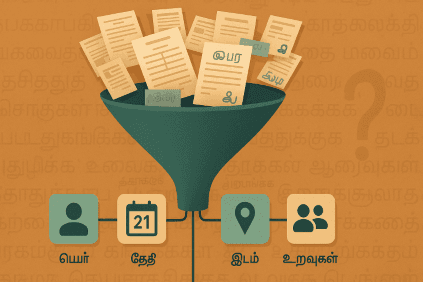
Taking a document (scan, PDF, photo) and pulling out specific, checkable facts – names, dates, places, relationships, roles – then storing those facts as structured data linked back to the original.
You’re not trying to rewrite the whole document.
You’re trying to:
- extract the signal,
- keep the original as evidence,
- and make search + analysis possible.
If you’re not doing extraction, your PDFs are just prettier piles of paper.
2. Which documents are worth extracting from (and which are just noise)
Not every document deserves the same effort. Prioritise.
2.1. High-value documents
These directly affect your tree and timelines:
- Vital records
- birth, baptism, NIC/Aadhaar, marriage, death certificates
- Land and property
- pattas, sale deeds, inām records, lease documents, mortgage papers
- Migration and ID
- passports, visas, PR cards, ship lists, estate registers, ration cards
- Education & employment
- school/college records, appointment orders, service books
- Temple / church / mosque
- pooja registers, donor lists, trust minutes when they name your people.
These are worth systematic extraction.
2.2. Medium-value documents
Good for context and cross-checking:
- court case copies,
- association membership lists,
- old letters with dates/addresses,
- newspaper obituaries,
- festival souvenir books.
Extract selectively: only the pieces that touch your people.
2.3. Low-value documents
Mostly noise:
- generic religious pamphlets,
- random motivational PDFs,
- WhatsApp forwards,
- undated political rants,
- adverts / marketing junk.
Don’t waste time “extracting” from these. If they don’t add verifiable facts, ignore them.
3. The four layers: image → text → facts → links
If you don’t separate these layers, you’ll make a mess.
3.1. Layer 1 – Image
- Raw scan / photo / PDF page.
- This is your evidence.
- You never edit history here; you only attach metadata.
3.2. Layer 2 – Text
- Either:
- OCR output (Tamil / English / Sinhala etc.), or
- manually typed transcription.
- Still close to the original:
- includes errors, formatting issues, noise.
- Purpose:
- make the document searchable,
- make manual extraction faster.
3.3. Layer 3 – Facts
From the text, you pull specific units like:
- “Person X born on Y at Place Z.”
- “Person A married Person B on Date, at Place.”
- “Person C listed as patta holder of Survey S in Village V in year Y.”
- “Household listed at address A in e-roll year Y.”
Each fact gets:
- a type,
- structured fields,
- a confidence level,
- a link back to the document.
3.4. Layer 4 – Links into TamizhConnect
Facts then hook into:
- Person profiles
- Places (villages/towns/temples)
- Land parcels
- Events (birth, marriage, migration, land transfer, etc.)
That’s where your tree and maps become grounded in something more than memory.
4. What to extract: a small, brutal checklist
Stop trying to “extract everything”. You’ll burn out. Pull what actually matters.
4.1. From birth / baptism / naming records
Extract:
- person’s full name as written,
- date of birth / baptism,
- place of birth (village, town, hospital if given),
- parents’ names as written,
- religion / temple / church (if explicit),
- any informants or witnesses.
Ignore long boilerplate legal text. It’s the same on every certificate.
4.2. From marriage records
Extract:
- both partners’ names,
- date and place of marriage,
- each partner’s age, occupation, and address at time of marriage (if given),
- parents’ names and whether alive/deceased (if present),
- witness names.
These are gold for linking branches and locations.
4.3. From death records
Extract:
- name of deceased (as written),
- date and place of death,
- age at death,
- cause of death (if meaningful),
- informant’s name and relationship,
- last known address.
Useful for bounding birth year and tracking address changes.
4.4. From pattas / land deeds
Extract:
- land parcel ID: survey number + village,
- extent and type (wet/dry/house-site),
- holder/owner names,
- date of transaction/issue,
- type of transaction: sale, gift, inheritance, partition, lease, etc.,
- any clear relationships (s/o, w/o, etc.).
Don’t get lost in long legal clauses unless they introduce new people or dates.
4.5. From e-rolls / voter lists
Extract:
- name as written,
- relation name (father/husband/mother),
- age or year of birth,
- sex,
- house number / address fragment,
- part/section and constituency,
- voter ID.
Plus the year of the roll itself.
4.6. From temple/church/mosque records
Extract:
- devotee/worshipper/donor name (as written),
- any gothram / nakshatram / rasi if present,
- date or festival/year,
- offering / role (donation, lamp, pooja, trustee, worker),
- village or address if written.
Everything else is context.
5. How to store extracted facts + confidence in TamizhConnect
If you don’t model extraction properly, you can’t trust your own data.
5.1. Source object
For each document:
sourceIdsourceType:"birth-cert","marriage-cert","death-cert","patta","sale-deed","e-roll","temple-record","school-record","passport", etc.
titleOrDescription:"Birth certificate of X","Patta #123 for Survey 45/2"yearApproxfileLink(PDF/image)languageocrStatus(if relevant).
5.2. Fact object
For each extracted fact:
factIdfactType:"birth","marriage","death","land-holding","residence","education","occupation","donation", etc.
sourceIdpageOrLocation:"page 3, entry 12"or similar- structured fields depending on type, e.g.:
For a birth fact:
personId(if linked)nameAsWrittendateOfBirth(oryearRangeif approximate)placeId(if mapped)fatherNameAsWritten,motherNameAsWrittennotes.
For a land-holding fact:
personId[](list of holders)landParcelIdrole("holder","co-holder","tenant")effectiveYear.
5.3. Confidence and review
Every fact needs:
confidence:"high" | "medium" | "low"extractionMethod:"manual-typed" | "ocr-reviewed" | "ocr-raw"reviewStatus:"not-reviewed" | "reviewed"reviewer(optional)reviewDate.
Rules of thumb:
- High confidence: typed from clear document; double-checked.
- Medium: OCR + human glance; or old handwriting you’re fairly sure about.
- Low: hard-to-read, partial, or conflicting sources.
High-confidence facts can drive merges and major tree edits.
Medium/low should push you to look for more evidence.
6. Avoiding Data Corruption: Common Mistakes in Document Extraction
If you do any of these, fix your habits.
6.1. “Cleaning” names instead of keeping originals
Bad:
- Reading
MUTUSAMIand storing onlyMuthusamywithout keeping the exact original spelling as written.
Correct:
nameAsWritten:"MUTUSAMI"nameNormalized:"Muthusamy"
Original stays; your “cleaned” version is an extra, not a replacement.
6.2. Mixing multiple documents into one vague note
Bad:
“He was born around 1950 in Trichy, worked in Chennai, moved to Canada.”
With no source references.
Correct:
- create separate facts for:
- birth (from cert),
- address (from e-roll / ration card),
- migration (from passport/visa),
- each with its own
sourceId.
6.3. Guessing dates instead of marking them as approximate
Bad:
- Document says “age 30 in 1978” → you record DOB as
1948-01-01.
Correct:
- store
yearOfBirthRange:1947–1949, - or
approxYearOfBirth: 1948, - plus note: “derived from age 30 in 1978 death certificate.”
Don’t manufacture exact days out of nothing.
6.4. Over-trusting OCR
Bad:
- Using raw OCR names directly to merge person profiles.
- Assuming every OCR “Nadarajan” is the same “Natarajan”.
Correct:
- for names and places, always visually check against the scan before merging,
- especially if the match changes relationships in the tree.
7. A practical extraction workflow for one messy PDF
Take one real-world mess: a 40-page scanned PDF of old records (say, a school or temple book). Here’s how to not screw it up.
Step 1 – Decide scope
Ask:
- “What am I trying to get from this?”
Example:
- “Names, fathers’ names, and villages for anyone related to our three core branches.”
Ignore everything else.
Step 2 – Prepare the document
- Run OCR if the print is reasonably clear.
- If it’s handwriting / terrible print, skip OCR and just view the images.
Step 3 – Make a simple extraction template
Open a spreadsheet or table with columns like:
SourceId,Page,LineOrEntry,NameAsWritten,FatherOrHusbandName,VillageOrAddress,YearOrDate,Notes.
No fancy schema yet. Just structured rows.
Step 4 – Go page by page and log only relevant rows
- For each page, skim for known surnames, initials, or villages.
- When you hit a relevant line:
- type it into the template,
- don’t try to reformat; keep it close to what’s on the page.
Step 5 – Import into TamizhConnect
Once you have a few dozen rows:
- create
sourceentry for the document, - for each row:
- create
factobjects (birth, education, donation, etc.), - link to person profiles when you are confident,
- leave as unlinked if you’re not sure yet.
- create
Step 6 – Review links and adjust tree
Only after facts exist:
- consider merging person profiles,
- update life events (birthplace, schooling, temple roles),
- log conflicts and uncertainties explicitly.
Step 7 – Stop, don’t “perfect” everything
Once you’ve extracted the high-value bits:
- move on to the next document.
- You can always come back later if you discover a new branch that ties into unused pages.
If you treat “document extraction” as some vague tech buzzword, you’ll stay stuck at the “We have so many PDFs” stage forever.
If you treat it as:
- a disciplined process of pulling out minimal, high-value facts,
- tying them to people, places, and events,
- and always keeping a clear link back to the original,
then TamizhConnect stops being a pretty file cabinet and actually becomes what it’s supposed to be:
a hard, evidence-backed map of who your people were, where they lived, and how their lives changed over time.