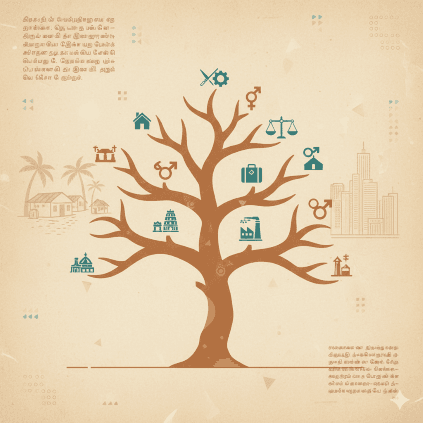
Overview: Cultural Anthropology & Tamil Families: A Guide
Tamil Ancestry Research | Family Tree Guide
In everyday Tamil talk we say:
- “In our place, mama and marumagal should not speak directly.”
- “In our family, cross-cousin marriage is the rule.”
Cultural anthropology treats these not as trivia but as core data.
This article sketches how an anthropological lens
adds depth to Tamil family history:
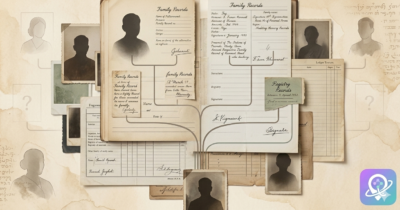
- Kinship maps, not just family trees
- Marriage rules – allowed, preferred, taboo
- Dowry, stridhanam and property as structures
- Diaspora and change, especially for overseas Tamils
1. Kinship maps – more than father/mother/children
A typical family tree records:
- parents, children, siblings, cousins.
Anthropology cares about:
- cross-cousins vs parallel-cousins
- how terms like mama, chithappa, athai are used
- which relatives are “joking” vs “avoidance” relations
- who can marry whom.
Your research notes should record:
- what people actually call each other in Tamil,
- plus (if helpful) an approximate English gloss.
This preserves nuances that English words like “uncle” can’t capture.
2. Marriage rules – allowed, preferred, and taboo
In many Tamil jatis:
- certain cousin marriages are preferred,
- some are formally forbidden,
- some are technically allowed but socially rare.
For anthropology, this links to:
- how property and responsibility move
- how alliances between families are made and kept
- how caste boundaries are maintained or crossed.
In your tree, for each marriage, note:
- relation type (cross-cousin, parallel-cousin, same village, different jati, etc.)
- where the spouse’s family came from
- any clear “rule” the family mentions.
Across generations you will see shifts like:
- “close-kin marriages until the 1980s,
then more out-of-village or out-of-jatti marriages”.
3. Dowry, stridhanam, and property – more than money
When elders say:
- “In those days there was no dowry, only gifts”, or
- “She got her share in the form of jewellery”,
anthropology asks:
- what actually moved – cash, land, gold, loans?
- what did that mean for power and security?
From a documentation point of view, look at:
- settlement deeds
- gift deeds
- partition documents
- court cases (if any).
Questions to ask:
- At what point do daughters start appearing as named sharers?
- When do joint families break into nuclear units?
These patterns show major social shifts,
not just internal family disagreements.
4. Diaspora – from “our village” to “our global family”
Tamil diaspora families have additional layers:
- a clear native village (or several),
- one or more destination countries,
- and often a pattern of back-and-forth visits.
Document:
- who was the first migrant, and why (education, labour, business, war, etc.)
- where they went first, and where the family is now
- how language, religion and caste practices changed (or didn’t).
In TamizhConnect, fields like:
- native place
- current city
- spouse’s origin
- children’s birth places
turn into rich data for future anthropologists.
4.1. Ritual ties across borders
Many diaspora families say:
- “We go back every few years mainly for temple festivals.”
This ties:
- emotional belonging,
- ritual calendars,
- and transnational kinship together.
Even a simple note like:
- “Visited village in 2012, 2016, 2023 for temple kumbabishekam or family functions”
helps future researchers understand
how traditions survive or change in motion.
Anthropology does not replace genealogy.
It sits next to it.
Your family tree tells:
- who was born, who married whom, who moved where.
Anthropology tells:
- what rules they lived under,
- what they believed was proper,
- how they negotiated change.
TamizhConnect is being built so that
both lenses can coexist in one workspace,
for Tamil families who want depth, not just diagrams.