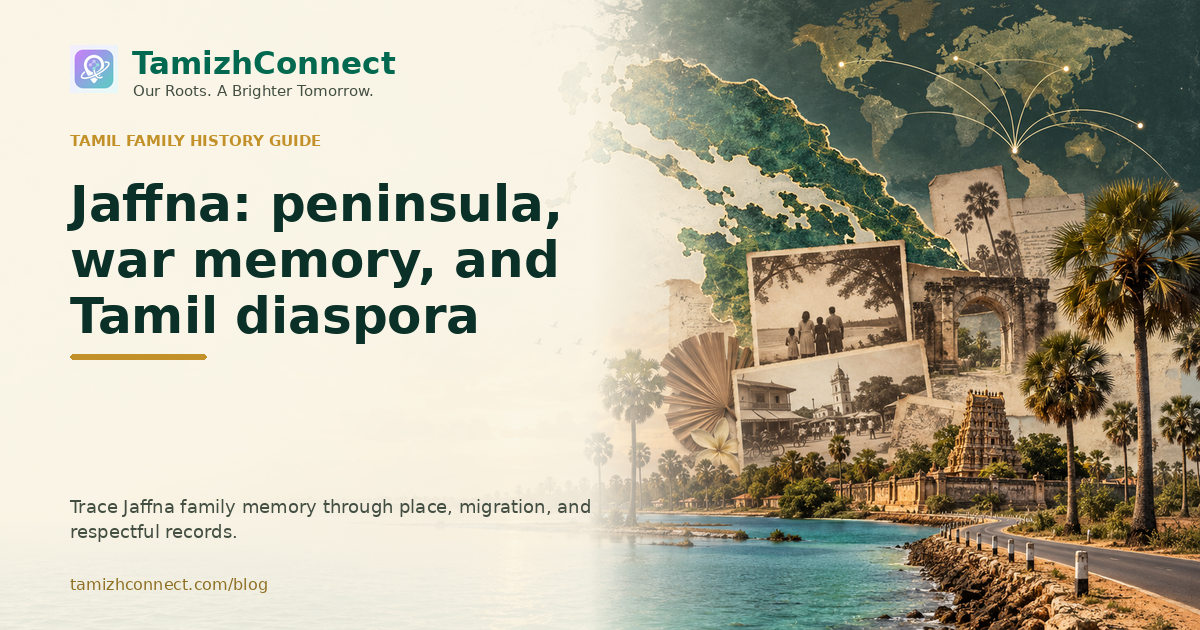
Jaffna is the cultural heartland of Sri Lankan Tamils — a peninsula of around 20 islands at the northern tip of Sri Lanka, ~1 million people at its peak before the 1983–2009 civil war, with a distinct dialect, caste structure (Vellalar-dominant), and naming conventions different from Eastern Sri Lankan Tamils and Indian Tamils. For genealogy this matters because Jaffna Tamil family trees rely on identifiable sources: Dutch Reformed and Anglican church registers from the 17th century onwards, British colonial land records (Thombus), Anglican-school matriculation lists, and oral pedigrees maintained by temples and caste associations. Jaffna diaspora after 1983 scattered primarily to London, Toronto, Zurich, Oslo, Paris, and Sydney — each destination produced its own paper trail.
In this article:
- What “Jaffna” actually refers to
- Land, water and everyday life on the peninsula
- Education, religion and the making of a migrant class
- War, displacement and loss – how not to romanticise Jaffna
- Jaffna and the global Tamil diaspora
- How to record Jaffna roots properly in TamizhConnect
- Questions to ask your own family
1. What “Jaffna” actually refers to
People casually say:
- “We are Jaffna Tamils.”
- “Our ooru is Jaffna.”
- “Yaazh side.”
That phrase can mean at least three different things:
- The city of Jaffna – historic urban centre in the far north, once the second-largest city in Ceylon, and still the administrative capital of the Northern Province.
- The Jaffna peninsula – the wider region (Valikamam, Vadamarachchi, Thenmarachchi, islands) with hundreds of villages, strong agricultural and fishing bases and its own caste and village networks.
- The old Jaffna kingdom / Tamil heartland – a historical Tamil polity that existed roughly from the 14th to early 17th century, before being absorbed by the Portuguese.
For genealogy, you can’t be lazy and treat all three as the same.
When someone in your family claims “Jaffna” as identity, you need to pin down:
- City, peninsula or just a label?
- Which village / street / parish / kovil area?
- Which caste cluster / hamlet?
- Pre-war, war-time or post-war Jaffna?
Inside TamizhConnect, you should treat “Jaffna” as the starting question, not the final answer.
2. Land, water and everyday life on the peninsula
Jaffna is not just a war zone or a brainy stereotype. It has a particular land–water setup that shapes people’s lives.
2.1. Limestone, wells and small plots
The peninsula:
- sits on limestone,
- relies heavily on shallow and deep wells for water,
- has thousands of open-dug wells used for domestic and agricultural needs.
For many families:
- owning or accessing a good well = survival and status.
- salinity, contamination and over-extraction = constant risk.
In TamizhConnect, if an ancestor farmed in Jaffna, record:
- whether they used well irrigation,
- what crops they grew (palmyrah, chillies, onions, tobacco, paddy in pockets, home gardens, etc.),
- whether they owned land or worked as tenants / labourers.
2.2. Agriculture and fisheries
Even with the stereotype of “clerks and teachers”, the district’s base has been:
- agriculture and fisheries – majority of the workforce depends directly on these.
So if your family story jumps straight from “Jaffna” to “civil servant” or “doctor”, you should ask:
- Who worked the fields?
- Who did the fishing?
- Which castes and villages fed the educated class?
Your archive should reflect that, not just the shiny middle.
3. Education, religion and the making of a migrant class
One reason Jaffna shows up everywhere in diaspora stories:
it produced disproportionately high numbers of educated people for its size.
3.1. Mission schools and literacy
Colonial and missionary activity built:
- dense networks of schools and churches,
- early emphasis on English and literacy,
- a pipeline into clerical and professional jobs in Ceylon and across the empire.
In family terms:
- a grandfather in Jaffna mission school
→ clerk in Colombo
→ son becomes doctor in UK / engineer in Canada.
Don’t just log:
- “Educated family from Jaffna.”
Log:
- which school / college,
- which church / kovil / institution backed that education,
- what that meant for siblings who didn’t get in.
3.2. Religion and institutions
Jaffna has:
- strong Saivite temple networks,
- Catholic and Protestant institutions with deep roots,
- Hindu revival movements,
- local Islam histories,
- complex caste–religion overlaps.
In TamizhConnect, for each person deeply tied to these networks, record:
- specific temple / church / mosque,
- role (priest, teacher, choir, office staff, cleaner, cook, organiser),
- how that institution shaped migration or schooling.
4. War, displacement and loss – how not to romanticise Jaffna
You cannot talk about Jaffna honestly without facing the civil war and its aftermath.
Between roughly 1983 and 2009:
- the peninsula saw multiple cycles of occupation, shelling, massacres, forced displacement and military control,
- population numbers collapsed as many residents fled to Colombo or abroad; those remaining lived through sieges and shortages.
If your family is from Jaffna and your internal archive pretends it was just:
- “We were there, then we moved overseas for studies,”
you’re lying by omission.
4.1. Specific events matter
For older generations, life is split into:
- Before the worst fighting,
- During key events (e.g., pogroms, army operations, IPKF period, LTTE control, exodus),
- After the 2009 end of war.
You don’t have to turn TamizhConnect into a human-rights report.
But you should:
- attach rough dates to major moves,
- record who left when and why,
- note who never came back and why.
4.2. Trauma, silence and gaps
A lot of Jaffna elders simply won’t talk about:
- detention, torture, sexual violence,
- disappearances,
- massacres at sea or in villages,
- how they navigated both state and militant violence.
In TamizhConnect:
- respect their boundaries,
- but leave space for the gaps:
- “X refuses to speak about 1987–1990; we know there was detention.”
- and log whatever is already public inside the fam