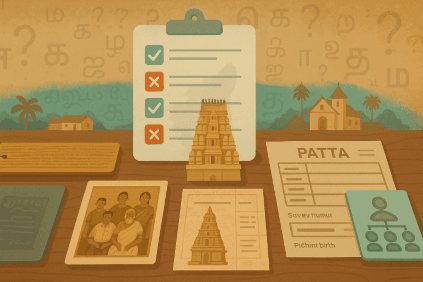
Claims like:
- “We are from a royal lineage”, or
- “Our family is the traditional donor family for that temple”
are extremely common.
The real question is:
“What evidence do we have, and how strong is it?”
This article covers:
- What a “heritage claim” actually is
- Types of evidence and their strengths
- How TamizhConnect thinks about validation (high-level)
- Ethics, including painful histories
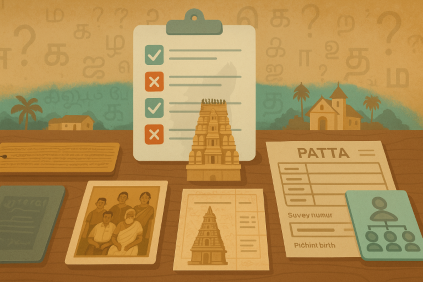
1. Heritage claims: belief vs documented history
A heritage claim is a story of identity and continuity, such as:
- “We come from X village”
- “We served in Y temple”
- “We migrated under Z scheme”
There are always two levels:
- Belief level – family stories, temple myths, pride narratives
- Evidence-backed level – documents, inscriptions, registers, etc.
TamizhConnect’s role is to:
- respect belief,
- highlight evidence when it exists, and
- make the status of each story transparent.
2. Evidence types – not all are equal
2.1. Oral history
Pros:
- captures details that are nowhere else
- includes women’s voices and marginalised experiences
Cons:
- dates and sequences can be fuzzy
- stories are edited over time
Use oral history as:
- a lead, not a final proof.
2.2. Official documents
Examples:
- birth, death, marriage certificates
- school and college certificates
- land and property documents
- ration cards, passports, ID cards
These are strong because they:
- were issued under legal procedures
- tie a name to a place, date and relationship.
TamizhConnect gives such documents high weight,
but still cross-checks where possible,
because errors and forgeries do exist.
2.3. Community and religious records
Examples:
- inscription stones
- temple, church, mosque registers
- old donation boards
These can be valuable but tricky:
- they may reflect local politics, prestige, and exclusions
- verifying them needs someone independent of local conflicts.
They are best treated as supporting evidence,
not as the only pillar.
3. A simplified view of TamizhConnect’s validation logic
(Details are internal, but the broad idea looks like this.)
3.1. Multi-layer matching
Suppose someone claims:
“Person X is Y’s son and lived in Z village
during a certain period.”
TamizhConnect will attempt to match this against:
- ingested e-roll data
- other uploaded documents
- address histories and age ranges.
It then ranks the match:
- high confidence
- medium confidence
- low confidence
Instead of simply saying “true” or “false”.
3.2. Story status, not story deletion
TamizhConnect is designed to:
- keep the story,
- attach a status to it.
Example statuses could be:
- “Heritage story – currently unverified (no linked external records).”
- “Heritage story – partially verified (temple register only).”
- “Heritage story – strongly verified (multiple independent records).”
This lets:
- families keep their narratives alive, and
- researchers see clearly how solid each claim is.
4. DNA kits – useful for some things, limited for Tamil heritage
Many people ask:
“If I take a DNA test, will that prove my Tamil heritage
or my exact lineage?”
In reality:
- consumer DNA tests give you broad region or cluster information,
- they are not designed to prove that:
- your family built a specific temple, or
- you belong to a particular historic house.
From a TamizhConnect standpoint:
- DNA data is extremely sensitive,
- raises serious ethical and legal questions,
- and is not suitable as a primary validation source.
At best, it is one piece of context,
not a certificate of royal or sacred lineage.
5. Ethics: glory and pain are both part of heritage
Heritage is not only about pride.
It also includes:
- caste-based oppression
- land loss and displacement
- bonded labour and indenture
- riots, partition, and migration trauma
TamizhConnect’s design principles therefore include:
- strong user control over what is public vs private
- tools for researchers that discourage:
- sensationalising pain
- extracting stories without giving anything back
Your heritage may contain:
- honourable service,
- difficult compromises,
- and outright injustice.
A responsible platform acknowledges all three,
and makes space for Tamil families to decide how much to show.
In short:
“This is our ancestral story”
is a beautiful starting point. To make it stand as history, you need:
- documents where possible,
- clear labelling of what is known vs believed,
- and tools like TamizhConnect that keep stories and proofs side by side without confusing them.