Tamil Ancestry Research | Family Tree Guide
In this article:
- What “fragmented memory heritage” actually means
- Why Tamil memories and records are so incomplete
- How to work seriously with partial, biased or broken evidence
- Practical methods to capture fragments inside TamizhConnect
- How to document doubt, conflict and silence honestly
1. What “fragmented memory heritage” actually means
Most families imagine “heritage” as:
- neat family trees,
- clean timelines,
- a single story that everyone agrees with.
Reality is the opposite.
For many Tamil families and communities, what we actually have is:
- half-remembered names,
- missing dates and lost documents,
- contradictory stories from different branches,
- silence or shame around caste, gender, politics or migration,
- records written by outsiders (colonial, state, missionary, elite).
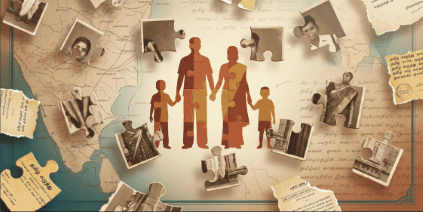
This is fragmented memory heritage:
The pieces of our past that survive in broken, scattered and biased forms – in people’s heads, in forgotten documents, in old photos, in government papers, in rumours and silence.
If you wait for a “perfect” source before you start documenting,
you will never start.
The goal is not perfection.
The goal is to understand the fragments and use them carefully.
2. Why Tamil memories and records are so incomplete
Your family is not uniquely disorganised.
The fragmentation has structural reasons.
2.1. Migration and displacement
- labour migration to Ceylon, Malaya, Burma, Gulf
- urban moves to Chennai, Madurai, Coimbatore, Bombay, Delhi
- partition, riots, wars, emergencies
Each move:
- breaks continuity with older neighbours and kin,
- throws away old papers and local knowledge,
- forces people to simplify their story for new environments.
2.2. Fragile paper culture
For long stretches:
- house documents were kept in tin boxes, not archives,
- floods, fires, insects and simple neglect destroyed material,
- land disputes led to deliberate hiding or destroying of papers.
Many “important” documents existed only once,
on low-quality paper, in one small place.
2.3. Colonial, state and elite bias
Official records were often created for:
- taxation, policing, revenue, control – not for your family’s pride.
So we see:
- caste and land-owning families more visible,
- women, labourers, enslaved and oppressed castes under-recorded,
- names spelled according to colonial ears, not local practice.
Your great-grandmother’s life might be barely visible in paper,
even if she shaped the entire family’s survival.
2.4. Silence, shame and “respectability”
Certain topics are covered deliberately:
- inter-caste relationships
- conversion (or reconversion)
- adoption, non-marital births
- criminalisation, prison, political activity
- mental health, disability, domestic violence
Families rewrite history to look “respectable”.
Over time, this curated version becomes official truth.
Working with fragmented heritage means:
- noticing what is missing,
- asking why it is missing,
- not blindly trusting the “clean” story.
3. How to work responsibly with partial and broken evidence
You cannot magically fix the gaps.
But you can work with them honestly and intelligently.
3.1. Treat each piece as a clue, not the full story
A single document or memory tells you:
- something,
- but never everything.
Train yourself to ask:
- Who created this?
- Why did they record this and not something else?
- Who is absent from this story?
- What might contradict this evidence?
3.2. Keep layers of truth, not one flat version
Instead of forcing everything into one clean narrative, maintain:
- confirmed facts – names, dates, places backed by multiple sources
- probable connections – strongly suggested by stories / context
- hypotheses – carefully worded possibilities
- known gaps – places where we simply do not know
Inside your notes, use phrases like:
- “Probably born between 1920–1925, based on X.”
- “Family says he ‘went to Burma’ – unclear if labour or army.”
- “Some elders claim inter-caste marriage; others deny it. Not resolved.”
Maturity in heritage work = ability to live with uncertainty.
3.3. Respect contradictions without forcing a winner
If two branches of the family tell different versions:
- record both clearly,
- attribute each to a specific person and date:
- “Version A: told by P. Meenakshi (b. 1948) in 2023.”
- “Version B: told by S. Ramesh (b. 1965) in 2024.”
You don’t have to “decide” immediately.
Time, additional sources and future researchers may clarify.
4. Practical methods to capture fragments in TamizhConnect
TamizhConnect is not only for neat trees.
It should be used as a lab for your fragments.
Here’s how.
4.1. Use profiles as containers of fragments
For each person, in addition to name and relationships, add:
- uncertain details:
- “Birth village: maybe Thiruthuraipoondi or nearby.”
- story notes:
- “Said to have worked on tea estates in Ceylon; no documents.”
- local rumours (labelled clearly as such):
- “Reputation: very strict shopkeeper; rumours of lending disputes.”
Treat each profile as a small archive of possibilities, not just facts.
4.2. Attach even low-quality evidence
Do not wait for high-resolution scans and perfect metadata.
Attach:
- blurred photos of old ration cards
- half-torn property documents
- backside of photos with handwritten notes
- screenshots from WhatsApp family groups
- short audio clips of elders talking
Later you can:
- re-scan with better quality,
- transcribe, translate and annotate.
Right now, priority is capturing before it vanishes.
4.3. Use tags for themes, not just people
Examples of useful tags in TamizhConnect:
#migration-burma#migration-ceylon#partition#caste-conflict#conversion#land-dispute#freedom-struggle#domestic-work#plantation-labour
Attach these tags to:
- people
- stories
- documents
Over time you will see patterns:
- “We thought we were a ‘teacher family’, but many were plantation workers.”
- “Multiple branches had land disputes around the same decade.”
4.4. Record exact sources for each statement
Every time you add a non-trivial detail, answer:
- How do I know this?
Record something like:
- “Told by K. Radhakrishnan (b. 1952) on 17 Aug 2024 at Tirunelveli.”
- “From voter list, 1967, Saidapet constituency – name spelled as …”
- “From inscription in Mariamman temple, Kumbakonam, photo attached.”
It takes a few extra seconds.
It multiplies the value of your tree for decades.
5. How to document doubt, conflict and silence honestly
Heritage work without discomfort is fake.
You will touch sensitive nerve endings.
5.1. Separate private notes from sharable stories
Inside TamizhConnect, maintain two layers:
- Internal notes – raw, detailed, sometimes painful facts
- Public or family-facing view – simplified but still honest summary
Example:
- Internal: “Strong evidence of inter-caste marriage; branch later cut off; harsh treatment described by X.”
- Public summary: “There was a controversial marriage in this generation; it led to long-term conflict between branches.”
You are not obliged to expose every detail immediately.
But you also shouldn’t erase it.
5.2. Name power and bias
When you see patterns like:
- women rarely named in documents,
- oppressed-caste relatives appearing only as first names or nicknames,
- labour history absent, landowners over-represented,
say it explicitly in your notes:
- “Records are heavily biased towards male landowners.”
- “No direct information on domestic workers in this household; only hinted in stories.”
This keeps later readers from taking the archive as neutral truth.
5.3. Accept that some gaps will never close
There will be people in your tree for whom you will never know:
- full name,
- exact birth place,
- date of death.
Instead of faking information:
- leave fields empty or approximate,
- add a note explaining the attempts you made,
- and why the gap remains.
This transparency is more respectful – both to the dead and the living.
6. Moving forward with fragmented heritage
You cannot fix the past.
You can refuse to let it disappear silently.
Your next concrete steps:
- Identify 3–5 fragments you already know:
- an old story,
- a rumour,
- a damaged document,
- a mysterious photo.
- Create or update profiles in TamizhConnect for the people involved.
- Attach the fragment with:
- your best interpretation,
- all alternative possibilities,
- source details (who told you, which document).
- Tag the fragment with 2–3 themes (
#migration,#caste,#work, etc.). - Schedule one elder conversation specifically about one fragment:
- “Today I’m only going to ask about that uncle who went to Burma.”
Over years, this discipline turns:
- scattered, fragile fragments
into - a dense, searchable, honest record of Tamil lives.
TamizhConnect cannot magically fill every gap. But it can give you a strong, transparent framework to live with, work with and learn from fragmented memory heritage. Your responsibility is to start documenting – even when it feels incomplete.
Related Articles
Practical research note
When a family memory is fragmented, do not force it into one clean story too early. Keep every clue as a separate note: who said it, when they said it, which place or temple they mentioned, and which part is uncertain. Later, compare those notes against voter rolls, land records, temple references, migration stories, and elder interviews. This preserves uncertainty without losing the clue.