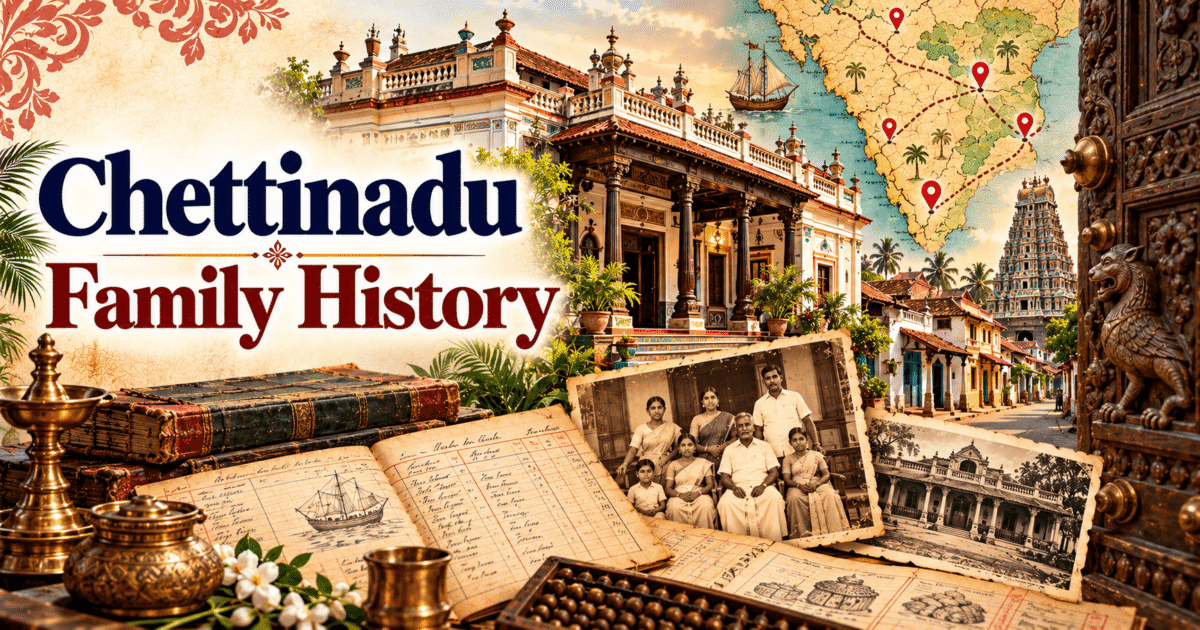
Chettinadu Tamil Ancestry Research | Chettinadu Family Tree Guide
Chettinadu is a region of ~75 villages in Sivagangai and Pudukkottai districts of Tamil Nadu, home to the Nattukottai Chettiar (Nagarathar) merchant-banker community. Nagarathars built the global South-East Asian Tamil financial network from the mid-19th century — operating banking and moneylending firms across Burma, Malaya, Singapore, Sri Lanka, Vietnam, and Mauritius — and the famous Chettinad mansions were funded by remittances from those branches. For genealogy this matters because Nagarathar families kept unusually detailed records: temple donation books, marriage registries maintained by the community’s 96 main temples, ledger books of overseas firms, and the oral tradition of pangali (kin-group) lineages that most non-Chettiar Tamil communities don’t maintain with the same rigour.
In this article:
- What “Chettinadu” actually is – region, community, marketing label
- Nagarathar finance networks and why the mansions exist at all
- Chettinad houses, Athangudi tiles and how to read a building as data
- Food, caste and the labour behind “Chettinad cuisine”
- Migration routes: Burma, Malaya, cities, Gulf and further
- How to record Chettinadu roots in TamizhConnect without lying
- Questions to pressure-test your own “Chettinad heritage”
1. What “Chettinadu” actually is – region, community, marketing label
People throw around:
- “Chettinadu side.”
- “Chettinad food.”
- “Chettiar family from Chettinadu.”
None of that is precise.
Reality:
- Chettinad is a region in Tamil Nadu with roughly 70–80 villages (traditionally 96, about 73 still recognised), spread across today’s Sivaganga and Pudukkottai districts, with Karaikudi as the main town / ‘capital’.
- It is historically associated with the Nagarathar / Nattukottai Chettiar merchant–banker community, who built dense banking and trade networks across South and Southeast Asia.
- Modern tourism and food writing hijack the name to mean:
- big mansions,
- Athangudi tiles,
- “fiery Chettinad chicken”.
Inside TamizhConnect you cannot afford that laziness.
For each person you tag with #chettinadu, you should know:
- which village / theru / nagaram,
- whether they are Nagarathar or from another community,
- how they were connected to money, houses, tiles, labour, or none of the above.
2. Nagarathar finance networks and why the mansions exist at all
The mansions didn’t drop from the sky. They were built on specific money flows.
Basics:
- Nagarathars (Nattukottai Chettiars) are a Tamil mercantile–banking community whose roots are tied to ancient Tamil ports like Kaveripoompattinam and later to Chettinad’s village network.
- By the late 19th and early 20th century they were:
- running indigenous banks and moneylending operations,
- financing plantations and trade across Sri Lanka, Burma, Malaya, Singapore and beyond,
- filling gaps left by European banks in the colonial economy.
If your family is Nagarathar and you never mention:
- hundis, interest rates, partners, foreign branches, political shocks,
you’re telling a fairy tale, not history.
In TamizhConnect, for any serious ancestor in this system, log:
- business type – pawn-broking, trade finance, plantation lending, urban lending, shop credit, etc.
- locations – e.g., “branch in Rangoon”, “office in Penang”, “operations in Kandy”.
- shocks – WWII, nationalisation, anti-Indian policies, licence raj, banking regulation changes.
That’s the backbone behind “Chettinadu wealth”.
3. Chettinad houses, Athangudi tiles and how to read a building as data
Everyone fetishises the houses. Fine. Use that obsession properly.
3.1. What the architecture actually signals
Chettinad mansions are known for:
- long, axial layouts with multiple courtyards,
- facades loaded with stucco work and sometimes dates / initials,
- imported materials: Burma teak, Italian or other marbles, Belgian glass,
- decorative floors including locally-made Athangudi tiles.
Each of those is a clue:
- Teak and marble point to specific trade periods and ports.
- Tiles from Athangudi tie your house to local artisan networks and a 19th–20th century tile industry.
So when you document a house in TamizhConnect:
- note approximate construction and renovation decades,
- list key materials and where they likely came from,
- tie them to known business peaks / migration waves.
3.2. House layout as social map
Don’t just rave about “heritage”.
The layout is a sharp diagram of hierarchy:
- front thinnai / verandah for public and male-facing business,
- series of halls and courtyards for family and guests,
- inner women’s spaces shielded from street view,
- kitchens, wells and service spaces where workers move and live.
In TamizhConnect, for any house that matters:
- sketch the sequence of spaces in text (“street → thinnai → main hall → first courtyard → inner hall → second courtyard → kitchen/service yard”),
- note who used which zones (men, women, workers, children, guests),
- attach photos of inscriptions, door carvings, tiles, well, store rooms.
The house becomes a structured source, not background wallpaper.
3.3. Decay, heritage tourism and partial survival
A lot of Chettinad mansions are now:
- abandoned or underused,
- split between heirs,
- turned into heritage hotels or homestays,
- showcased in festivals meant to revive local crafts and tourism.
You need to log:
- when / why parts of houses were sold or demolished,
- which branches kept what,
- which structures turned into commercial heritage and what that did to local labour and property relations.
4. Food, caste and the labour behind “Chettinad cuisine”
“Chettinad cuisine” is now a global brand. Most of the people saying the phrase have never asked who actually cooked and served.
Facts you can’t dodge:
- Chettinad cuisine is known for fiery, aromatic dishes built from complex masala blends – star anise, kalpasi (black stone flower), marathi moggu, lots of chillies, pepper, fennel, etc.
- The cuisine grew out of:
- the wealth and travel of Chettiar merchants,
- access to spices from trade routes,
- and a domestic setup where cooks and kitchen staff (often from non-Nagarathar, lower and oppressed-caste communities) did the hard work.
So in your archive:
- don’t just record “famous for Chettinad chicken”.
- record who in your line cooked, who supervised, who served, who ate first, and who cleaned.
If your branch ran messes, catering, or marriage kitchens:
- log that explicitly – scale, staff, caste mix, seasonality.
If your branch worked as that labour:
- stop airbrushing it into “hotel side work”; describe the actual tasks and conditions.
5. Migration routes: Burma, Malaya, cities, Gulf and further
Chettinadu is definitionally a region whose money came from outside.
5.1. Colonial-era South/Southeast Asia
The classic pattern:
- Chettiar men moved as financiers and traders to Sri Lanka, Burma (Myanmar), Malaya/Malaysia, Singapore, sometimes beyond, following colonial expansion.
- They ran kittangi / boarding houses and offices, lent to plantations and traders, and remitted profits to Chettinad for houses, temples and education.
You should be recording, for each such migrant:
- destination town (“Rangoon”, “Moulmein”, “Penang”, “Colombo”),
- role (partner, clerk, cashier, runner, junior, agent),
- years active,
- impact of:
- WWII and Japanese occupation,
- independence / nationalisation,
- forced repatriation and confiscations.
5.2. Post-independence and contemporary flows
Later waves include:
- shift from old-style moneylending to:
- modern banking,
- industry and real estate,
- salaried professions;
- moves to Chennai, Bangalore, Mumbai, Delhi for education and business;
- Gulf migration for trade, finance, construction and services;
- global professional migration (US, Europe, Australia).
Non-Nagarathar communities in Chettinadu have their own routes:
- skilled craft workers following construction markets,
- cooks and hospitality workers riding the “Chettinad restaurant” boom,
- casual labour and domestic work in cities and abroad.
In TamizhConnect, for each person:
- break life into migration segments:
Village in Chettinad → Rangoon (banking) → back to Karaikudi (retired, built house)Chettinad village → Chennai (engineering college) → Dubai (engineer) → Canada (PR)
- add approximate years, reasons and documents (passport, visa, appointment letters, ship tickets if you have them).
6. Documenting Chettinadu Heritage in TamizhConnect with Historical Accuracy
"Chettinadu" in your tree should be a structured context, not a decorative tag.
6.1. Per-person minimum fields
For anyone with Chettinadu connection, record:
-
Place
- specific village / town, street / theru, taluk, district, state, country,
- mark explicitly: “Chettinad region; nearest major town: Karaikudi.”
-
Community and role
- Nagarathar or other caste/community,
- work type: banking / trade / craft / cooking / housework / farm / government / professional,
- owner/partner vs worker/employee vs contract labour.
-
House or no house
- if associated with a notable mansion/house:
- house name, street, layout sketch, key features, current status,
- if not:
- record that plainly – “lived in rented quarters / small house behind X mansion”, etc.
- if associated with a notable mansion/house:
-
Business / labour context
- what money activity they were part of: hundi, pawn-broking, shop trade, food supply, tile work, carpentry, cleaning, etc.,
- which towns or countries those activities tied into.
-
Migration segments
- each move captured with
from,to,approx years,reason,source of information.
- each move captured with
-
Caste and labour notes (PRIVATE)
- who worked for this branch and under what conditions,
- which communities were systematically above or below them in the local hierarchy,
- any known conflicts, strikes, social reforms.
6.2. Tagging strategy
Use multiple tags, not just #chettinadu:
#chettinadu/#karaikudi#nagarathar/#chettiar#chettinad-house/#athangudi-tiles/#burma-teak#merchant-banking/#moneylending/#south-east-asia-trade#chettinad-cuisine/#kitchen-labour#burma-migration/#malaya-migration/#sri-lanka-migration/#gulf-migration/#city-migration#craft-workers/#tile-makers/#carpenters/#domestic-workers
Tag:
- people,
- houses,
- stories,
- documents (deeds, partnership papers, temple receipts, bank letters, passports).
That’s how you get meaningful pattern search later.
7. Critical Questions to Validate Your Family’s Chettinad Heritage
If someone in your family says "We’re from Chettinadu", don’t treat it as a full answer.
7.1. Place and house
- “Exactly which village, which theru, which kovil cluster?”
- “Did our family actually own a big house, or live in a smaller place behind/beside one?”
- “What’s the house name? When was it built? Has it been sold, partitioned, converted?”
7.2. Money and work
- “What was the first money-making activity we can prove – lending, trade, crafts, labour, service?”
- “Which towns and countries were we seriously connected to, and through what work?”
- “Who did the accounting, who travelled, who stayed back to run the house and local obligations?”
7.3. Labour and neighbours
- “Which communities worked in our kitchens, houses, fields, tile yards, or shops?”
- “What did they actually do, and how were they treated and paid?”
- “Did we ever have union disputes, wage conflicts, or social reform attempts?”
7.4. Collapse and change
- “Which events hit us hardest – war, nationalisation, business failures, tax, court cases, policy changes?”
- “What exactly did we lose – houses, branches, land, status?”
- “Who adapted how – moved into jobs, moved abroad, married out, or fell into debt?”
Then:
- Create or update the relevant profiles in TamizhConnect.
- Fill in:
- precise Chettinadu locations,
- house details (or the lack of one),
- finance / work / labour context,
- migration segments and shocks.
- Attach:
- photos of houses and tiles,
- land and partnership deeds,
- temple and trust records,
- passports, shipping papers, bank letters.
- Tag properly with
#chettinaduplus specific context tags.
Do that and “Chettinadu” stops being a food brand and heritage wallpaper.
It becomes a usable record of how trade, houses, caste and labour actually built – and sometimes broke – your family.