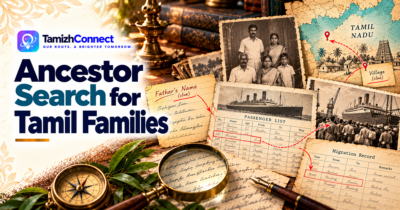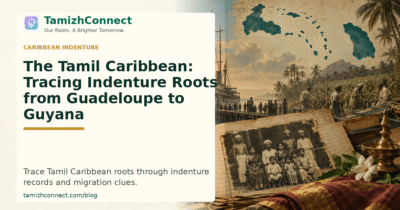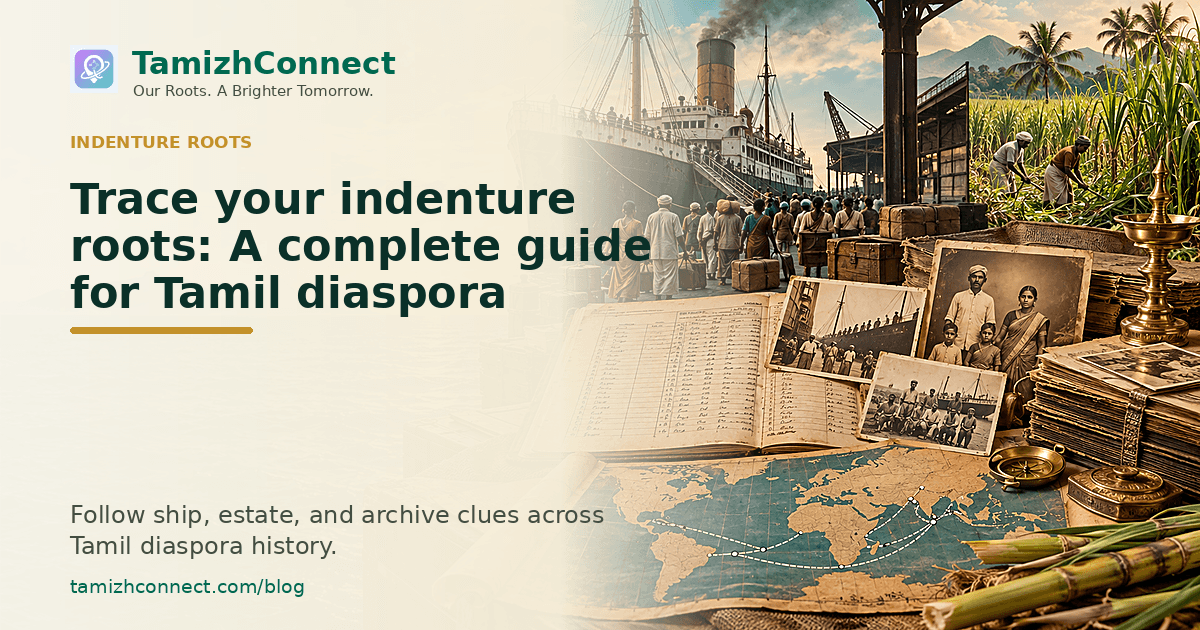
Trace Your Indenture Roots: A Complete Guide for Tamil Diaspora
If your Tamil family migrated during the indenture period (1834–1917), you have one of the best-documented paper trails in genealogy. The indenture system created detailed records that can help you trace your roots back to specific villages in Tamil Nadu.
This guide shows you exactly how to use those records.
Related: Indentured Labour Records | Tamil Ancestry Research
Why Indenture Records Are Powerful
Unlike many other migration systems, indenture produced individual-level documentation:
- Immigration Passes – Name, age, caste, father’s/husband’s name, district, village
- Depot Registers – Registration details before departure
- Ship Manifests – Voyage records with passenger lists
- Return Certificates – Records of those who returned to India
- Plantation Records – Work assignments and settlements
Each document contains geographic anchors that can lead you back to your ancestral village.
Step 1: Start with Family Oral History
Before diving into archives, gather what your family remembers:
- Which country did your ancestors settle in? (Mauritius, Trinidad, Guyana, Fiji, South Africa, etc.)
- Any remembered names of great-grandparents or ancestors?
- Any village names, even partial or mispronounced?
- Approximate time period of migration?
- Family surname or initials that might indicate a place?
Tip: Even fragmented information like "from Madras" or "near Trichy" is valuable.
Step 2: Locate Immigration Passes
Immigration passes are the gold standard for indenture research. They typically include:
| Field | Why It Matters |
|---|---|
| Name | May show original Tamil spelling |
| Age | Helps identify generation |
| Caste | Can narrow down geographic region |
| Father’s/Husband’s Name | Critical for lineage |
| District | Narrows search to specific area |
| Village | Direct link to ancestral location |
Where to Find Immigration Passes
- Mauritius: Aapravasi Ghat Trust Fund archives
- Trinidad & Tobago: National Archives of Trinidad and Tobago
- Guyana: National Archives of Guyana
- Fiji: Fiji National Archives
- South Africa: KwaZulu-Natal Archives (Pietermaritzburg)
- Online: Indianindenture.com, FamilySearch collections
Step 3: Decode Village Names
Village names in indenture records often appear in anglicized or phonetic forms:
- "Trichinopoly" → Tiruchirappalli
- "Tanjore" → Thanjavur
- "Chingleput" → Chengalpattu
- "North Arcot" → Vellore/Ranipet
- "South Arcot" → Villupuram/Cuddalore
Strategy:
- Note the district first
- Search for phonetic variants of the village name
- Cross-reference with modern district gazetteers
- Use Tamil Nadu Gazetteers for historical boundaries
Step 4: Use Depot Registers
Before boarding ships, indentured labourers were registered at depots in Madras (Chennai), Puducherry, or Karaikal. These registers contain:
- Registration number
- Date of registration
- Recruiter’s name
- Origin district and village
- Physical description (sometimes)
Depot registers can fill gaps when immigration passes are missing.
Step 5: Track Return Certificates
Approximately 25–40% of indentured labourers returned to India. Return certificates document:
- Name and registration number
- Ship and date of return
- Amount of money saved
- Intended destination in India
If your ancestor returned, this record pinpoints their final destination village.
Step 6: Cross-Reference with Electoral Rolls
Once you have a village name and family names, use Tamil Nadu Electoral Rolls to:
- Find living relatives still in the village
- Verify family name spellings
- Track address changes over generations
- Reconstruct household clusters
Step 7: Connect with Village Records
With a confirmed village name, you can explore:
- Patta documents – Land ownership records (Guide)
- Temple records – Donations, rituals, family connections (Guide)
- Local genealogies – Some villages maintain family trees
Common Challenges and Solutions
Challenge: Name Variants
Solution: Search multiple spellings. "Ramasamy" may appear as "Ramaswamy", "Ramasami", or "Ramassamy".
Challenge: Missing Village Names
Solution: Use district + caste combinations to narrow down. Some castes are highly localized.
Challenge: Incomplete Records
Solution: Cross-reference multiple sources. Ship manifests may have details missing from immigration passes.
Research Workflow Summary
1. Gather family oral history
2. Search immigration passes by country
3. Extract name, district, village, father's name
4. Decode anglicized place names
5. Check depot registers for additional details
6. Search return certificates (if applicable)
7. Cross-reference with Tamil Nadu electoral rolls
8. Contact village records/relatives
Tools and Resources
- TamizhConnect – Link records across generations and geographies
- Indianindenture.com – Searchable indenture database
- FamilySearch – Free genealogy platform with indenture collections
- Tamil Nadu Archives – Official state records
- National Archives (by country) – Local indenture collections
Next Steps
Once you’ve identified your ancestral village:
- Document all findings with source citations
- Create a family tree linking diaspora to India
- Share findings with family members
- Consider visiting the village if possible
- Add your story to community genealogy projects
Continue your research:
Have indenture records from your family? Share your discoveries to help other Tamil families trace their roots.