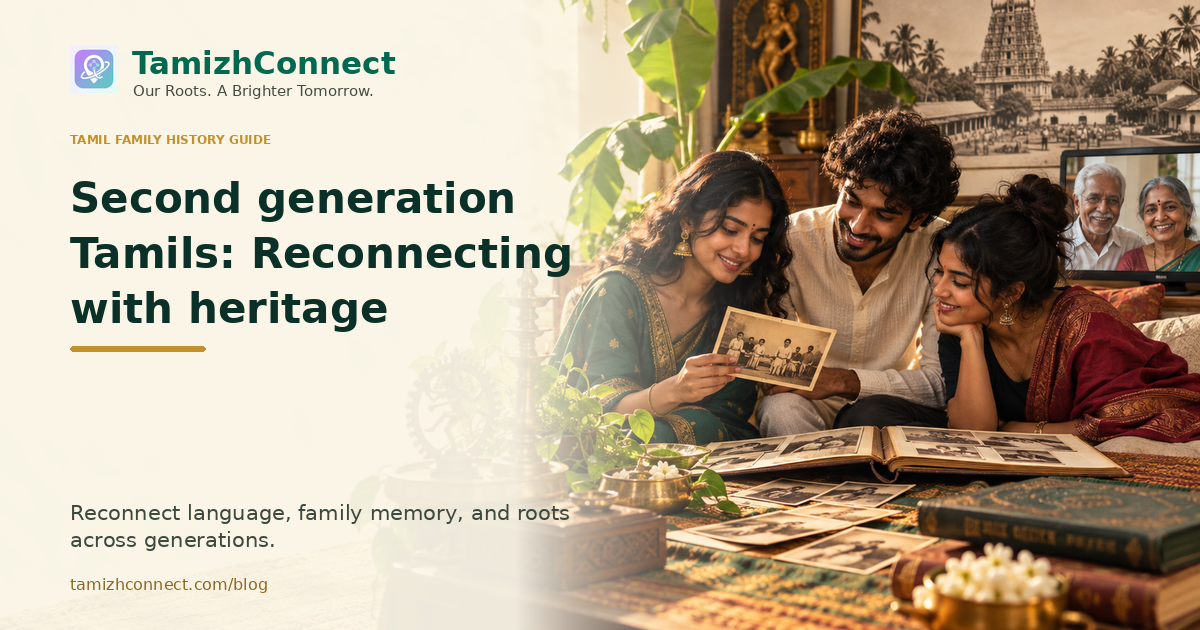
Second Generation Tamils: Reconnecting with Heritage & Family Roots
As a second-generation Tamil growing up in the diaspora, you occupy a unique position between worlds. You may be fluent in English and integrated into your host country’s society, but there’s often a persistent feeling of incompleteness—a sense that a significant part of your heritage and identity remains just beyond your grasp. The journey to reconnect with your Tamil roots is both deeply personal and universally relevant to the millions of second-generation Tamils worldwide who grapple with questions of cultural identity, language fluency, and ancestral connections.
This comprehensive guide explores practical strategies for second-generation Tamils to rebuild meaningful connections with their Tamil heritage while maintaining their modern identity. The process of reconnecting with your roots is neither a return to the past nor a rejection of your present—it’s the integration of your full identity, honoring both your immigrant parents’ sacrifices and your own contemporary experiences.
Whether you grew up in London, Toronto, Sydney, Singapore, Dubai, or dozens of other global cities, the path to Tamil cultural reconnection involves understanding your unique position as a bridge between the old world and the new. Your journey may begin with simple curiosity about your parents’ stories or deepen into a comprehensive exploration of Tamil literature, philosophy, and family history.
1. Understanding Your Second-Generation Position in Tamil History
The second-generation Tamil experience represents a crucial chapter in Tamil diaspora history. You are the products of your parents’ courage to migrate, work, and preserve cultural values while raising children in foreign environments. Understanding this historical context provides perspective on both the challenges and opportunities you face in reconnecting with your roots.
1.1 The Unique Challenges of Second-Generation Identity
Language Disruption:
- Passive comprehension without active expression abilities
- Code-switching patterns that mix Tamil vocabulary with English grammar
- Formal vs. informal Tamil gaps where basic communication exists but formal language skills are missing
- Reading and writing deficits in Tamil script despite some speaking ability
- Cultural expression gaps where you understand concepts but lack the precise vocabulary to express them
Cultural Disconnection:
- Village origin ignorance: Uncertainty about specific ancestral locations
- Family history gaps: Limited knowledge about grandparents and early family members
- Religious practice confusion: Understanding of basic customs but uncertainty about deeper meanings
- Social custom ambiguity: Knowing "we do this" but not "why we do this"
- Regional dialect differences: Unawareness of differences between South Indian, Sri Lankan, and diaspora Tamil usage
Identity Navigation:
- Dual belonging challenges: Feeling somewhat foreign in both Tamil and host countries
- Generational expectations: Balancing parents’ traditional expectations with contemporary values
- Professional identity: Maintaining cultural identity while excelling in global workplaces
- Marriage and relationship decisions: Navigating between family preferences and personal choice
- Cultural transmission: Considering how to pass traditions to your own children
1.2 The Strengths of Your Position
Despite these challenges, second-generation Tamils possess unique strengths:
Cultural Synthesis Abilities:
- Cross-cultural competency: Natural understanding of both Tamil and host country contexts
- Language bridge capabilities: Ability to translate between Tamil and English speakers
- Modern perspective: Fresh eyes to identify which traditions serve contemporary families
- Technological fluency: Advantage in using digital tools for heritage research and preservation
- Global network access: Connections to Tamil families across multiple countries and continents
Personal Agency:
- Choice-based identity: Ability to embrace Tamil heritage by choice rather than by obligation
- Selective preservation: Capacity to maintain valuable traditions while discarding limiting ones
- Innovation potential: Freedom to adapt Tamil practices to modern contexts
- Research skills: Access to genealogical and cultural resources unavailable to previous generations
- Community building: Opportunity to create new Tamil organizations and connections
2. Language Reclamation: Starting Your Tamil Learning Journey
Reclaiming Tamil language skills is often the most challenging but rewarding aspect of cultural reconnection. The approach to language learning as an adult is fundamentally different from child acquisition, but your cognitive advantages make you capable of rapid progress with the right methods.
2.1 Assessment and Goal Setting
Evaluate current Tamil proficiency:
- Listening comprehension: Can you understand conversations with parents/elders?
- Speaking comfort: Do you feel comfortable expressing emotions, complex thoughts, or abstract concepts?
- Reading ability: Can you read Tamil script, identify basic words, or comprehend texts?
- Writing capability: Are you able to write simple sentences, formal letters, or personal communication?
- Cultural vocabulary: Do you know specific terms for customs, festivals, relationships, and values?
Define realistic learning objectives:
- Conversational Tamil: Prioritize basic communication with relatives and community members
- Heritage Tamil: Focus on vocabulary needed for understanding family stories and traditions
- Academic Tamil: Pursue formal grammar and literary language for deeper cultural understanding
- Professional Tamil: Develop skills for business or professional contexts where needed
- Religious Tamil: Learn specific vocabulary for understanding prayers, religious texts, and customs
2.2 Practical Learning Strategies
Immersion and Practice:
- Home environment modifications: Dedicate specific times and spaces for Tamil use in your household
- Media consumption: Watch Tamil films, listen to Tamil podcasts, and read Tamil news sources
- Community engagement: Attend local Tamil cultural organizations, temples, and festivals
- Family conversations: Schedule regular conversations with Tamil-speaking relatives
- Technology utilization: Use language learning apps, Tamil input methods, and digital resources
Structured Learning Approaches:
- Online courses: Enroll in formal Tamil language classes offered by community organizations
- Private tutoring: Arrange one-on-one lessons with Tamil teachers who understand adult learners
- Cultural immersion: Plan trips to Tamil-speaking regions for intensive language exposure
- Peer groups: Form study groups with other second-generation Tamils pursuing similar goals
- Practice partnerships: Connect with native speakers for regular conversation practice
2.3 Technology-Assisted Language Learning
Digital Tools for Tamil Acquisition:
- Tamil keyboard apps: Enable typing in Tamil for mobile and computer use
- Tamil OCR tools: Convert scanned documents and images to readable Tamil text
- Voice recognition: Use Tamil voice assistants and voice-to-text features
- Translation services: Use Tamil-English translation for comprehension and verification
- Audio resources: Access Tamil pronunciation guides and listening practice materials
Language Exchange Platforms:
- Online communities: Join Tamil language learning groups and forums
- Video calls: Practice with elderly relatives or native speakers via video chat
- Cultural content streaming: Access Tamil content with subtitles to improve listening skills
- Social media: Engage with Tamil cultural accounts and community platforms
- Messaging applications: Send and receive messages in Tamil to build fluency
3. Family History Research: Connecting with Ancestral Roots
Reconnecting with your family’s history is a powerful way to understand your place in the broader Tamil narrative and gain insights into the migration stories that brought your family to their current location.
3.1 Documentation and Memory Gathering
Primary source collection:
- Elder interviews: Record conversations with grandparents and aging relatives about their lives
- Family documents: Collect birth certificates, marriage certificates, and immigration papers
- Photographs: Gather family photos from different time periods and locations
- Letters and correspondence: Preserve family letters, greeting cards, and written communications
- Religious records: Access temple and church records that document family histories
Oral history techniques:
- Gentle questioning: Ask elders about daily life, experiences, and family stories without being intrusive
- Story mapping: Connect personal experiences to historical events and broader migration patterns
- Cultural context: Understand the meaning behind family traditions, customs, and practices
- Geographic connections: Learn about ancestral villages, towns, and regions that shaped your family
Example interview questions:
- "What was your village or town like when you were young?"
- "How did your parents meet and marry?"
- "What brought your family to this country?"
- "What are the stories about our family that I should remember?"
- "Are there specific places in our ancestral region that our family is associated with?"
3.2 Genealogical Research Tools and Techniques
Digital platforms for Tamil genealogy:
- TamizhConnect family trees: Systematically document family relationships and connections
- Collaborative research: Work with relatives worldwide to build comprehensive family records
- Geographic mapping: Track family movement across different regions and countries
- Historical context: Understand political, economic, and social factors that influenced family migrations
- Documentation verification: Cross-reference family stories with historical records
Research strategies:
- Start with known relatives: Build from verified information outward to unknown connections
- Focus on migration patterns: Understand the routes and reasons your family moved
- Connect to village origins: Research ancestral villages and regional identities
- Validate stories: Confirm family legends with available records and documentation
- Preserve uncertainty: Note what remains unknown rather than fabricating details
3.3 Identity Mapping and Cultural Discovery
Understanding your ancestral regions:
- Geographic origins: Learn about specific districts, villages, and regions associated with your family
- Historical context: Understand the economic, political, and social conditions in your ancestral areas
- Cultural practices: Discover regional variations in traditions, festivals, and customs
- Language variations: Recognize local dialects, accents, and cultural expressions
- Caste and community connections: Understand traditional social structures and relationships
Family branch exploration:
- Multiple family lines: Research both maternal and paternal sides of your family
- International connections: Connect with relatives in Tamil Nadu, Sri Lanka, Malaysia, and other countries
- Migration generations: Understand which generations experienced different cultural contexts
- Cultural evolution: Track how family traditions changed across different countries and generations
- Shared heritage: Identify common cultural elements that connect various family branches
4. Cultural Practices and Traditions: Selective Reconnection
Reconnecting with Tamil culture involves understanding both the "what" and "why" of traditional practices, allowing you to choose which elements to incorporate into your modern life based on their meaning and relevance.
4.1 Festival and Religious Observance
Festival participation and understanding:
- Pongal: Understanding the harvest celebration’s significance and your family’s specific traditions
- Deepavali: Learning the religious and cultural meanings beyond surface-level celebrations
- Tamil New Year: Participating in cultural renewal and traditional observances
- Family-specific celebrations: Understanding traditions unique to your family or region
- Regional variations: Appreciating how different Tamil regions celebrate the same festivals
Religious practice integration:
- Temple visits: Understanding temple customs, appropriate behavior, and spiritual significance
- Prayer practices: Learning family-specific prayer traditions and their meanings
- Ritual participation: Engaging meaningfully in life-cycle ceremonies and religious observances
- Cultural context: Connecting religious practices to broader Tamil cultural patterns
- Personal relevance: Finding meaning in traditions that resonate with your values
4.2 Culinary Heritage and Food Connections
Traditional cuisine exploration:
- Family recipes: Learning recipes from your parents’ or grandparents’ regions
- Regional specialties: Understanding differences between Chettinad, Kongu Nadu, and other regional cuisines
- Festival foods: Preparing special dishes for specific occasions and celebrations
- Ingredient sourcing: Finding authentic Tamil ingredients in your local area
- Cooking techniques: Mastering traditional preparation methods and equipment
Food as cultural transmission:
- Storytelling through meals: Understanding the stories and significance behind specific dishes
- Intergenerational knowledge: Learning cooking from elders and preserving family techniques
- Adaptation and innovation: Modifying traditional recipes for modern kitchens and dietary preferences
- Community building: Sharing traditional foods to connect with other Tamil families
- Cultural preservation: Ensuring that food traditions survive in your own family
4.3 Arts, Literature, and Cultural Expression
Classical arts appreciation:
- Bharatanatyam: Understanding the cultural and spiritual significance of traditional dance
- Carnatic music: Learning about classical music traditions and their cultural context
- Literary traditions: Exploring Tamil literature from Sangam poetry to contemporary works
- Film appreciation: Understanding Tamil cinema as a cultural expression and historical record
- Folk traditions: Engaging with traditional songs, stories, and regional art forms
Cultural preservation through participation:
- Learning traditional instruments: Participating in classical music or folk traditions
- Attending cultural events: Supporting and participating in Tamil cultural programs
- Story retelling: Keeping traditional stories alive by sharing them with younger family members
- Cultural mentorship: Finding teachers to guide in traditional arts and practices
- Modern adaptation: Applying traditional cultural values to contemporary contexts
5. Identity Formation and Intergenerational Communication
Building a confident Tamil identity as a second-generation person involves reconciling different cultural elements while respecting both your parents’ experiences and your own contemporary reality.
5.1 Navigating Generational Differences
Communication strategies:
- Active listening: Creating space for parents to share their experiences without judgment
- Cultural context seeking: Asking questions about the historical and social context of family decisions
- Respectful dialogue: Discussing differences in values and expectations with mutual respect
- Bridging roles: Serving as cultural translator between generations
- Validation practices: Acknowledging the validity of both traditional and modern perspectives
Understanding parental motivations:
- Migration experiences: Recognizing the sacrifices and challenges your parents faced
- Cultural preservation goals: Understanding why certain traditions seemed essential to them
- Economic pressures: Appreciating the financial and professional challenges they navigated
- Identity concerns: Recognizing their fears about cultural loss and assimilation
- Future hopes: Understanding their aspirations for your success and happiness
5.2 Creating Your Own Cultural Identity
Selective tradition adoption:
- Value-based evaluation: Choosing traditions based on their personal meaning and family values
- Modern adaptation: Modifying practices to fit contemporary family situations
- Personal relevance: Maintaining traditions that have emotional or spiritual significance
- Practical consideration: Evaluating traditions based on their feasibility in your life context
- Cultural authenticity: Ensuring that adopted practices maintain their essential meaning
Balancing multiple identities:
- Professional identity: Maintaining success in global workplaces while honoring Tamil values
- Community connections: Participating in both Tamil and general community activities
- Relationship choices: Making marriage and friendship decisions that respect both cultures
- Parenting decisions: Determining how to raise your own children with Tamil connections
- Cultural expression: Finding appropriate ways to share Tamil culture with non-Tamil friends and colleagues
5.3 Building Intergenerational Bridges
Creating shared experiences:
- Joint activities: Participating in cultural events together with parents and elders
- Learning exchanges: Teaching parents about modern technology while learning traditions from them
- Travel together: Visiting ancestral regions with elder family members to share the experience
- Documentation projects: Working together to preserve family stories and cultural knowledge
- Cultural transmission: Ensuring that valuable knowledge passes to your own children
Resolving cultural conflicts:
- Compromise approaches: Finding middle ground between traditional and modern values
- Explanation and education: Helping parents understand contemporary contexts for modern choices
- Mutual respect: Maintaining respect for traditional values while asserting contemporary priorities
- Communication improvements: Developing better ways to discuss cultural differences constructively
- Shared values identification: Finding common ground in values that transcend generational differences
6. Technology and Digital Tools for Heritage Maintenance
Modern technology provides unprecedented opportunities for second-generation Tamils to explore, preserve, and share their heritage across geographic and generational boundaries.
6.1 Digital Family Tree and Genealogy Platforms
Using platforms like TamizhConnect:
- Family connection: Linking relatives across different countries and continents
- Historical mapping: Tracking family migration patterns and geographic distribution
- Story preservation: Recording family stories, traditions, and cultural practices
- Photograph archives: Preserving visual memories across multiple generations
- Collaborative research: Working with relatives worldwide to build comprehensive records
Maximizing digital tools:
- Regular updates: Maintaining current information about family members
- Media integration: Adding photographs, audio recordings, and video content
- Document storage: Preserving important family documents digitally
- Communication facilitation: Using platforms to connect family members across distances
- Cultural context: Adding explanations for traditions, places, and cultural references
6.2 Online Cultural Resources
Accessing Tamil culture digitally:
- Educational materials: Online Tamil language courses, grammar guides, and learning resources
- Cultural content: Streaming Tamil films, music, TV shows, and news programs
- Literary resources: Accessing Tamil literature, poetry, and classical texts online
- Religious materials: Finding devotional songs, prayers, and religious content
- Community platforms: Joining online Tamil communities for support and connection
Digital preservation:
- Audio recordings: Preserving elders’ voices and stories before they’re lost
- Video documentation: Recording cultural practices, festivals, and family events
- Scanned documents: Digitally preserving historical documents and photographs
- Tamil script: Learning to read and write in Tamil using digital tools
- Cultural mapping: Using GPS and mapping tools to locate ancestral places and family connections
7. Practical Steps for Reconnection
7.1 Immediate Actions for Second-Generation Tamils
Week 1-2: Assessment and Foundation
- Inventory current knowledge: Write down everything you know about your family history, origins, and traditions
- Engage with elders: Schedule time to have meaningful conversations with grandparents and older relatives
- Create a learning plan: Identify specific Tamil language and cultural goals for the next six months
- Research family origins: Use available information to identify ancestral villages and regions
- Join cultural groups: Find local Tamil associations, temples, or cultural organizations
Month 1-3: Active Engagement
- Begin language lessons: Start formal or informal Tamil learning with consistent practice
- Gather family documents: Collect birth certificates, photos, and other family records
- Visit cultural events: Attend festivals, temple events, and cultural programs in your area
- Cook traditional foods: Try preparing traditional Tamil dishes with family guidance
- Begin genealogy research: Start building your family tree with available information
Month 3-6: Deepening Connections
- Plan ancestral visits: Organize a trip to visit family origins in Tamil Nadu or Sri Lanka if possible
- Expand language skills: Focus on reading and writing Tamil script and engaging in longer conversations
- Participate actively: Take on roles in cultural organizations or volunteer activities
- Document discoveries: Record new information about your family history and cultural background
- Connect with relatives: Reach out to unknown family members in other countries
7.2 Long-term Integration Strategies
Annual commitments:
- Festival participation: Actively participate in major Tamil festivals and community events
- Family history updates: Annually update family trees and interview elders about new information
- Language advancement: Continuously improve Tamil language skills with advanced learning
- Cultural education: Attend workshops, classes, or cultural programs annually
- Heritage travel: Plan regular visits to Tamil-speaking areas to maintain connection
Multi-generational planning:
- Family traditions: Develop traditions that honor heritage while fitting modern life
- Cultural transmission: Consider how to pass knowledge to your own children
- Community involvement: Participate in organizations that serve next-generation Tamils
- Documentation maintenance: Ensure that family records and stories remain accessible to future generations
- Cultural preservation: Support institutions that maintain Tamil language, arts, and traditions
8. Challenges and Solutions
8.1 Common Obstacles in Cultural Reconnection
Time constraints:
- Solution: Integrate Tamil activities into existing routines rather than adding new time commitments
- Strategy: Practice Tamil during commutes, meals, or other regular activities
- Approach: Set realistic weekly goals rather than overwhelming daily targets
Family resistance:
- Solution: Approach cultural learning as personal enrichment rather than criticism of family choices
- Strategy: Frame learning as honoring parental sacrifices rather than rejecting their adaptation
- Approach: Find areas of common interest that bridge traditional and contemporary values
Lack of resources:
- Solution: Use online resources and digital tools when local resources are limited
- Strategy: Connect with Tamil communities in nearby cities or online
- Approach: Start with available family members before seeking external resources
8.2 Sustaining Interest and Motivation
Creating accountability:
- Learning partnerships: Partner with other second-generation Tamils for mutual support
- Regular check-ins: Schedule periodic assessments to measure progress
- Goal setting: Establish clear, measurable objectives for cultural learning
- Celebration of milestones: Acknowledge achievements in language and cultural learning
Maintaining momentum:
- Progressive challenges: Gradually increase difficulty and complexity of learning activities
- Variety in approach: Use multiple methods to maintain engagement and interest
- Practical application: Find real-world opportunities to use Tamil language and cultural knowledge
- Community connection: Stay engaged with Tamil communities for ongoing support and opportunity
9. Creating a Sustainable Heritage Plan
9.1 Personal Heritage Goals
Short-term objectives (6 months to 1 year):
- Achieve conversational Tamil fluency with family members
- Document at least three generations of your family history
- Learn to read basic Tamil script
- Participate in two major Tamil cultural events
- Connect with unknown relatives in other countries
Medium-term objectives (1-3 years):
- Visit ancestral locations in Tamil Nadu or Sri Lanka
- Read classical Tamil literature in original or translation
- Prepare traditional meals independently
- Lead family cultural activities or ceremonies
- Mentor other second-generation Tamils in their reconnection journey
Long-term objectives (3-5 years):
- Achieve reading fluency in classical Tamil texts
- Contribute to Tamil cultural organizations as a leader
- Successfully transmit Tamil heritage to your own children
- Document your family’s complete migration history
- Preserve family history in published or digital format for future generations
9.2 Community Building and Leadership
Developing cultural competency:
- Mentorship roles: Help other second-generation Tamils reconnect with their heritage
- Leadership positions: Take on roles in Tamil organizations and community groups
- Educational initiatives: Create programs or resources for Tamil heritage learning
- Preservation efforts: Contribute to efforts to maintain Tamil language and culture
- Bridge building: Connect Tamil communities with broader society in your host country
Conclusion: Second-Generation Tamil Heritage Reconnection
Reconnecting with Tamil heritage as a second-generation person is a journey of self-discovery, cultural appreciation, and intergenerational healing. It’s not about becoming "more Tamil" or "less Western"—it’s about achieving wholeness by embracing all aspects of your identity with equal pride and understanding.
The path to cultural reconnection is unique for each individual, and your approach should reflect your personal circumstances, interests, and goals. Some may focus primarily on language acquisition, others on family history research, and still others on cultural practices and traditions. The important element is consistent engagement with your heritage rather than passive disconnection.
Remember that your parents’ generation made enormous sacrifices to provide you with opportunities in your host country, and their decision to prioritize English education and integration was made with your future success in mind. Reconnecting with Tamil heritage is not a rejection of their choices but an expansion of the identity they gave you—a way to honor their sacrifices by maintaining the cultural richness that was part of their identity.
The Tamil civilization has survived for over 2,000 years by adapting to changing circumstances while maintaining its essential values and identity. Your generation faces the same challenge: how to maintain Tamil identity and values in a globalized world. By taking control of your heritage learning and creating your own path to cultural connection, you’re participating in this ancient tradition of cultural adaptation and preservation.
Technology, community resources, and global Tamil networks provide unprecedented opportunities for heritage connection that previous generations could never have imagined. Use these tools wisely to build bridges between your family’s past and your family’s future, ensuring that the Tamil cultural chain remains unbroken through your generation.
Most importantly, remember that cultural reconnection is a lifelong journey, not a destination. It’s natural to face setbacks, lose momentum, or encounter obstacles. The key is to maintain a long-term perspective and view this as an ongoing relationship with your heritage rather than a finite project with a clear endpoint.
Your unique position as a second-generation Tamil allows you to serve as a bridge between worlds—honoring your ancestors while building a path forward for future generations. This is both an honor and a responsibility that carries forward one of the world’s most ancient living cultures.
To continue your Tamil heritage journey, consider exploring resources on Tamil language and identity, tracing your Tamil ancestry, or discovering your ancestral village. Our family tree builder provides specialized tools designed to help second-generation Tamils document and explore their complex cultural heritage while connecting with relatives across multiple countries and generations.
The time to begin this journey is now, before opportunities to learn directly from elder generations are lost forever.