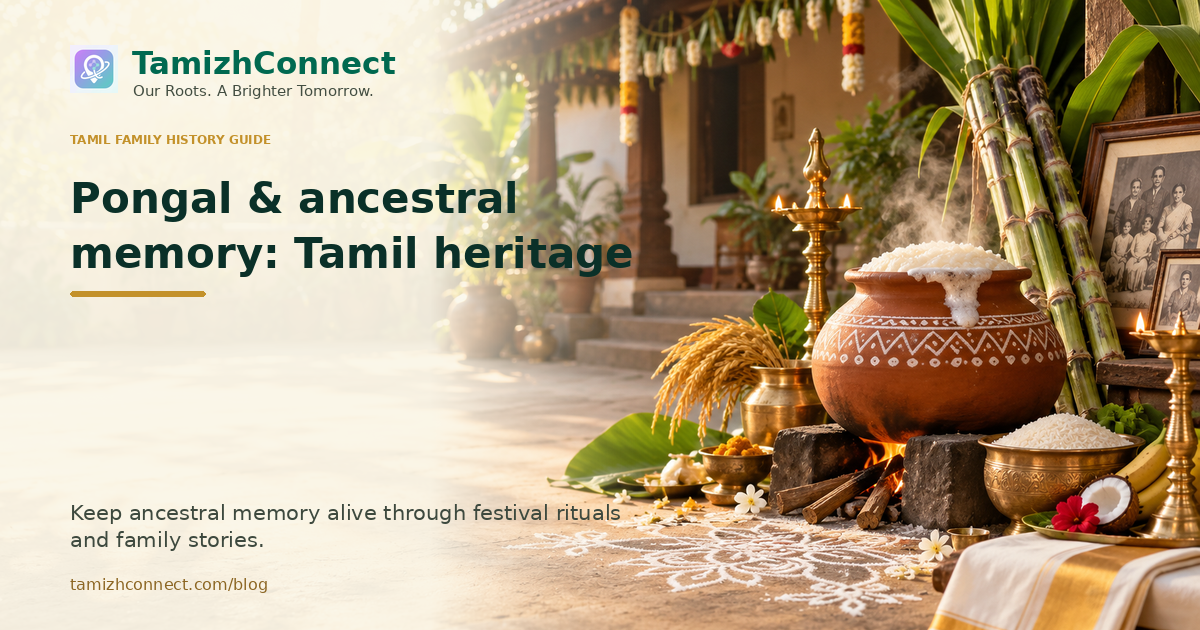
Overview: Pongal & Ancestral Memory: Preserving Tamil Heritage
Among Tamil festivals, none provides a more powerful opportunity for genealogical research than Pongal. This four-day harvest celebration serves as a natural catalyst for ancestral memory sharing, when Tamil families worldwide gather to celebrate and inadvertently reveal precious details about their origins, migration patterns, and cultural heritage.
Pongal represents more than agricultural thanksgiving—it’s a structured opportunity for Tamil families to document their heritage while respecting the festival’s spiritual and cultural significance. The four-day celebration, with its distinct observances, naturally triggers memories about ancestral villages, family migrations, and traditional practices that remain dormant for most of the year.
For Tamil families serious about preserving their heritage, Pongal provides an ideal environment for collecting ancestral information because it combines:
- Family congregation: Multiple generations gathered in one place
- Cultural context: Ancestors and traditions are naturally part of the celebration
- Open storytelling: Elders are disposed toward sharing memories of "the old days"
- Temporal permission: The festival creates a natural time and space for reflection
Understanding Pongal’s Unique Documentation Potential
The four-day Pongal celebration creates distinct opportunities for collecting different types of ancestral information that connect to specific aspects of Tamil heritage:
- Bhogi Day: Triggers memories about material heritage and village life
- Thai Pongal Day: Connects families to agricultural heritage and land relationships
- Mattu Pongal Day: Reveals livelihood traditions and economic identity
- Kaanum Pongal Day: Unlocks social networks and migration patterns
By understanding these connections, families can structure their documentation efforts to maximize the ancestral information gathered during the festival while maintaining its spiritual significance.
Understanding Pongal’s Four-Day Framework for Memory Collection
The four-day Pongal celebration creates distinct opportunities for collecting different types of ancestral information:
Day 1 – Bhogi: Material Heritage and Village Memory
Bhogi represents renewal and purification, focusing on discarding old items and celebrating new beginnings. This ritual of elimination and renewal creates powerful psychological connections to the past:
Cultural significance:
- Symbolic renewal: Removing physical and metaphorical obstacles from the past year
- Ancestral gratitude: Honoring the wisdom and sacrifices that sustained the family
- Village connections: Reflecting on traditions and practices from origin communities
- Material heritage: Appreciating objects and traditions that carried cultural identity through generations
Genealogical opportunities:
- Material preservation: Items from origin villages that were cherished and maintained
- Customs evolution: Practices that changed due to circumstances or choice
- Migration context: Circumstances that led to leaving ancestral homes
- Village descriptions: Physical details of original homes and environments
Strategic questions during Bhogi:
- "When you were young, what items did your parents bring from the original village that they especially valued?"
- "Which customs did your grandparents maintain that your generation chose not to continue?"
- "What was the layout and structure of your childhood home? Can you describe the rooms, courtyard, and surroundings?"
- "During Bhogi celebrations in your original village, which specific items did families typically discard or renew?"
Documentation insights: This day provides information about:
- Geographic origins: Specific details about villages and homes
- Cultural identity: Objects that preserved Tamil identity during migration
- Economic status: Indicators of family resources in origin locations
- Transformation patterns: How customs evolved across generations and continents
Day 2 – Thai Pongal: Agricultural Heritage and Land Connections
Thai Pongal represents the heart of the harvest celebration, centered on the ritualistic boiling of rice and offering gratitude to nature. This day naturally connects families to agricultural heritage, land ownership, and community relationships:
Cultural and historical significance:
- Agricultural acknowledgment: Honoring the land, sun, rain, and labor that produced the harvest
- Community gratitude: Expressing thanks to forces beyond individual control
- Ancestral wisdom: Recognizing the knowledge and labor of previous generations
- Cyclical awareness: Understanding the eternal pattern of planting, harvesting, and replanting
Genealogical information to collect:
- Land ownership: Details about ancestral property and agricultural practices
- Crop specialization: Specific crops that defined regional identities and economic patterns
- Water management: Irrigation systems, tanks, and water bodies that supported agriculture
- Community relationships: Neighbors, landlords, and tenant arrangements that shaped social networks
Targeted questioning approaches:
- "What type of land did your family own or work on? Was it primarily rice paddies, sugarcane fields, or mixed crops?"
- "Which river, canal, or tank provided water for your family’s agricultural activities?"
- "Were there specific rituals followed when preparing the Pongal rice in your ancestral village?"
- "How did your family share the harvest celebration with neighbors and community members?"
Research implications: This day reveals:
- Economic patterns: How families sustained themselves through agricultural work
- Regional specialization: Crops and practices specific to different geographic areas
- Social structures: Hierarchical relationships within rural communities
- Environmental adaptation: How families worked with local climate and geography
Day 3 – Mattu Pongal: Livelihood Heritage and Economic Identity
Mattu Pongal celebrates the role of cattle in agricultural life, highlighting the animal-human partnership essential to traditional farming. This day provides unique insights into family occupations, economic activities, and livestock management practices:
Cultural and economic significance:
- Livestock appreciation: Honoring oxen, cows, and other animals that enabled agricultural productivity
- Economic recognition: Acknowledging the role of animals in transportation, plowing, and dairy production
- Skill preservation: Maintaining knowledge about animal care, breeding, and healthcare
- Community cooperation: Recognizing shared resources and cooperative arrangements in rural areas
Genealogical data to collect:
- Livestock ownership: Number and types of animals owned by the family
- Occupational specialization: Roles related to animal husbandry, dairy farming, or transportation
- Village resources: Common grazing areas, water sources, and animal care facilities
- Skill transmission: Knowledge about animal care, veterinary practices, and breeding
Information collection strategies:
- "How many cattle, oxen, or other animals did your family own during agricultural years?"
- "What specific roles did livestock play in your family’s economic activities—transportation, farming, or dairy production?"
- "Were there particular individuals in your community known for their expertise in animal care?"
- "How did your family arrange for grazing areas and animal care during different seasons?"
Historical insights: This day uncovers:
- Economic roles: Specialized occupations related to livestock management
- Social relationships: Cooperative arrangements and shared resources in rural communities
- Skill sets: Traditional knowledge about animal husbandry and care
- Environmental management: How families balanced resource use with sustainability
Day 4 – Kaanum Pongal: Social Networks and Migration Patterns
Kaanum Pongal emphasizes social connection and family mobility, involving visits to relatives, temples, and community gatherings. This day provides insights into family networks, migration patterns, and social relationships:
Cultural and social significance:
- Family reunion: Strengthening bonds through visits to extended family members
- Community celebration: Participating in broader social and religious events
- Relationship mapping: Reinforcing connections across different family branches
- Geographic awareness: Recognizing how family members distributed across regions
Genealogical information to capture:
- Family connections: Which relatives were considered essential to visit during Pongal
- Geographic distribution: How family members spread across different towns and cities
- Migration patterns: Historical movements that separated family branches
- Community ties: Relationships with neighbors, religious communities, and business associates
Strategic inquiry methods:
- "Which relatives did your family never miss visiting during Pongal celebrations?"
- "How far did family members typically travel to gather for Pongal? Which towns or villages were common destinations?"
- "Were there particular temples or pilgrimage centers that your family visited annually during Pongal?"
- "How did your family’s Pongal gatherings change when members migrated to different cities or countries?"
Network mapping opportunities: This day reveals:
- Network maps: Geographic distribution of extended family members
- Migration corridors: Historical movements of family branches
- Community connections: Relationships extending beyond family boundaries
- Adaptation strategies: How family traditions adjusted to new environments
Strategic Documentation Approaches During Pongal Celebrations
Successfully collecting genealogical information during Pongal requires balancing respect for the festival’s spiritual significance with systematic data collection.
1. Story-Centered Methodology
Principle: Allow narratives to develop naturally rather than forcing direct questions.
Implementation:
- Begin with open-ended prompts: "Tell me how your family traditionally celebrated Pongal when you were young"
- Permit stories to unfold organically without interruption
- Extract key information points as they emerge naturally
- Follow up with clarifying questions: "You mentioned a temple near your village—was that the main deity temple?"
Benefits:
- Reduces resistance from elders who dislike interrogation
- Creates more detailed and emotionally connected narratives
- Reveals unexpected information that direct questions might miss
- Maintains the spiritual and cultural atmosphere of the celebration
2. Validation and Cross-Checking
Principle: Confirm information accuracy while showing respect for the storyteller’s knowledge.
Implementation:
- Summarize key points: "So your family lived in a village near Thanjavur, and they grew rice and sugarcane on about 5 acres of land irrigated by the Kaveri river system?"
- Acknowledge uncertainty: "I want to make sure I understand—did your grandfather own land outright or did he work as a tenant farmer?"
- Express gratitude: "Thank you for sharing these important details—this helps me understand our family’s agricultural heritage."
Advantages:
- Prevents errors in recording names and locations
- Demonstrates that elders’ knowledge is genuinely valued
- Creates opportunities for correction or clarification
- Builds trust for future information sharing
3. Multi-Source Verification Strategy
Principle: Cross-reference information from multiple family members to account for memory variations.
Implementation:
- Record the same stories from different relatives separately
- Note variations without arguing about "accuracy"
- Document multiple versions: "Thambiappa remembers 3 acres, while Ammachi recalls 2 acres of paddy land"
- Resolve discrepancies later using documentary evidence
Advantages:
- Accounts for normal variations in memory across different people
- Preserves multiple perspectives on the same events
- Identifies areas that require additional research
- Prevents family conflicts over "correct" versions of stories
Digital Documentation and Preservation Techniques
Modern genealogical tools enable systematic preservation of Pongal-collected memories while maintaining cultural relevance and accuracy.
1. Structured Data Collection Framework
People documentation:
- Names: Full names with alternative spellings (Tamil script, English variations, nicknames)
- Relationships: Precise connections to current family members
- Lifespan: Approximate birth and death years
- Roles: Occupational roles, community positions, and social functions
- Character traits: Personality details that provide human dimension to genealogical records
Places documentation:
- Primary locations: Village names with district and state identification
- Geographic features: Rivers, tanks, mountains, and other landmarks
- Social infrastructure: Temples, schools, markets, and community centers
- Transportation links: Roads, bus routes, train connections to other areas
- Land details: Specific field names, water sources, and property boundaries
Events documentation:
- Timing: Approximate years for major life changes and movements
- Causes: Economic, social, or political reasons for changes
- Consequences: How events affected family distribution and activities
- Participants: Which family members were involved in specific events
- Witnesses: Other individuals who observed or participated in events
Customs documentation:
- Ritual specifics: Unique Pongal practices in the family
- Community variations: How the family’s practices differed from neighbors
- Evolution patterns: How traditions changed across generations
- Regional influences: Local customs that distinguished the family’s practices
- Cultural significance: Spiritual or social meanings behind specific practices
2. Technology Integration
Audio recording:
- Use smartphone apps for high-quality recordings with consent
- Create separate files for different topics or family members
- Add metadata tags: date, location, participants, topics covered
- Back up recordings in cloud storage to prevent loss
Note-taking apps:
- Create structured templates for consistent information collection
- Use voice-to-text features for hands-free capture during conversations
- Sync across devices to ensure information is immediately accessible
- Collaborate with other family members on shared documents
Genealogical platforms:
- Enter information directly into systems like TamizhConnect
- Link related events, people, and places systematically
- Add media attachments (photos, documents, audio clips) to entries
- Share access with other interested family members
Addressing Common Documentation Challenges
Understanding typical issues prevents wasted opportunities during Pongal celebrations.
1. Information Fragmentation
Challenge: Notes, recordings, and conversations scattered across multiple systems without systematic organization.
Solution:
- Assign specific roles during Pongal: one person records, one organizes, one follows up
- Create a centralized repository for all collected information
- Establish systematic naming conventions for files and entries
- Schedule follow-up conversations within days to clarify or expand on initial information
2. Memory Limitations
Challenge: Assuming elders have complete or accurate memories of distant events.
Solution:
- Accept that details may be approximate rather than exact
- Collect the same information from multiple sources
- Distinguish between factual information and personal impressions
- Plan for later verification using records, documents, or other evidence
- Document uncertainty alongside confident assertions
3. Cultural Sensitivity
Challenge: Focusing so intensely on information collection that it disrupts the spiritual and cultural significance of the celebration.
Solution:
- Respect the primary purpose of Pongal as a spiritual celebration
- Frame information collection as appreciation for elders’ wisdom
- Allow natural conversation flow without constant redirection
- Participate fully in traditional activities while remaining observant
- Balance curiosity with appropriate cultural behavior
Practical Implementation Checklist
Pre-Pongal Preparation
- Research basic family migration history to guide questioning
- Prepare gentle, open-ended questions that encourage storytelling
- Set up recording equipment and obtain permission from participants
- Coordinate with other family members about role distribution
- Create templates or note-taking apps ready for information capture
During Pongal Collection
- Focus on one family member or story at a time to avoid confusion
- Listen more than you ask; let stories develop naturally
- Clarify names and places immediately while context is fresh
- Be flexible about the specific information collected
- Respect when elders decline to share certain information
Post-Pongal Follow-up
- Transcribe recordings within 48 hours while memory is fresh
- Organize information by person, place, and time period
- Verify critical details through other family members or sources
- Enter information into genealogical systems with proper citations
- Share discoveries with interested family members
- Plan additional information collection opportunities
Connecting Pongal Heritage to Broader Cultural Identity
The information collected during Pongal celebrations serves multiple genealogical and cultural purposes:
Geographic Mapping
- Village identification: Locating origin communities for future research
- Regional clustering: Identifying other family members from the same areas
- Migration patterns: Understanding how family branches distributed across regions
- Economic networks: Mapping traditional trade and occupation connections
Cultural Preservation
- Tradition maintenance: Documenting how specific practices evolved
- Language conservation: Preserving dialect variations and regional expressions
- Spiritual continuity: Recording religious and philosophical elements of family traditions
- Social customs: Preserving behavioral patterns and community relationship rules
Identity Formation
- Roots connection: Helping younger generations understand their origins
- Cultural pride: Providing tangible evidence of family contributions and heritage
- Historical perspective: Giving context to contemporary Tamil identity
- Intergenerational bonding: Creating shared understanding across age groups
Advanced Documentation Techniques
Multi-Modal Story Capture
- Combine audio recordings with photographs of relevant objects, locations, or documents
- Create timeline sequences showing how family celebrations evolved over time
- Record traditional songs, chants, or prayers mentioned during storytelling
- Document recipes and food preparation methods that connect to ancestral practices
Collaborative Family Projects
- Organize family members to simultaneously collect parallel information from different relatives
- Create shared digital albums with photos and stories from different family branches
- Develop family newsletters or websites featuring collected heritage information
- Plan regular family history sessions to build on initial Pongal collections
Cross-Reference Validation
- Compare family stories with historical records such as:
- Census documents
- Land records
- School enrollment records
- Temple registration records
- Immigration and emigration records
- Use multiple sources to confirm geographic and temporal details
- Look for external evidence that supports or challenges family narratives
Digital Platforms for Pongal Heritage Management
Platform-Specific Strategies
When using genealogy platforms like TamizhConnect, maximize the cultural context features:
Person profiles:
- Include full names in Tamil script and English variations
- Add birth and death locations with village and district identification
- Document occupations and their relationship to agricultural or traditional practices
- Link to other family members with specific relationship descriptions
Event documentation:
- Create detailed event entries for significant family milestones
- Attach stories and audio recordings as event notes
- Link events to specific geographic locations
- Add media files that illustrate the cultural context
Source management:
- Cite family members as primary sources
- Note the date and circumstances of information collection
- Distinguish between documented facts and family narratives
- Preserve original quote phrases and expressions
Preservation Considerations
- Backup strategies: Ensure multiple copies of recordings and documents
- Access permissions: Control who can view or edit sensitive family information
- Format compatibility: Use standard file formats that will remain accessible over time
- Metadata standards: Include descriptive information that will be useful for future researchers
Conclusion: Preserving Heritage Through Pongal Traditions
Pongal represents one of the most culturally appropriate and emotionally powerful opportunities for Tamil families to preserve their ancestral heritage. The festival’s four-day structure, combined with its deep connection to agricultural and family traditions, creates natural openings for collecting genealogical information while maintaining cultural authenticity and respect for elders.
The systematic approach to information collection during Pongal—focusing on Bhogi’s material heritage, Thai Pongal’s land connections, Mattu Pongal’s economic roles, and Kaanum Pongal’s relationship networks—provides a comprehensive framework for understanding family history in its cultural context.
For Tamil families worldwide, whether celebrating in traditional villages, modern urban centers, or diaspora communities, Pongal offers the perfect opportunity to connect with ancestral memories that might otherwise disappear with aging family members. The ritual context of Pongal makes discussing origins, migrations, and cultural practices feel natural rather than intrusive, creating optimal conditions for meaningful genealogical research.
The key to successful heritage preservation during Pongal lies in balancing respect for the festival’s spiritual significance with systematic documentation of family history. This requires preparation, sensitivity, and a genuine appreciation for the cultural wisdom that elders carry with them.
By approaching Pongal as both a celebration and a documentation opportunity, Tamil families can ensure that the rich agricultural, social, and spiritual heritage embedded in their ancestral memories continues to enrich future generations. The information collected during these celebrations becomes the foundation for understanding not just where Tamil families came from, but how they adapted to changing circumstances while maintaining cultural identity across centuries and continents.
The time to begin this important work is now, before opportunities for direct information collection from elders are lost forever. Each Pongal celebration represents a unique chance to strengthen the connection between ancestral wisdom and contemporary Tamil identity, ensuring that family heritage remains vibrant and meaningful for generations to come.
Key Documentation Priorities During Pongal
- Plan ahead: Prepare gentle, open-ended questions that encourage storytelling without disrupting celebration
- Focus on one family member at a time: Concentrate on detailed information from specific relatives rather than broad approaches
- Listen more than you ask: Allow stories to develop naturally while remaining observant to cultural details
- Clarify names and places immediately: Verify geographic and personal information while context is fresh
- Respect when elders decline to share: Honor boundaries while appreciating the information they do provide
Continue Your Tamil Heritage Documentation Journey
To continue exploring Tamil heritage preservation techniques and family history documentation, consider reading about documenting family history from elders, tracing Tamil migration patterns, or discovering your ancestral village. Our family tree builder includes specialized features designed to help Tamil families document the complex geographic and cultural patterns that characterize traditional Tamil heritage, including agricultural, occupational, and migration details.
Additionally, explore these related resources:
- Cultural preservation through kolam patterns for maintaining artistic traditions
- Migration timeline documentation for organizing movement patterns
- Global Tamil communities to understand worldwide distribution
The opportunity to learn directly from elders during Pongal celebrations is precious and irreplaceable—make the most of it to preserve your family’s invaluable heritage for future generations. Proper documentation during these culturally significant times ensures that the rich agricultural, social, and spiritual heritage embedded in ancestral memories continues to enrich future generations.