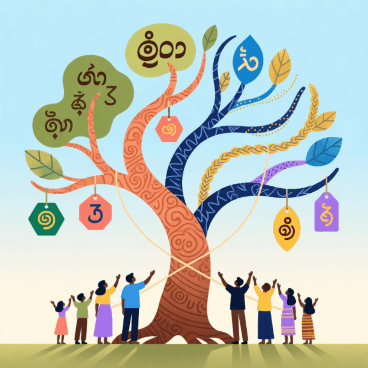
Overview: Mixed-Heritage Tamils: Identity, Surnames and Family Trees
Maybe this is you:
- One parent is Tamil, the other is not.
- Or both parents are Tamil, but from different countries and very different histories.
- Your surname doesn’t look obviously Tamil.
- You speak some Tamil, or none, or you understand but can’t reply properly.
So what does that make you? Half-Tamil? Quarter-Tamil? “Just British”? Something else?
To answer that properly, you need to understand what Tamil actually is – language, culture, history – not just as a label. If you haven’t read it yet, start with our
guide to Tamil language and identity. This article builds on that and focuses on mixed-heritage cases.
1. What does it mean to be “mixed Tamil”?
Forget the social media clichés for a second.
“Mixed Tamil” usually covers situations like:
- One Tamil parent, one non-Tamil parent (e.g. Tamil + English, Tamil + Chinese, Tamil + Nigerian, etc.)
- Two Tamil parents from very different backgrounds:
- Sri Lankan Tamil + Indian Tamil
- Malaysian Tamil + Singaporean Tamil
- Tamil + another South Asian ethnicity
The common thread: your Tamil side is only one part of your background, but it’s also not trivial. It shows up in:
- Names
- Food
- Festivals
- Stories about where your family came from
The question is not “Are you allowed to call yourself Tamil?” but:
“How does the Tamil part of your heritage fit into your overall identity?”
Our article Tamil Race and Ethnicity dissects the race/ethnicity side in more detail. Here we stay focused on mixed families.
2. Surnames, initials and the mixed-heritage mess
Tamil naming systems were already messy before you add mixed heritage to the mix.
You’ll see combinations like:
- Western-style family names (e.g. “Rajasekar”, “Pillai”, “Nadar”)
- Patronymics (father’s name as an initial or surname)
- Anglicised or shortened forms, especially in diaspora
- Completely new surnames after migration or marriage
Add a non-Tamil side to the equation and you get:
- Double-barrelled names
- Children taking the non-Tamil surname
- Children taking the Tamil surname with the other parent’s name as a middle name
- Siblings with slightly different naming patterns because parents changed approach mid-way
If you’re trying to build a clean family tree, this is a headache. But it’s reality.
Practical approach in TamizhConnect
Inside TamizhConnect, you don’t have to pretend the mess doesn’t exist. You can:
- Store:
- Full legal name
- Tamil form (if different)
- Maiden names / former names
- Add notes like:
- “Took mother’s surname after moving to the UK.”
- “Original village surname was X, changed at immigration.”
- “Non-Tamil surname, Tamil middle name.”
The point is to document what actually happened, not to shoehorn people into a fake “pure Tamil” pattern.
3. “Half Tamil, half X” – is that a real label?
People say things like:
- “I’m half Tamil, half Irish.”
- “I’m Tamil–Chinese.”
- “I’m quarter Tamil on my mum’s side.”
Is that wrong? No. It’s a quick, honest way of saying:
“One part of my ancestry is Tamil.”
But don’t kid yourself: your body and mind don’t split neatly into percentages. What matters is:
- How strongly the Tamil side is present in your life
- How much you know about that side’s family history
- Whether you have any Tamil language or cultural habits at all
You could be:
- 25% Tamil by blood, but the Tamil side is deeply involved, you know the language, the food, the festivals – and you clearly feel Tamil.
- 100% Tamil by ancestry, but raised with no Tamil language, no Tamil relatives nearby, and a vague sense of “my parents are from somewhere in South Asia”.
The label alone doesn’t tell the whole story. The map of your family does.
That’s where the global context from Tamil Communities Worldwide becomes useful.
4. How mixed-heritage shows up on forms
On official forms, mixed-heritage Tamils run into three annoying realities:
- There’s almost never a box that says “Tamil”.
- Mixed categories focus on race (“White and Asian”, “Asian and Black”), not ethnicity.
- There’s rarely space to specify Tamil properly.
You end up doing things like:
- Race:
- “Mixed – White and Asian”
- “Mixed – Other”
- Ethnicity (free text):
- “Tamil and Irish”
- “Tamil and Chinese”
- “Tamil (Sri Lankan Tamil) and English”
That’s fine. The trick is:
- Use the tick-boxes to follow the system.
- Use the free-text box to tell the truth: make sure the word “Tamil” appears somewhere.
For a bigger breakdown of race vs ethnicity vs Tamil, see Tamil Identity and Race.
5. Mixed-heritage children and the Tamil side
If you’re raising mixed-heritage kids, you’re probably juggling:
- Multiple languages
- Multiple food cultures
- Multiple religious or philosophical backgrounds
- Grandparents pulling in different directions
On the Tamil side, you have a few non-negotiables if you actually want it to survive:
- Language exposure – at least basic words, songs, phrases, even if they never become fully fluent.
- Visible symbols – Tamil books, photos, Tamil script somewhere in the house.
- Stories – not just “we’re Tamil”, but concrete stories about villages, migration, and older relatives.
If you do nothing, the Tamil side will fade into a vague “my grandparents were from somewhere in India / Sri Lanka”.
If you design it properly, your kids can truthfully say:
“I’m mixed – but the Tamil part of my background is real, not just a word.”
We go into detailed, practical steps in UK Families Guide.
6. Building a mixed-heritage Tamil tree in TamizhConnect
Here’s how to use TamizhConnect without pretending your family is “pure” anything.
1. Set up branches honestly
For each person, record:
- Birthplace
- Ancestral village/town (if known)
- Country of passport
- Ethnic background (free-text notes)
For mixed people:
- Make it explicit:
- “Mother: Tamil (Sri Lankan Tamil). Father: English.”
- “Mother: Malaysian Tamil. Father: Chinese Malaysian.”
- “Mother: Indian Tamil. Father: Nigerian.”
No need to round off the story to fit a box.
2. Track migration routes
Mixed heritage nearly always reflects movement:
- Tamil Nadu / Sri Lanka → Malaysia / Singapore / Gulf
- → UK / Canada / Australia etc.
- Tamil person meets non-Tamil person along the way.
Map those steps:
- Each move is a node in your family history.
- Each location explains part of your identity mix.
This is exactly what we talk about in Mapping Tamil Communities.
3. Attach culture to people, not just labels
Instead of writing “we’re Tamil on mum’s side”, record specifics:
- “Paati always made this particular Tamil dish on Deepavali.”
- “Appa taught us this Tamil proverb.”
- “Grand-uncle sang this specific Tamil film song at every wedding.”
Then link those:
- To photos
- To recipes (for example, the routines in
Tamil Food Online Guide) - To places on the map
That’s what turns “mixed heritage” from a diluted, generic idea into something concrete your kids can point at.
7. You don’t have to pass a “Tamil exam” to count
Here’s the blunt reality:
- Your Tamil is probably not as strong as your grandparents’.
- Your kids’ Tamil will probably not be as strong as yours.
- If you try to gatekeep too hard (“you’re not Tamil enough”), you’ll drive them away from the identity altogether.
The goal is not to produce perfect textbook Tamil speakers. The goal is:
- They know what Tamil is.
- They know which part of their family is Tamil.
- They know some Tamil words, songs and stories.
- They know where that branch of the family came from.
If they want to go deeper later – learn the language properly, travel, study the literature – they can. But if you drop the thread now, they won’t even know where to start.
TamizhConnect exists to keep that thread visible and unbroken.
If you want more context on how to describe yourself and your kids honestly, read:
- Tamil Identity: Race and Ethnicity Explained
- Global Tamil Communities: Where Tamils Live Today
- UK families guide: learn Tamil and keep culture alive
Then go and actually fill in your family tree – messy surnames, mixed heritage and all. That’s the only way any of this survives.