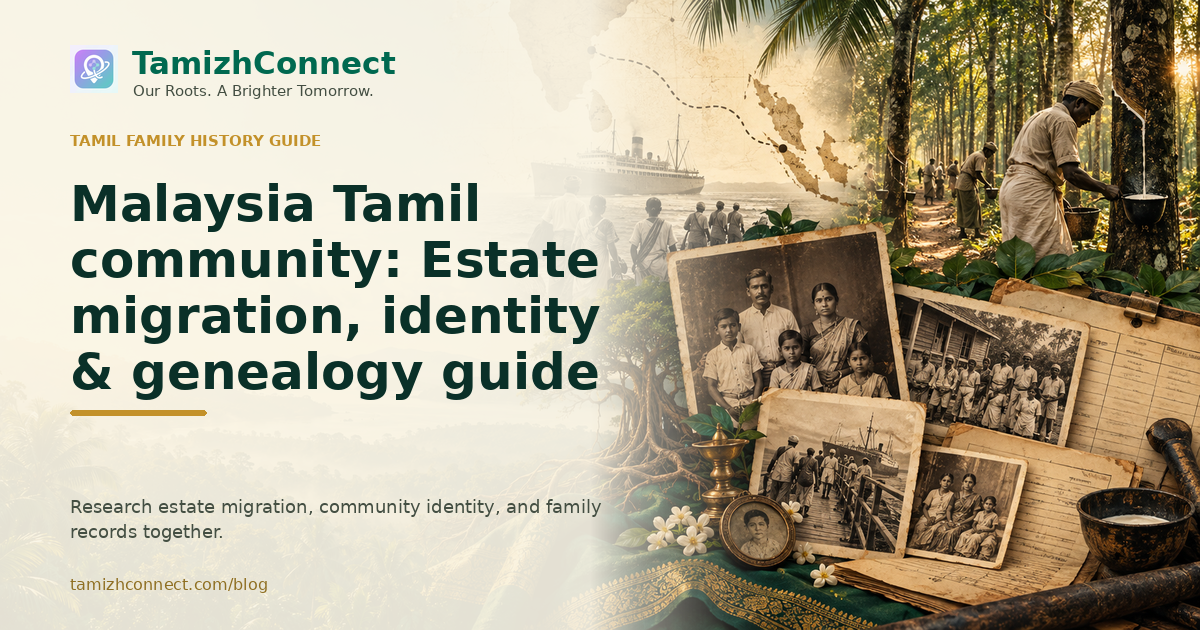
Malaysia Tamil Community: Estate Migration, Identity & Genealogy Guide
Malaysian Tamils are the largest Tamil community outside India and Sri Lanka — approximately 2 million people, most descending from 19th- and 20th-century estate labourers recruited from Tamil Nadu’s southern districts (Ramanathapuram, Madurai, Thanjavur, Tirunelveli) for rubber, palm oil, and tea plantations. The migration ran in three phases: indentured labour to Penang from the 1790s, Kangani-system recruitment to Federated Malay States estates from the 1870s–1930s, and post-independence free movement. Most Malaysian Tamil genealogy traces back to one of these three streams, each leaving different paper trails (ship manifests vs. kangani registers vs. passport records).
If your family has ties to Malaysia, you’ve likely heard phrases like:
- "Estate-la dhaan valandhathu life." (Life was hard on the estate)
- "IC-la name different, school-le different." (The name on the IC card differs from the one used at school)
- "Appa came from ‘India side’ long time ago."
Many Malaysian Tamil families know they are Tamil. But often they don’t realize the specific geographic origins or know the rich historical journey that brought their ancestors to Malaysia. Tamil migration to Malaysia represents one of the most significant population movements in modern Tamil history, involving millions of people and transforming Tamil communities across multiple countries.
Understanding your Malaysian Tamil heritage requires more than the vague reference of "some ancestor came during British times." This comprehensive guide explores the historical waves of Tamil migration to Malaysia, covers the unique estate system that shaped identities, explains naming conventions, and provides practical strategies for documenting your family’s migration story.
Understanding Malaysian Tamil Migration: Key Historical Waves
Malaysian Tamil migration occurred through distinct historical periods, each with different motivations, conditions, and outcomes:
- Pre-colonial maritime connections (before 1800s): Tamil traders established commercial relationships around the Malay Peninsula
- Colonial-era estate labor migration (late 1800s-1950s): Systematic recruitment for rubber and oil palm plantations using the Kangani system
- Post-independence urban transition (1960s onward): Movement from estates to urban centers for education and professional opportunities
- Contemporary professional migration (1990s-present): Skilled workers and professionals in various sectors
Understanding these waves helps identify your family’s migration period and provides context for genealogical research.
Historical Waves of Tamil Migration to Malaysia
Understanding the different phases of Tamil migration is crucial for genealogical research and historical context.
Pre-colonial Maritime Connections (Before 1800s)
Before British colonial rule, South Indian traders established commercial relationships around the Malay Peninsula. These included Tamil traders in particular.
- Chola Empire trade networks connected Tamil ports with Southeast Asian kingdoms. This included regions like Kedah and areas along the Strait of Malacca.
- Tamil Muslim trading communities (Rowthers, Marakkayars, etc.) established permanent settlements and trading posts.
- Cultural and religious exchanges led to temple construction and cultural integration.
- Intermarriage and settlement patterns created small but permanent Tamil communities.
- Language and cultural influence can still be observed in Malaysian place names and cultural practices.
These early connections created foundational Tamil communities, but most modern Malaysian Tamils trace their origins to the colonial-era migration waves that began in the late 1800s.
Colonial-Era Estate Labour Migration (Late 1800s – Mid 1900s)
The largest population shift occurred during British colonial rule. Tamil laborers were systematically recruited for plantation work:
Economic drivers:
- Rubber boom: Demand for rubber tappers and agricultural workers drove initial recruitment
- Oil palm development: Later expansion of oil palm estates created additional employment opportunities
- Infrastructure projects: Railway construction and town development required manual labor
- Tin mining: Additional employment opportunities in mining operations
Geographic recruitment patterns:
- Tamil Nadu: Primary source region with heavy recruitment from districts including:
- Thanjavur district (high concentration of estate workers)
- Tirunelveli district (substantial migration patterns)
- Ramanathapuram district (significant contribution to estate populations)
- Madurai district (skilled and semi-skilled workers)
- Present-day Andhra Pradesh and Telangana: Contributors of Telugu-speaking laborers
- Kerala regions: Smaller but consistent migration streams
Recruitment systems: The Kangani system was the primary recruitment mechanism:
- Trusted estate managers or established workers recruited relatives, neighbors, and caste members
- Entire micro-communities from specific Tamil villages were transplanted to single estate locations
- Workers often brought families after establishing themselves. This created village-like communities within estates.
Identifying estate-era family connections: Your ancestors likely belonged to this wave if they:
- Mentioned "estate quarters" or "line houses"
- Recalled stories about lorry journeys from ports (Penang, Singapore, or Port Klang)
- Remembered early experiences of rubber tapping or field cultivation
- Had specific knowledge about estate management systems and kangani operations
Post-Independence Urban Transition (1960s Onward)
After Malaya’s independence (1957) and Malaysia’s formation (1963), many estate families transitioned to urban centers:
Migration patterns:
- Major urban centers: Kuala Lumpur, Penang, Johor Bahru, Ipoh, and Kuantan became primary destinations
- Educational opportunities: University access enabled professional career paths
- Business development: Estate workers’ experience translated to entrepreneurial ventures
- Professional careers: Second and third generations pursued medical, engineering, legal, and other professional careers
Generational change impact: By the second and third generations, many families experienced "village memory degradation":
"Appa always mentioned our people came from somewhere near Thanjavur district, but the exact village escapes me now."
This represents the crucial loss of detailed origin information. Proper documentation could preserve this information.
Estate Life: Identity, Records, and Community Formation
The estate system fundamentally transformed Tamil identity and record-keeping practices.
Identity Transformation: From Village Names to Estate Numbers
Traditional Tamil Nadu identity structure: In rural Tamil Nadu, people typically identified with:
- Specific village names (e.g., "Kallidaikurichi side")
- District and regional indicators (e.g., "Sivaganga district, so-and-so village")
- Household or family names (e.g., "House name family")
- Caste and community markers (providing origin and social context)
- Local temple and religious associations (indicating community ties)
Estate system identity transformation: In the estate environment, identity became simplified and standardized:
- Estate name identification (e.g., "Ladang ____")
- Division and line numbers (e.g., "Division 3, Line 5")
- Worker identification numbers (e.g., "Number 24" or "Worker No. 127")
- Simplified social categorization (laborer categories instead of traditional identities)
Example of identity shift: Instead of identifying as "Muthusamy from the Pillai family of Kallidaikurichi village in Ramanathapuram district," the same person might be known as "Muthusamy of Division 3, Line 5, Estate Worker No. 24."
This was efficient for estate payroll systems. But it hid ancestral origins for genealogical research. This happened unless deliberately connected back to village identities.
Documentation Systems: English and Malay Records, Minimal Tamil
Estate and colonial administrative systems created documentation patterns that significantly impacted family record preservation:
Language preferences in documentation:
- English dominance: British colonial administration used English for official records
- Malay secondary usage: Local administration often incorporated Malay alongside English
- Tamil script scarcity: Very little Tamil script appeared in official estate documents
- Standardization pressures: Names were often simplified or altered for administrative convenience
Common documentation patterns:
- Simplified spellings:
MUTHUSAMYinstead of full "Muthusamy Pillai" - Phonetic approximations:
VELOOinstead of classical "Velu" or "Velu Thevar" - Spelling evolution:
KUPPANNAN→KUPPANAN→KUPPANover time - Loss of caste markers: Traditional caste identifiers often omitted in official records
- House name omissions: Specific family house names rarely documented in official systems
Impact on genealogical research: If researchers rely solely on Romanized spellings without consulting elder family members, they lose:
- Caste and community markers that indicate specific origin regions
- Traditional house names that connect to specific villages or families
- Village information that might still be preserved in oral family traditions
- Religious and cultural identifiers that indicate specific community origins
Malaysian Tamil Naming Conventions: Hybrid Systems and Cultural Significance
Malaysian Tamil names represent a trilingual hybrid system that combines:
- Traditional South Indian naming logic
- British colonial bureaucratic requirements
- Malaysian legal and cultural frameworks
The "a/l" and "a/p" Patronymic System
The most distinctive feature of Malaysian Tamil names is the patronymic system using Malay abbreviations:
Common name patterns:
RAJENDRAN A/L SUBRAMANIAM(Rajendran, son of Subramaniam)MEENA A/P KANDASAMY(Meena, daughter of Kandasamy)THAMBIRAJAH A/L NADARAJAH(Thambirajah, son of Nadarajah)
System breakdown:
a/l= anak lelaki = son of (male children)a/p= anak perempuan = daughter of (female children)- Patronymic structure: [Given name] [relationship marker] [Father’s name]
Genealogical advantages: This system is particularly valuable for family research because it preserves the father’s name clearly, maintaining clear parent-child relationships unlike some Western systems that may omit father’s names.
Documentation in genealogical systems: When recording these names in family trees:
- Given name → person’s main name field
- Father’s name → link to father’s family tree node
- Relationship marker (
a/lora/p) → stored in notes or dedicated relationship field
Important preservation note: Do not discard or ignore a/l / a/p markers. These encode crucial genealogical relationships that connect generations.
Multiple Name Systems: IC, Everyday, and Cultural Names
Malaysian Tamil families typically maintain three distinct naming systems that require comprehensive documentation:
Three-name system example:
- IC name:
SIVASANGARI A/P SUBRAMANIAM(identity card version, usually all caps) - Home name:
Sangari(familiar name used within the family) - Tamil name:
சிவசங்கரி(Tamil script version, traditional pronunciation)
Documentation best practices: When logging family member information, capture all three name variants:
- Exact IC spelling: For matching official Malaysia government records, school enrollment records, and employment documents
- Tamil script spelling: For cultural identity preservation, religious documentation, and connection to ancestral traditions
- Everyday familiar name: For family recognition, oral history, and cultural context understanding
Practical application: This comprehensive approach ensures you can locate individuals in:
- Government databases using official spellings
- Religious and cultural records using Tamil spellings
- Family memories using familiar names and nicknames
Language Evolution and Its Impact on Cultural Memory
The gradual shift in language competency across generations has created significant challenges for preserving cultural and geographic information.
Generational Language Patterns
Estate generation (1900s-1950s):
- Primary language: Tamil used extensively at home and within the community
- Secondary languages: Basic English and Malay for work and official interactions
- Cultural preservation: Strong Tamil literary, religious, and cultural traditions
- Geographic memory: Clear knowledge of Indian village origins
Early urban generation (1960s-1990s):
- Mixed competency: Tamil at home, increasing English/Malay usage in public
- Cultural adaptation: Maintaining Tamil traditions while adopting local customs
- Educational shift: English-medium education beginning to affect Tamil competency
- Memory retention: Good knowledge of family origins and traditions
Modern generation (2000s-present):
- English/Malay dominance: Often more comfortable in English/Malay than Tamil
- Reading/writing weakness: Reduced ability to read Tamil script documents
- Cultural disconnection: Less direct connection to ancestral traditions
- Oral tradition loss: Decreasing knowledge of original village origins
Cultural Memory Preservation Strategies
Critical documentation needs: As Tamil literacy weakens across generations:
- Village name preservation: People may still remember village names but struggle to spell them in Tamil or Roman script
- Temple and place name integrity: Traditional names may become distorted through repeated oral transmission
- Script reading capability: Tamil script documents become inaccessible to younger family members
- Cultural context loss: Understanding of traditional naming patterns, customs, and regional variations diminishes
Preservation solutions: If serious about maintaining cultural roots, families should ensure at least one member can:
- Read Tamil script documents: Essential for accessing original records and certificates
- Map traditional names to modern spellings: Bridge the gap between old and contemporary representations
- Store multiple spellings: Maintain both traditional and modern versions in family records
- Connect linguistic patterns: Understand how names and places were historically recorded and how they evolved
Essential Information Collection from Malaysian Tamil Relatives
Effective genealogical research requires systematic collection of specific information categories from knowledgeable family members.
Estate Documentation and History
Essential questions for estate-era relatives:
Estate identification:
- What was the exact name of the estate where your family lived?
- What type of estate: Rubber, oil palm, tin mine, or other industry?
- Which division and line number housed your family (if remembered)?
- What years did your family live in this specific location?
Community connections:
- Were many relatives from the same Indian village part of this estate community?
- Which other families from the area were connected to your family?
- What was the primary language used in estate communications?
- Who were the estate managers or kangani figures from that period?
Example documentation:
"Ladang Semenyih, Rubber Estate, Division 2, Line 4. Grandfather arrived around 1935 during the rubber boom. Several families originally from villages near Thanjavur district came together through the same kangani system."
Even with incomplete Indian village information, estate details provide crucial research anchors for cross-checking old labor, immigration, and community records.
Official Documentation: IC Cards, Passports, and Legal Records
Systematic record transcription:
Key information to collect:
- Exact official name as printed on documents (do not change or correct spelling)
- IC number or old IC number for verification purposes
- Place of birth (may provide additional location clues)
- Date of birth or at least approximate year ranges
- Parents’ names as recorded (especially fathers’ names for family connections)
Additional information:
- Tamil script spelling of names when available
- Oral family information about Indian origins
- Traditional naming patterns that may have been simplified in official records
This combination provides both legal identity verification and family origin context.
Indian/Sri Lankan Origin Documentation
Value levels for origin research:
High-value information:
- Specific village name + district: Provides exact geographic location for research
- Nearby major town identification: Offers verification context and nearby landmarks
- Regional dialect markers: Indicates specific accent or cultural variations
- Caste and community indicators: Points to specific regional traditions and practices
Acceptable starting points:
- General regional information: "Near Thanjavur" or "From Ramanathapuram area"
- District-level identification: Tamil Nadu district names provide valuable research direction
- State-level information: Tamil Nadu vs. Sri Lanka origin differentiation
Finding geographic details: Strategic questioning techniques:
- "When Appa or Thaatha first arrived in Malaya, which port did they enter through? Penang, KL, Singapore?"
- "Older family members used to say ‘namma ooru…’? What exact word did they use for our hometown?"
- "Did you ever send letters or money-order receipts back to India/Sri Lanka? Address eppadi irundhuchu?"
Physical documentation preservation: If any family members possess old letters, money-order receipts, passport pages, photographs with writing, or other documents, these should be photographed. These should be securely stored using digital preservation methods. These materials often contain the only surviving written references to original village names and addresses.
5.4 Religious and Educational Institution Connections
Critical institutional documentation:
Religious connections:
- Temple names where the family regularly worshipped and participated in festivals
- Church affiliations for Christian Tamil families (often contain valuable genealogical information)
- Mosque connections for Tamil Muslim families and their specific community practices
- Religious festival participation that may indicate specific regional traditions
Educational institutions:
- Early Tamil schools attended by family members (often contain student origin information)
- Language schools that preserved cultural connections
- Religious schools that maintained traditional knowledge
- College and university records that may contain additional geographic information
Community gathering places:
- Festival locations where families traveled for specific celebrations
- Cultural centers that maintained specific regional traditions
- Community halls where important family events occurred
Research significance: Religious and educational institutions often maintain systematic records of families, including names of individuals, parents, origins, and family connections over extended periods.
6. Structured Data Management for Malaysian Tamil Genealogy
Effective genealogical management of Malaysian Tamil family history requires systematic organization of the unique information patterns.
6.1 Comprehensive Name Field Documentation
Recommended name storage system for each individual:
- Display name: Readable combination for general use, e.g.
Sivasangari Subramaniam - IC/legal name: Exact spelling as printed on official documents, e.g.
SIVASANGARI A/P SUBRAMANIAM - Tamil script name: Traditional spelling in Tamil script, e.g.
சிவசங்கரி - Nickname/home name: Familiar name used within family context, e.g.
Sangari - Alternative spellings: Other documented spelling variations found in different records
While not all name variants need display in user interfaces, they should all be systematically recorded and preserved.
6.2 Dual-Origin Geographic Documentation
Location categorization system:
Malaysian origin context:
- Estate names: Specific plantation locations and divisions
- Settlement locations: Towns, villages, or urban areas where families later settled
- State identification: Malaysian state (Selangor, Perak, Johor, etc.)
- Regional clustering: Geographic concentrations of specific family groups
Indian/Sri Lankan origin context:
- Village identification: Specific village names (if known exactly)
- Near town: Reference points for geographic location
- District identification: Administrative districts for research purposes
- State and region: Broader geographic context (Tamil Nadu, Sri Lanka)
Managing uncertainty: When exact village information is unavailable, document this clearly:
"Unknown village – believed to be in Thanjavur district, Tamil Nadu"
This preserves knowledge uncertainty while indicating research directions.
6.3 Branch-Level Historical Documentation
Comprehensive branch notes for major family lines:
Rather than embedding all historical context in name fields, create detailed notes for each major family branch:
"This branch arrived in Malaya during the 1920s as rubber estate laborers at Ladang ___ near Ipoh, Perak. Original village believed to be near Kumbakonam, Thanjavur district, Tamil Nadu. Uses
a/l/a/pformat on IC; no fixed surname."
Such comprehensive notes provide future researchers with essential context that illuminates family movement patterns and community connections.
7. Common Documentation Pitfalls to Avoid
Critical mistakes that compromise genealogical research:
7.1 Over-Generalization of Geographic Origins
The problem: Treating "India side" as a specific location rather than acknowledging its vast diversity.
Documentation refinement:
- Target district-level specificity: Determine if origins were in Thanjavur, Ramanathapuram, Tirunelveli, or other specific Tamil Nadu districts
- Regional precision: Push for more specific regional information like "near Kumbakonam" vs. "northern Tamil Nadu"
- Cultural markers: Identify caste, community, or linguistic indicators that suggest specific regions
- Sri Lankan differentiation: Carefully distinguish between Tamil Nadu and Sri Lankan origins
Questioning techniques:
- "Was it definitely Tamil Nadu, or possibly Sri Lanka?"
- "Which major town or city was nearest to the village?"
- "Even if the exact village is unknown, can you remember which district people mentioned?"
7.2 Neglecting Inter-Community Connections
Problem: Historically minimizing women’s experiences or multicultural family connections.
Women’s Gulf experiences documentation:
- Professional roles: Healthcare workers, domestic workers, retail staff, educators
- Family support roles: Maintaining households, raising children, elder care
- Community leadership: Religious, cultural, and social organization roles
- Financial contributions: Remittances, family investments, business support
Multicultural family connections: Many Malaysian Tamil families now include connections with:
- Chinese Malaysian families: Through business partnerships or marriage
- Malay Malaysian communities: Through neighborhood connections or marriage
- Other Indian communities: Telugu, Malayalam, or North Indian connections through work or marriage
- Sri Lankan Tamil communities: Particularly common in certain regions
Documentation approach: Fully document these branches including their naming patterns, cultural practices, and connection stories. This represents authentic family history, not cultural dilution.
7.3 Excessive Name Normalization
Documentation principle: Preserve exact spellings rather than forcing uniformity.
Best practice approach:
- Maintain official spellings: Keep exact spellings as they appear on documents and records
- Store variants systematically: Catalog different spelling variations found across different records
- Research connection points: Use variant spellings to locate the same individuals across different documents
- Preserve historical evolution: Document how names may have been anglicized or malayicized over time
Research consequence: Over-regularizing names can prevent successful matching of individuals across different record systems, losing crucial genealogical connections.
8. Urgent Documentation: Preserving the Estate Generation Memories
Critical timeframe awareness:
The estate generation – people who personally remember:
- Estate manager names and operational details
- Names of other laborer families
- The exact story of how and why they came to Malaya
- Community connections between different Indian villages’ representatives
…is diminishing rapidly.
Memory degradation consequences: Once these individuals pass:
- Estate names become misremembered
- Indian village names become vague generalizations
- Migration reasons collapse into oversimplified "poverty / British time" clichés
- Specific family and community connections are lost forever
Immediate action framework:
8.1 Priority Relative Identification
Step 1: Locate estate-era knowledge bearers:
- Identify 2-3 older relatives who remember estate life firsthand
- Target individuals who were adults during the estate period
- Include both direct descendants and extended family members who may have different information
8.2 Systematic Documentation Sessions
Step 2: Conduct detailed collection sessions:
- Schedule in-person meetings when possible for better engagement
- Record conversations (with permission) for later analysis
- Photograph old documents, photographs, letters, and certificates
- Create written records of IC spellings, estate names, and any village information recalled
8.3 Structured Data Conversion
Step 3: Transform collected information into family tree data:
- Convert handwritten notes into structured digital entries
- Cross-reference multiple sources for accuracy verification
- Create connection points between different family branches
- Establish timeline frameworks for migration patterns
9. Cultural and Historical Context Preservation
Broader preservation framework:
9.1 Community Memory Documentation
Collecting broader community history:
- Estate operational details: Working conditions, pay scales, living arrangements
- Community leaders: Estate managers, kangani figures, religious leaders
- Migration networks: How different villages sent workers to specific estates
- Cultural practices: How traditional customs adapted to estate life
- Religious institutions: Early temples, churches, and their establishment contexts
9.2 Institutional Research Opportunities
Government and organizational records:
- Immigration Department records: Entry records and permits
- Estate company records: Employment records and family registrations
- School records: Student enrollment with origin information
- Religious institution records: Baptism, wedding, and funeral records
- Hospital records: Birth records and medical histories
- Cemetery records: Burial information and family connections
10. Future-Proofing Malaysian Tamil Heritage
Long-term preservation strategies:
10.1 Digital Documentation Standards
Recommended digital practices:
- Multi-format preservation: Store information in multiple accessible formats
- Regular backup systems: Ensure information survives technological changes
- Accessibility planning: Make information accessible to future generations with different technology
- Cultural context preservation: Maintain explanations of practices and traditions
10.2 Educational Continuity
Preserving knowledge across generations:
- Tamil literacy maintenance: Ensure some family members can read original scripts
- Cultural practice explanation: Document why traditions were important
- Migration story preservation: Keep personal narratives alive through storytelling
- Research skill transfer: Teach younger generations genealogical research methods
Conclusion: The Legacy of Malaysian Tamil Migration
Malaysian Tamil migration represents one of the most significant population movements in modern Tamil history. It affected millions of families. It created transnational connections that continue today.
Documenting these experiences is important. It’s not just genealogical work—it preserves history. It shows how Tamil families adapted to globalization. It shows how they dealt with economic necessity. It shows how they seized opportunities to build better lives for themselves and their children.
The estate-based, temporary residence structure of early migration created unique family experiences. These differ significantly from traditional immigration patterns. These experiences involved systematic family separation. They included complex transnational relationships. They had economic dependency on remittances. They faced significant legal and social challenges that deserve historical record. Without proper documentation, future generations will inherit incomplete family histories. These fail to acknowledge the sacrifices. They fail to show the strategies. They fail to highlight the successes that enabled current circumstances.
The urgency of this documentation task increases annually. The first generation of estate workers reaches advanced age. Memories fade. Families must act decisively. They need to capture detailed information. This includes countries of employment. It includes job roles and career progression. It includes remittance patterns. It includes significant experiences. It includes the profound impacts on families left behind.
This documentation should extend to women’s migration experiences. These have historically been minimized. But they equally contributed to family success.
Modern genealogical platforms like TamizhConnect offer tools. These properly model complex transnational family experiences. These include multi-country residence timelines. They include occupational progression documentation. They include asset-linkage systems. These connect Gulf earnings to home country investments. These tools enable families to move beyond oversimplified narratives. They provide accurate, detailed records. These honor the complexity and significance of Malaysian Tamil migration experiences.
For families committed to preserving their complete heritage, documenting Malaysian Tamil migration experiences is important. It’s essential for understanding the true scope of family achievements. It explains economic strategies. It shows cultural adaptations. These enabled success across generations. The work of asking, listening, and recording these stories honors the sacrifices of the past. It provides essential context for understanding family history in the present. It helps plan for the future.
Key Documentation Priorities for Malaysian Tamil Families
- Estate documentation: Record specific estate names, divisions, and line numbers where families lived
- Name variations: Document IC spellings, Tamil script names, and familiar names used in different contexts
- Origin village identification: Capture specific village names, districts, and regional connections
- Migration timeline: Create detailed chronologies of movements between estates and urban centers
- Cultural preservation records: Document how Tamil traditions were maintained in Malaysian contexts
Continue Your Malaysian Tamil Heritage Journey
To continue exploring Tamil migration patterns and family history preservation, consider reading about documenting family history from elders, understanding Tamil migration patterns, or exploring global Tamil communities. Our family tree builder includes specialized features. These help Tamil families document the complex geographic and cultural patterns that characterize Malaysian migration experiences.
Additionally, explore these related resources:
- Comprehensive migration timeline guide for organizing movement patterns
- Gulf Tamil families documentation for other significant migration patterns
- Cultural preservation strategies for maintaining Tamil identity in diaspora
The time to document these irreplaceable family stories is now. Don’t wait until the opportunity is lost forever. Proper documentation ensures that future generations understand the true scope of sacrifices and achievements that enabled their current circumstances.