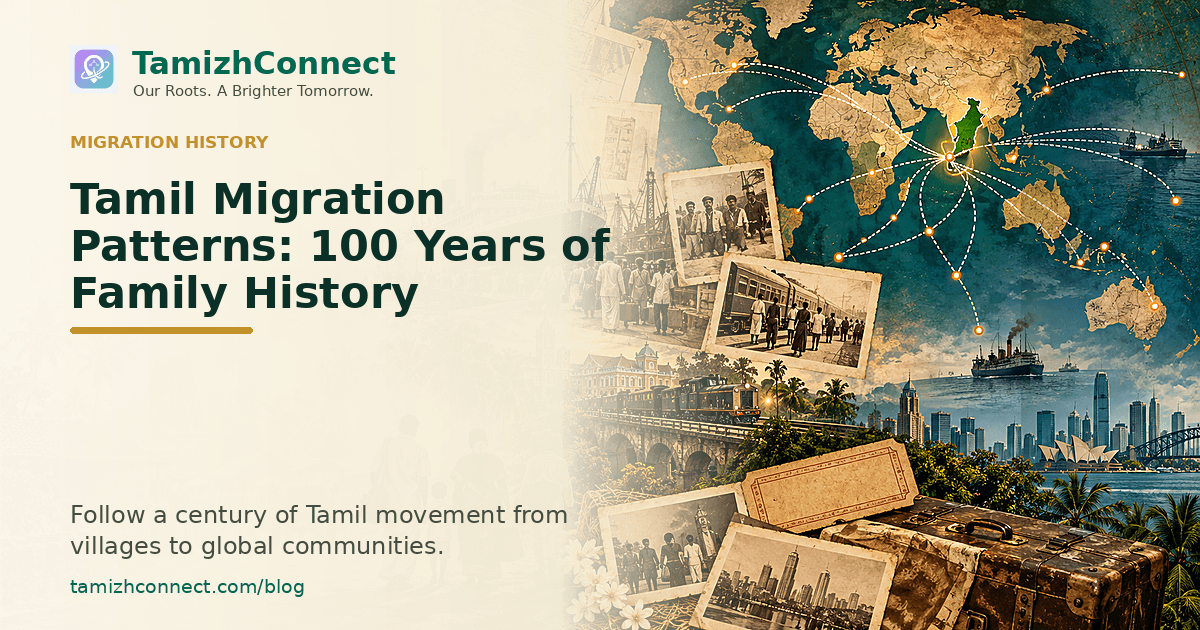
Tamil Migration Patterns
Tamil families have travelled far in the last century — across Tamil Nadu, India, Sri Lanka, Malaysia, Singapore, the Gulf, and beyond. Understanding these migration waves helps decode your family tree and trace your ancestral routes.
Migration has been a constant in Tamil history, with families adapting to economic opportunities, political changes, and social transformations. In this comprehensive guide, we’ll explore the major waves of Tamil migration over the past 100 years and how these movements shaped the Tamil diaspora as we know it today.
1. Early 1900s — Village to Nearby Towns
During the early 1900s, most Tamil families lived in agraharams (Brahmin settlements), oorus (village communities), and small agricultural villages. The migration during this period was relatively limited compared to later waves, primarily confined to nearby areas for specific economic activities.
Most families migrated within a 20-50 km radius for:
- Weekly markets where they could sell agricultural produce and buy goods not available in their villages
- Temple towns which served as centers of commerce, culture, and religious activities
- Rice mill areas where agricultural workers could find seasonal employment
- Farming regions with better soil conditions or more reliable rainfall patterns
This early migration pattern established many of the social networks that would later support larger migration waves. Family connections made during these early movements created pathways for future relocations when opportunities arose.
2. 1930s–1950s — Plantation & Labour Migration
The 1930s through 1950s marked the beginning of large-scale international Tamil migration, particularly to Southeast Asia and Sri Lanka. This period saw large Tamil communities move to plantations under the Kangani recruitment system, which was a form of indentured labor.
Large Tamil communities moved to:
- Malaysia, where they worked on rubber plantations in areas like Perak, Negeri Sembilan, and Selangor
- Singapore, which served as a major hub for Tamil workers moving within the region
- Sri Lanka tea estates in areas like Kandy, Nuwara Eliya, and Hatton where Tamil laborers worked for British-owned plantations
Most went through Kangani recruitment systems, which were labor contracts that brought Tamil workers to work on plantations, primarily in rubber and tea estates. The Kangani system was named after the Tamil word for "headman" or "contractor" who recruited workers.
These migrations had profound effects on Tamil society, creating significant Tamil populations outside India that remain today. Many families were separated for years under these contracts, leading to unique cultural adaptations and developments in the diaspora.
3. 1960s–1980s — Chennai & Industrial Migration
The 1960s through 1980s saw a different type of migration as Tamil families moved to growing industrial centers within India. This period created the urban Tamil identity that many Tamil families identify with today.
Families moved to:
- Chennai, which became a major industrial and administrative center attracting Tamil workers from across the state
- Coimbatore, known for its textile industry and growing manufacturing base
- Tiruppur, which emerged as the cotton knitwear capital of India
- Madurai, maintaining its status as a major cultural and trading center
- Trichy (Tiruchirappalli), which became important for its engineering industries and administrative functions
This period of industrial migration transformed Tamil society by creating new economic opportunities while also dispersing Tamil communities across the state. The urban centers they moved to became melting pots where Tamil culture adapted to cosmopolitan environments while maintaining traditional values.
4. 1990s–2000s — IT, Engineering, Education Boom
The 1990s through 2000s brought about the largest and most diverse migration wave in Tamil history, driven by the IT revolution and educational opportunities. This period saw mass migration to major Indian metropolitan centers and international destinations.
Mass migration to:
- Bangalore, which became known as India’s Silicon Valley attracting Tamil IT professionals
- Hyderabad, growing as a major IT hub with companies like Microsoft, Google, and numerous other tech firms
- Pune, known for its educational institutions and IT companies
- Delhi NCR, which attracted Tamil families seeking administrative, business, and professional opportunities
Followed by movement abroad to:
- USA, particularly to areas like Silicon Valley, New Jersey, and Chicago where Tamil professionals established communities
- UK, with significant populations in London, Manchester, and other industrial cities
- Canada, especially Toronto which now has one of the world’s largest Tamil diaspora populations
- Australia, with growing Tamil communities in Sydney, Melbourne, and Perth
- Gulf countries, where Tamil workers found employment opportunities in construction, services, and professional sectors
This migration wave was characterized by higher education levels, with many Tamil families investing significantly in education to access these opportunities. It also led to the establishment of Tamil cultural organizations, temples, and community centers worldwide.
5. Sri Lankan Tamil Migration
The political conflict in Sri Lanka from the 1980s onwards forced large numbers of Sri Lankan Tamils to migrate globally, creating another distinct pattern in Tamil migration history. This was largely a refugee and asylum-seeking migration rather than economic migration.
Due to conflict, families dispersed widely:
- Toronto, Canada, which became home to the largest Tamil diaspora city population outside Sri Lanka
- London, UK, which attracted many educated Sri Lankan Tamil professionals
- Paris and other French cities where Tamils sought asylum and rebuilt their lives
- Switzerland, known for accepting Tamil refugees and providing pathways to stability
- Norway, among other Nordic countries that provided humanitarian support to Tamil refugees
These migrations were often forced and traumatic, with families separated and having to rebuild their lives from scratch in new countries. Despite the challenges, Sri Lankan Tamil communities have made significant contributions to their adopted countries while maintaining strong connections to their homeland.
Understanding Migration Patterns for Genealogy
Understanding these migration timelines makes your family history clearer and can help you trace your genealogy across borders. Each migration wave offers clues about where to look for records, family connections, and historical documents that can help you build your family tree.
To further explore your family history, consider reading about genealogy techniques, understanding your family names and their origins, Tamil language origins, or connecting with relatives abroad. Our family tree builder tool can help you visualize your family’s migration journey across generations.
Migration shapes identity. Understanding migration timelines makes your family history clearer. Use TamizhConnect to plot your family’s journey across generations.