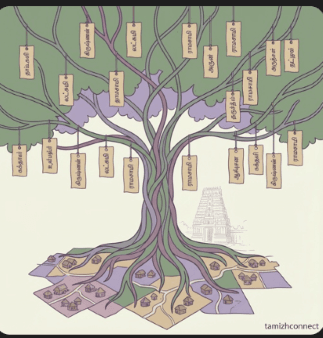
Tamil Names: Understanding Ancestral Heritage
Tamil names are far more than simple labels — they serve as preserved identity markers that carry centuries of heritage, family history, and cultural continuity. Each Tamil name contains layers of meaning that can reveal geographic origins, family lineages, community affiliations, and historical contexts that connect you to your ancestral roots.
Understanding the deep structure of Tamil names is crucial for genealogical research and cultural preservation. In every Tamil name, there is a story that connects generations, preserves family identity, and maintains the integrity of Tamil cultural heritage.
1. Tamil Initials and Lineage Patterns
Tamil naming conventions traditionally include initials that directly connect children to their paternal lineage. This system creates an unbroken chain of identity that can be traced across generations and geographical locations.
Traditional Initial System
The initial in a Tamil name represents the father’s first name and creates a direct link to the paternal lineage:
- R. Karthik → Initial "R" comes from father’s name "Rajendran"
- M. Lakshmi → Initial "M" comes from father’s name "Manoharan"
- K. Suresh → Initial "K" comes from father’s name "Kumaran"
- T. Meera → Initial "T" comes from father’s name "Thirumurugan"
Lineage Connection Chain
This traditional system connects generations in a clear pattern:
- Current generation (Child) → Immediate ancestor (Parent) → Previous generation (Grandparent) → Geographic origin (Village or Community)
Understanding these patterns helps genealogical researchers identify family connections, track migration patterns, and verify relationships across different regions and time periods.
Patrilineal Naming Significance
The use of paternal initials creates a unique identification system that:
- Establishes clear parent-child relationships
- Preserves ancestral names across generations
- Provides research trails for genealogical discovery
- Maintains cultural continuity despite geographic displacement
2. Village Names Embedded in Personal Names
One of the most distinctive features of Tamil nomenclature is the inclusion of village names (ooru) directly within personal names. This practice serves as a permanent geographic marker that indicates ancestral origins.
Geographic Identity Preservation
Some families embed their ooru (ancestral village) directly into names:
- Thiruvenkatam Subramanian – Thiruvenkatam indicates the village of origin
- Kallidaikurichi Narayanan – Kallidaikurichi is the ancestral village
- Theni Gopinath – Theni indicates the person’s ancestral connection to Theni district
- Kanchipuram Raghavan – Kanchipuram shows ancestral connection to Kanchipuram
Regional Naming Conventions
Different Tamil regions have specific patterns for incorporating village names:
- South Tamil Nadu: Often prefixes village names directly (e.g., Tirunelveli Suresh)
- Chettinad region: Incorporates village names as middle names (e.g., Karaikudi Ramasamy)
- Coastal areas: Sometimes uses district names (e.g., Nagapattinam Venkatesh)
Research Value of Village Names
These embedded geographical markers are invaluable for genealogical research because they:
- Identify exact ancestral origins – Reveal the specific village or town where ancestors lived
- Connect families across diaspora – Help locate relatives in the same ancestral regions
- Preserve cultural identity – Maintain connections to traditional homelands
- Enable regional research – Guide researchers to specific geographic areas for record searches
3. Caste and Community Identity Indicators
Tamil surnames often carry historical indicators of community affiliations, occupational backgrounds, and regional identities that provide important context for genealogical research.
Traditional Community Surnames
Common Tamil surnames that indicate historical community affiliations include:
- Pillai – Originally indicated a community with royal or administrative connections
- Chettiar – Historically associated with the Chettiar merchant community known for banking and trade
- Mudaliar – Traditionally a title for village headmen or administrative officials
- Gounder – Associated with the Vellalar agricultural community
- Naidu – Historically connected to the Balija community with trading and agricultural backgrounds
- Thevar – Connected to the Maravar community, traditionally warriors and landowners
- Naicker – Associated with the Vanniyar community, traditionally involved in agriculture
- Kovida – Related to the Kshatriya warrior class in some regions
Cultural Context and Research
Understanding these historical community affiliations is important for genealogical research because:
- Geographic clustering – Different communities traditionally lived in specific regions
- Marriage patterns – Historical endogamy patterns may help identify related families
- Occupational migrations – Understanding community occupations can reveal migration patterns
- Temple affiliations – Communities often had specific temple connections
- Regional concentrations – Communities typically clustered in certain districts
Sensitive Historical Context
It’s important to note that these naming patterns reflect historical social structures rather than contemporary social positions, and they provide research value regardless of modern social considerations.
4. Historical Evolution of Tamil Naming Conventions
Tamil naming practices have evolved significantly over time, reflecting political changes, social reforms, and cultural adaptations.
Pre-Independence Naming Patterns
Historical Tamil names often included:
- Paternal lineage indicators – More strictly followed traditional initial systems
- Occupational descriptors – Names often included references to family occupations
- Regional identifiers – Stronger geographic markers in names
- Religious appellations – More common use of deity names and religious titles
Post-Independence Changes
Modern Tamil naming has been influenced by:
- Social reform movements – Efforts to reduce caste-based naming markers
- Educational changes – Standardization of spelling and pronunciation
- Legal documentation – Passports and government forms requiring standardized names
- International migration – Adaptations for non-Tamil speaking systems
Contemporary Naming Trends
Today’s Tamil parents choose names that reflect modern values while preserving cultural connections:
- Short, modern names – Names like Aadhya, Viraaj, Nila, and Arjunan that are easy to pronounce internationally
- Unisex naming preferences – Names like Nilan, Venba, and Aarav that work for any gender
- Mythology-inspired names – Traditional names like Meenakshi, Arjunan, Padmanaban, and Saroja that carry spiritual significance
- Fusion names – Combinations that blend Tamil and international naming conventions
- Meaning-focused names – Selection based on the Tamil meaning and cultural significance rather than tradition alone
For guidance on balancing traditional Tamil heritage with modern global considerations when naming children, read our comprehensive guide to modern Tamil names.
5. Diaspora Name Adaptations and Variations
Tamil names have undergone significant changes in diaspora communities due to administrative requirements, cultural adaptation, and practical considerations.
International Naming Adjustments
In countries like Singapore, Malaysia, USA, and UK, Tamil names often adapt to local administrative systems:
Initial Expansion:
- R. Sundar → Ramasamy Sundar (passport and legal document expansion)
- A. Devi → Arumugam Devi (full name expansion for official purposes)
- M. Raj → Maniam Raj (common expansion pattern)
Spelling Variations:
- Sivaraman → Seevaraman (phonetic spelling in different countries)
- Kumaran → Kumar (shortened for practical purposes)
- Thirunavukkarasu → Tony (Western name adoption)
Regional Adaptation Patterns
Different diaspora communities have specific adaptation patterns:
Malaysia and Singapore:
- Retention of Tamil initials in everyday usage
- Adoption of local administrative naming requirements
- Development of "home names" vs. "official names"
North America:
- Initial expansion for legal documents
- Adoption of Western names alongside Tamil names
- Simplification for pronunciation by non-Tamil speakers
UK and Europe:
- Integration with Western middle-name conventions
- Legal name changes for administrative efficiency
- Cultural pride movements promoting original Tamil names
Documentation Implications
These adaptations create challenges and opportunities for genealogical research:
- Multiple name variations may appear in different documents
- Cross-referencing requires understanding of adaptation patterns
- Diaspora connections can be traced through name variations
- Identity preservation becomes important for cultural continuity
6. Advanced Genealogical Techniques Using Tamil Names
Understanding Tamil naming conventions enables sophisticated genealogical research techniques that can uncover family connections across vast geographic distances and time periods.
Initial-Based Research Strategies
The traditional Tamil initial system provides powerful research tools:
- Paternal lineage tracking – Following initial patterns to identify family branches
- Cross-regional matching – Finding relatives using similar initial naming patterns
- Historical connection verification – Confirming relationships through naming consistency
Geographic Indicators in Research
Embedded village names and geographic indicators enable:
- Targeted regional research – Focusing genealogical searches on specific locations
- Community connection mapping – Understanding family networks in specific regions
- Migration pattern analysis – Tracking family movements using geographic name markers
Comprehensive Documentation in TamizhConnect
Effective genealogical preservation requires documenting multiple aspects of names:
Original Names:
- Record traditional Tamil names in their original form
- Preserve historical spelling variations
- Document regional pronunciation differences
Multiple Versions:
- Include official government versions
- Document diaspora adaptations
- Record informal or "home" names used within families
Lineage Patterns:
- Track initial patterns across generations
- Document surname evolution within family lines
- Connect geographic indicators to specific regions
Relationship Verification:
- Use naming patterns to confirm family connections
- Identify potential relatives through similar naming conventions
- Cross-reference with historical records using name patterns
7. Cultural Significance and Identity Preservation
Tamil names carry deep cultural significance that extends beyond simple identification to encompass religious, regional, and community identity that connects multiple generations.
Religious and Spiritual Elements
Many Tamil names carry spiritual significance:
- Vishnu-related names – Narayanan, Venkatesh, Hari, Krishna
- Shiva-related names – Shiva, Rudran, Somu, Natarajan
- Shakti-related names – Meenakshi, Kamala, Parvathy, Lakshmi
- Regional deities – Names specific to local temple deities and traditions
Linguistic Preservation
Names serve as repositories of Tamil linguistic heritage:
- Classical Tamil elements – Names using ancient Tamil words and concepts
- Regional dialect influences – Names reflecting local Tamil variations
- Sanskritized elements – Names incorporating Sanskrit words commonly used in Tamil
- Pure Tamil movement influence – Names using original Tamil words instead of Sanskrit
Contemporary Cultural Relevance
Modern Tamil naming continues to reflect cultural values:
- Gender equality considerations – Names that don’t indicate gender
- Regional pride – Names that emphasize Tamil identity
- Global adaptation – Names that work in international contexts
- Family tradition – Names that continue ancestral patterns
8. Practical Applications for Family Research
Understanding Tamil name structures provides practical tools for genealogical research and family connection:
Research Methodology
Name-Based Search Strategies:
- Search for family names across multiple spelling variations
- Use village name indicators to target specific geographic regions
- Apply initial pattern matching to identify potential relatives
- Cross-reference name patterns with historical community records
Documentation Best Practices:
- Record all name variations encountered
- Note the historical period when name changes occurred
- Document the reasons for name adaptations
- Preserve original Tamil script spellings
Identity Verification:
- Use naming patterns to verify claimed relationships
- Apply geographic markers to confirm ancestral origins
- Cross-reference caste/community indicators with regional records
- Validate initial patterns across multiple generations
Conclusion: The Heritage Preserved in Tamil Names
Behind every Tamil name lies a rich tapestry of family heritage, cultural identity, and historical continuity that connects present generations to their ancestral roots. Tamil names serve as preserved records that carry geographical information, community affiliations, lineage patterns, and cultural values across centuries and continents.
Understanding Tamil naming conventions is essential for genealogical research because names provide the most consistent and reliable markers for tracking family connections across time and space. The embedded geographic, caste, and lineage information in Tamil names creates powerful tools for discovering relatives, verifying relationships, and understanding your family’s place in Tamil cultural history.
To preserve this invaluable cultural heritage, start documenting your complete family names inside TamizhConnect, including all variations, origins, and cultural contexts. This comprehensive approach may reveal relatives you never knew existed and create lasting records that preserve your family’s unique place in Tamil history for future generations.
Consider exploring how to discover your ancestral village, collecting family history from elders, understanding migration patterns, or building Tamil family trees to further your genealogical research journey.