Tamil Ancestry Research | Family Tree Guide
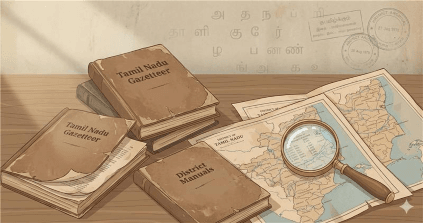
Tamil Nadu district gazetteers are British and Indian government reference volumes — one per district, updated roughly every 30 years between 1870 and 1960 — that document village names, canal and tank histories, famines, crops, markets, and local castes with dates and statistics. They are the single best source for the historical context around a family story: when an ancestral village was renamed, which famine forced a migration, which canal project resettled households. Most volumes are available free at Archive.org and the Tamil Nadu state digital library; they’re searchable by district, year, and village name.
Typical questions gazetteers answer for Tamil families:
- "What was our village called earlier?"
- "When was this canal or tank built?"
- "Which drought or flood was that story about?"
In this article:
- What gazetteers are and what they contain
- How to combine them with your family stories
- How to search and extract what you need
- How TamizhConnect fits in
1. Gazetteer basics – the district’s reference book
District gazetteers and settlement manuals were:
- prepared first in the colonial period,
- updated later in post-Independence times in some cases,
- intended as a reference for administrators.
They usually include:
- physical geography, rivers, tanks and canals
- rainfall and agriculture patterns
- main crops and markets
- population statistics
- brief notes on jati distribution
- information on zamindaris, inam lands, palaiyam estates
For genealogy, they anchor your family into a known historical landscape.
2. Matching family stories with gazetteer data
2.1. Disaster stories
Elders may say:
- “There was a huge famine in those days…”
- “The river flood washed everything away.”
To fix that in time, check the gazetteer:
- famines of particular years in that district
- large floods affecting specific taluks or delta areas
If your family was in that taluk at that time,
you can reasonably connect the story to a documented event.
2.2. Land and irrigation schemes
Family stories about land often mention:
- “Your grandfather helped build this canal”, or
- “This tank was revived in his time.”
Gazetteers and related manuals may record:
- government irrigation projects
- tank desilting schemes
- new canal systems and their dates
Compare:
- scheme dates with your grandfather’s active years,
- scheme locations with your family’s village.
Even if your ancestor is not named,
you get a strong context for his life story.
3. How to search and use gazetteers in practice
3.1. Choose the right volume
Step 1:
- identify the historic district,
remembering that boundaries changed after 1956 and later.
Step 2:
- open the gazetteer for that district,
- use the index to search for:
- your village name
- nearby major town names
- alternate spellings.
You may have to scan for:
- different transliterations,
- older versions of the village name.
3.2. Extract only what is needed
For genealogical work, you mostly need:
- key dates of major events
- information on famines, floods, epidemics
- notes on big land or irrigation changes
Make short, precise notes, for example:
“Trichinopoly District Gazetteer (1907), p.132:
Cauvery flood of 1882 ruined crops in the lower delta.”
Then link that to your family timeline:
- “Grandmother’s story of a major flood that forced them to move
may correspond to this 1882 event.”
4. Using gazetteer data with TamizhConnect
If you are already using TamizhConnect:
- your family members have native villages and current cities
- your tree shows who stayed and who migrated
Now:
- List villages that keep repeating across generations.
- For each such place, find references in the relevant gazetteer.
- Add key events (famine, flood, canal, railway) to your family timeline.
Suddenly, your tree is not just names and dates.
It becomes:
- a story of people moving through real historical events
- grounded in documents your grandchildren can still read.
Gazetteers might look like dry government books,
but for Tamil family historians they are a backbone for place-history.
Your family story is the muscle and skin that hangs on it.
Practical research note
When using gazetteers, copy the exact page title, district, taluk, year, and page number into your family notes. Then connect the historical detail to a specific claim: a village name, irrigation change, famine period, market route, or migration pressure. This turns a background source into evidence that explains why a family lived, worked, or moved in a particular way.