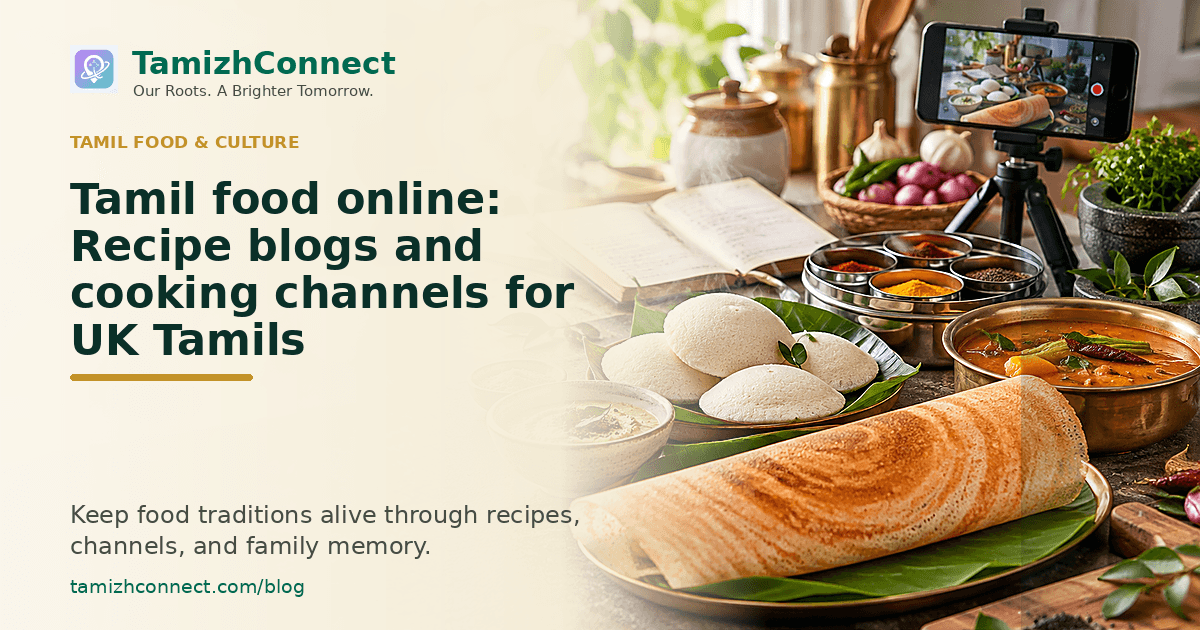
For many Tamils in the UK, the most direct link to home is not the news or the movies — it’s food.
The smell of sambar, the crunch of murukku, the feel of hot idlis on a cold British morning does more for identity than any textbook.
If you want more background on Tamil language and identity in general, read our
guide to Tamil together with this article.
Luckily, Tamil food is one area where the internet actually works in our favour.
1. Why Tamil recipe blogs matter in the UK
In Tamil Nadu, you can:
- Call an aunt for a recipe
- Ask the neighbour how to make a festival sweet
- Learn by watching your grandmother in the kitchen
In the UK, especially if you live away from extended family, that’s harder. Recipe blogs and channels:
- Capture home style cooking
- Translate “eyemeasure” cooking into measured recipes
- Preserve regional variations (Kongunadu, Chettinad, Tirunelveli, etc.)
They are not perfect, but they’re much better than random fusion recipes written for “generic Indian food”.
2. Types of Tamil recipe resources online
You basically have three categories:
- Tamil recipe websites/blogs in English
- Tamil-language cooking blogs
- YouTube cooking channels in Tamil
1. Tamil recipe websites/blogs in English
These are useful if:
- You’re more comfortable reading instructions in English
- You still want authentic Tamil flavours
They often have:
- Step-by-step photos
- Notes on substitutions (for UK ingredients)
- Tips on batch cooking and freezing
2. Tamil-language cooking blogs
These are great for:
- Practising Tamil reading
- Learning original Tamil names for ingredients
- Sharing recipes with older relatives without translating
The downside: sometimes the measurement style assumes prior experience. But if you already cook, they’re powerful.
3. YouTube cooking channels in Tamil
For many people, video beats text. Tamil cooking channels:
- Show texture, colour and consistency
- Explain cultural context (why this dish is cooked for this festival)
- Make it easy for kids to watch and absorb Tamil words while you cook
They are an easy way to mix language exposure with daily life. For a more systematic view on language, see
Learn Tamil and Keep the Culture Alive: A Guide for UK Families.
3. Using Tamil recipes to connect generations
Cooking Tamil food in the UK is not just about nostalgia. It’s a practical way to:
- Keep Tamil words alive (especially food vocabulary)
- Pass down festival traditions in a way children actually remember
- Create stories around dishes that link back to villages and grandparents
Concrete examples:
-
While making pongal, talk about:
- Your grandparents’ village
- What harvest season looked like there
- How the family celebrated
-
While making sambar or rasam, talk about:
- Who in the family was famous for it
- How they adjusted the recipe when they moved abroad
You can then record these stories and link them to specific people inside TamizhConnect.
4. How to build a “Tamil Food Routine” in a UK home
If you want food to actually carry culture, you need repetition, not one-off experiments.
Simple routine ideas:
- One Tamil breakfast day a week: idli/dosa/upma.
- One traditional Sunday meal: sambar, poriyal, pachadi, appalam.
- Festival calendar: decide which festivals you’ll cook something special for (Pongal, Deepavali, Tamil New Year, Karthigai Deepam, etc.).
When children know:
“On this day we always eat this dish, and it came from this person in the family…”
…that’s culture being transmitted, not just calories.
If you want to reinforce the same idea with books and clothing, read
Where to Buy Tamil Books and Traditional Clothing Online in the UK.
5. TamizhConnect and food stories
Food is one of the easiest starting points for family history:
- “This is the recipe your great-grandmother made.”
- “This sweet is from our ancestral village.”
- “Your thatha used to cook this every weekend.”
In TamizhConnect, you can:
- Add notes to a person’s profile like
- “Known for her Mysorepak”
- “Made the best fish curry in the family”
- Record the origin of particular dishes in your family
- Attach photos of festival meals to your family tree
That way, when someone cooks that dish 20 years from now in the UK, they can still trace it back to a name, a face, a village — not just a random recipe link.
Combine this with:
- Learn Tamil and Keep the Culture Alive: A Guide for UK Families – language and routine
- Digital Tamil Life in the UK: News, TV, Music and Movies – background Tamil media
…and your home becomes a place where Tamil language, food and family history all reinforce each other.