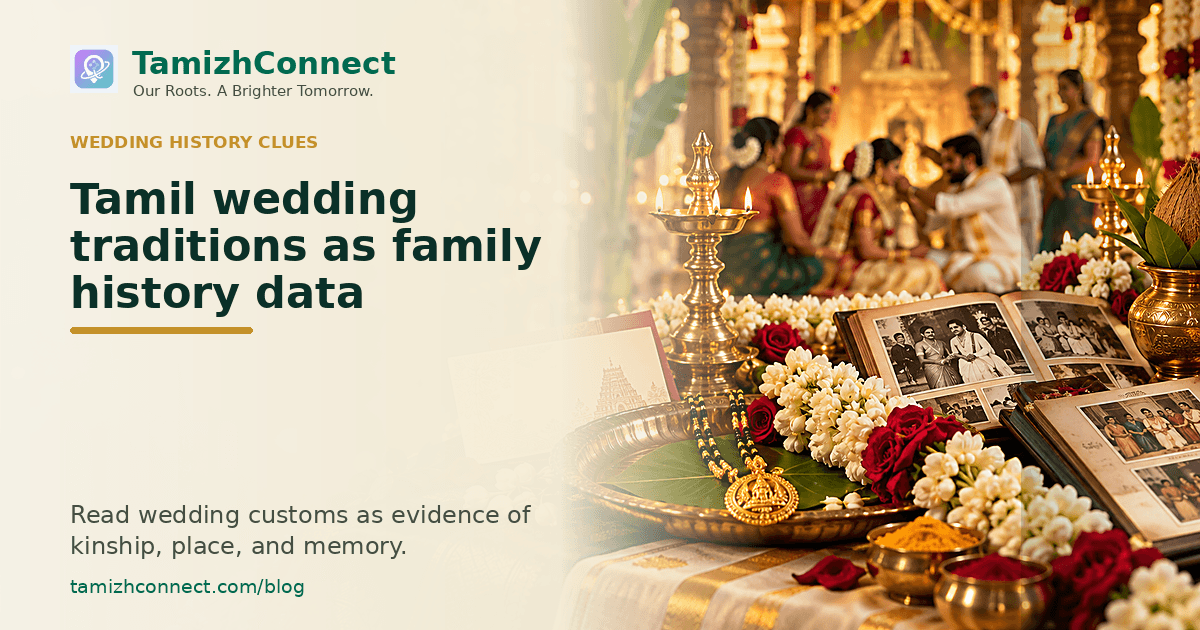
Tamil weddings are not “just” big social events. They are one of the densest data points in your entire family history:
- Both families are physically together.
- Lineage, caste/community, kuladeivam (family deity) and origin village all get checked, negotiated, and announced.
- Photos, videos, invitations, and receipts generate a paper trail you won’t get for most other rituals.
If you treat the wedding as pure drama and decoration, you walk past a goldmine of information that could anchor your family tree for generations.
This is a practical breakdown of Tamil wedding traditions as structured data, not nostalgia.
Start your family tree on TamizhConnect once you finish this checklist, or explore our guide on scanning documents for research to keep every invitation and receipt searchable.
1. Nichayathartham: the “contract” that nobody archives properly
Nichayathartham (engagement / betrothal) is where two family trees collide in a controlled way.
What usually gets decided or revealed:
- Lineage compatibility (gotra, sect, community)
- Kuladeivam and major temples for each side
- Origin villages / ooru
- Agreement on wedding date, venue, and main expenses
Almost nobody saves this information outside a half-broken WhatsApp group.
What you should capture
From the engagement phase, deliberately record:
- Full names of:
- Bride and groom
- Parents (with initials expanded)
- Grandparents, if mentioned
- Kuladeivam details:
- Temple name
- Village / town
- State / district
- Origin village or “family ooru” from both sides
- Any caste/sect/community identifications explicitly discussed
Put this into:
- A TamizhConnect family tree (ideal), or at minimum
- A shared document with clear headings
If you don’t, five years later half the people won’t even remember the temple name correctly.
2. Muhurtham and the core wedding rituals: dense with ancestral clues
Different regions and communities have their own sequences, but the common Tamil wedding core typically includes:
- Kashi yatra (for some sub-groups)
- Maalai maatral (garland exchange)
- Oonjal (swing ceremony)
- Kanya dhanam / kannikadhanam (in some traditions)
- Mangalyadharanam (thaali tying)
- Saptapadi or equivalent steps around the fire
Forget the sentimental commentary. Ask what each section reveals.
2.1 Who actually stands in the ritual roles?
In many weddings, the people who perform or stand-in for specific roles already encode family structure:
- Who gives the bride away? (father alone, both parents, uncle standing in, elder brother, etc.)
- Who ties the thaali if the groom is a child in child-widow remarriage customs (rare now, but historically important)?
- Who carries the lamps, plates, and leads the processions?
These are not random choices. They often reflect:
- Which uncle/aunt is functionally the “head” of a branch
- Which side has more influence or seniority
- How relationships are actually functioning, beyond clean family-tree diagrams
If you’re documenting, create a simple note:
“At Priya & Karthik’s wedding (2023), maternal uncle Raghavan acted as guardian for the bride due to father’s ill health.”
That line tells you relationships and health context without melodrama.
2.2 Kuladeivam, gothram, and community announcements
In many weddings, the priest announces:
- Gothram / lineage
- Devatha / kuladeivam references
- Sometimes the home village names
If you’re smart, you don’t let that disappear into the mic echo.
At least once in your extended family, someone should:
- Record audio of the priest’s announcements
- Later transcribe:
- Gothram name(s)
- Kuladeivam details
- Any explicit village / town references
Store that once in a structured way. Otherwise, every generation will interrogate the same exhausted grandmother about “what gothram are we?” until nobody remembers.
3. Invitations: the most underused genealogical document in Tamil families
Wedding invitations are basically temporary mini family registers:
- Names of both families
- Addresses
- Profession titles
- Sometimes grandparents and “late” relatives listed
- Occasionally, origin village printed explicitly
Then what do people do?
- WhatsApp a JPEG
- Throw away 500 printed copies after the event
- Lose the only copies that had correct spellings
Bare minimum you should do
For every wedding in your close family:
- Keep at least one physical copy of the invitation in a safe place.
- Take a clean, high-resolution scan (front and back).
- Save it with a sensible filename:
2024-01-15_wedding_priya-karthik_invitation.jpg
Then extract:
- Full names, spelled exactly as printed
- Addresses of both families
- Any mention of:
- Native place
- Kuladeivam
- “Granddaughter of Late X and Y” lines
In TamizhConnect terms, you would:
- Attach the scan as media to the wedding event
- Link each named person to corresponding nodes, or create them if missing
4. Photo and video: the only time you get the full cast in one frame
At weddings, you get:
- Cousins from different countries
- Elderly relatives who may not travel again
- In-laws from multiple states and countries
- Childhood friends and neighbours
If you dump all photos into Google Photos with no labels, you’re wasting the biggest identification opportunity you’ll ever have.
Do a post-wedding “who is who” session
Within 1–3 months after the wedding:
- Sit with the bride/groom and at least one elder who knows both sides.
- Open a curated set of 20–50 group photos (not all 2,000).
- For each photo, identify:
- Everyone’s name
- Basic relationship (“mother’s sister’s son”, “neighbour from Kumbakonam”, etc.)
- Add names as:
- Captions
- Face tags
- Or notes linked to that media in your system
You don’t have to tag every photo. You just need enough that future generations can recognise:
- Which branches attended
- When certain elders were last seen together
- Who existed at that time (small kids, new spouses etc.)
5. Regional and caste variations: don’t flatten them into generic “Tamil”
Different communities have very specific customs. If you merge them lazily into “Tamil style wedding”, you erase useful information.
Examples:
- Differences between Iyengar / Iyer / Saiva Pillai / Nadar / Chettiar / Thevar / Christian Tamil weddings
- Regional customs – Kongu, Tanjore, Madurai, Jaffna, Colombo, Malaya Tamils etc.
- Distinct rituals like:
- Kashi yatra
- Paalikai (sprouted seeds)
- Nalangu games
- Manjal Neerattu (turmeric water play)
- Christian Tamil engagement + reception hybrids
You don’t need a PhD in anthropology. Just add notes like:
“Groom side: Nadar community from Tirunelveli; follows tradition of X ritual before thaali.”
“Bride side: Jaffna Tamil Christian; ring exchange and church ceremony done day before Hindu rituals.”
Those one-liners preserve community texture your grandchildren won’t be able to reconstruct later.
6. Diaspora Tamil weddings: India + local law + compromise
If the wedding is in:
- UK, Europe, US, Canada, Australia, Singapore, Malaysia, Gulf…
…you’re almost certainly dealing with:
- A civil registration / church / registry office component
- A Tamil ritual ceremony
- Sometimes two ceremonies to satisfy both sides
From a family history perspective, you should record:
- All legal marriage registrations (country, date, place, certificate number if possible)
- All ritual ceremonies (temple / hall, city, date)
- Which relatives could attend which ceremony
Example entry:
“Legal marriage: London registry office, 2024-06-10. Tamil wedding rituals: Chennai, 2024-12-20, only close relatives attended from groom side due to travel constraints.”
Now the mismatch between photos, legal documents and oral memories makes sense.
7. Brutally practical checklist for any Tamil wedding in your family
If you want an actionable list instead of vague advice, here it is.
For each wedding (including your own), try to capture:
-
Names and basics
- Full names of bride, groom, parents (with initials expanded)
- Tamil spellings if possible
- Contact addresses / towns at the time of wedding
-
Lineage and origin
- Gothram / lineage names (if used)
- Kuladeivam temple name + village
- Stated “native place” for both sides
-
Ceremony details
- Dates and locations of each ceremony (engagement, wedding, reception, registry)
- Key rituals performed (especially those unique to your community)
- Who acted in important roles (guardian, tie-thaali delegate, etc.)
-
Documents
- Scan of invitation
- At least one photo that clearly shows each elder relative with their name written somewhere
- Any marriage registration details (country, certificate reference)
-
Notes
- Any cross-community, cross-language, or international aspects
- Big conflicts or compromises that shaped the ceremony
- Context like “first inter-state marriage in this branch” or “first marriage held abroad”
Feed this into TamizhConnect or whatever system you use, and your “one big noisy wedding” suddenly becomes a high-resolution family data point.
Tamil weddings are expensive, time-consuming, and emotionally exhausting. That’s the reality.
But if you’re going to burn that much time and money, at least extract the ancestral value that’s sitting right there:
- Two family trees intersecting
- Dozens of key relatives in one place
- Lineage, deity, village and community signals being spoken out loud
Capture it once, properly, and your future generations won’t have to reverse-engineer everything from half-remembered stories and pixelated photos. That’s exactly the angle TamizhConnect is built for: turning major life events like weddings into structured, searchable family history instead of one more forgotten folder in your gallery.
Beyond formal wedding rituals, don’t overlook the rich tapestry of Tamil folklore that gets shared during these celebrations. Family stories, paatti tales, and traditional beliefs often contain valuable historical clues about your ancestors. Learn more about preserving Tamil folklore in family traditions to capture these important cultural elements.
For additional resources on Tamil genealogy, explore our guides on understanding Tamil naming conventions and building Tamil family trees.