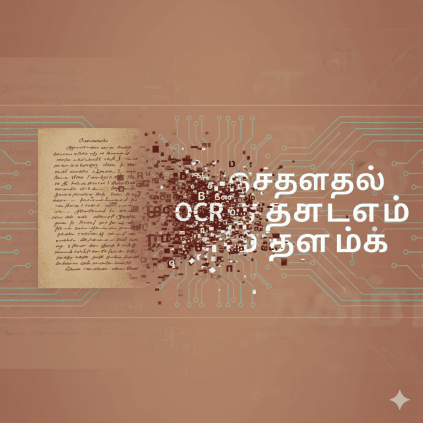
Tamil Ancestry Research | Family Tree Guide
In this article:
- What Tamil OCR actually is (and what people fantasise it is)
- Why Tamil OCR is hard: scripts, fonts, layout, garbage scans
- The different beasts: printed text vs handwriting vs palm leaf
- Typical Tamil OCR errors you’ll see again and again
- A sane pipeline: from paper → image → OCR → human check → TamizhConnect
- How to store OCR text, confidence and corrections in TamizhConnect
- When OCR is worth the pain – and when you should just type manually
1. What Tamil OCR actually is (and what people fantasise it is)
OCR = Optical Character Recognition:
Software looks at an image of text and outputs Unicode text (e.g., Tamil letters) it thinks are present.
People fantasise:
- “I’ll scan a 300-page Tamil book and get perfect searchable text in one click.”
- “I can OCR old newspapers in bulk and instantly search everything.”
- “We can feed temple records into OCR and magically get structured data.”
Reality:
- modern Tamil OCR engines are useful,
- but they are:
- biased towards clean, modern fonts,
- easily confused by old typefaces,
- hopeless with most handwriting,
- blind to structure (columns, tables, headings) unless you do extra work.
In TamizhConnect, Tamil OCR is a tool, not a miracle:
- it helps you accelerate data entry,
- but you must keep the link back to the original image and track errors.
If you treat OCR text as gospel, your archive will be full of silent corruption.
2. Why Tamil OCR is hard: scripts, fonts, layout, garbage scans
Tamil isn’t Latin. Shock.
Tamil OCR runs into a few predictable problems:
2.1. Complex script and ligatures
- Tamil has:
- consonant + vowel combinations,
- pulli (்),
- ligatures and similar-looking shapes.
- Old typesetting often:
- squeezes letters,
- uses odd ligatures,
- blends consonants.
OCR has to guess where one letter ends and another begins. It gets that wrong a lot.
2.2. Fonts and printing quality
- Modern Unicode fonts, high-resolution laser prints = decent OCR.
- 1960s/70s press, broken types, letterpress ink bleed = trash.
- Old grantha-mixed Tamil (for Sanskrit words) – even worse.
If the shapes are weird, smudged or inconsistent, OCR accuracy tanks.
2.3. Layout chaos
Tamil newspapers, magazines, souvenir books, temple books:
- multiple columns,
- sidebars,
- text wrapping around photos,
- headings in one font, body text in another,
- footers/headers repeating.
Basic OCR just reads line by line, and often:
- merges columns,
- jumps across headings,
- mixes unrelated blocks.
So even if character recognition is okay, the order of words can be wrong.
2.4. Garbage scans
If your scans are:
- low resolution,
- skewed (tilted pages),
- shadowed,
- warped (phone camera with curved pages),
- water-damaged, stamped, scribbled over,
then OCR will happily output nonsense.
Garbage in, garbage out. No surprise there.
3. The different beasts: printed text vs handwriting vs palm leaf
Group them properly, or you’ll expect miracles where there’s no hope.
3.1. Modern printed Tamil (books, PDFs, reports)
This is where OCR is most useful:
- clean fonts,
- straight lines,
- standard Unicode text originally (if PDF is born-digital).
Two cases:
-
Image-only PDF / scanned book
- OCR can often reach decent accuracy (70–95%) with good settings.
- You still need human review, but far less typing.
-
Real text PDF
- No need for OCR; you just extract text.
- If it’s in legacy encoding (non-Unicode), you have an encoding problem, not an OCR problem.
3.2. Old printed Tamil (pre-1980 typefaces, small letters, newspapers)
Here it gets ugly:
- older fonts, smashed letters, ink spread → OCR accuracy drops hard.
- newspapers with tiny text, poor contrast, bulk printing.
You may get:
- enough to search roughly,
- not enough to trust for names or precise quotes.
3.3. Handwriting (letters, notebooks, kovil records, school notes)
Most consumer-level Tamil OCR for handwriting ranges from bad to useless:
- highly variable handwriting styles,
- odd spacing,
- corrections and overwriting.
Do not expect a tool to reliably OCR:
- ancestral letters,
- temple pooja notebooks,
- village-level registers with handwritten Tamil.
For now, treat these as manual data entry tasks with maybe some helper tools (zoom, contrast).
3.4. Palm leaf, copper plates, old inscriptions
Forget it for off-the-shelf OCR:
- stylised scripts,
- erosion,
- unusual ligatures.
Specialist academic projects can sometimes OCR bits; you are not running those at home.
For TamizhConnect, treat this as:
- manual transcription by experts,
- then store as normal text with source images.
4. Typical Tamil OCR errors you’ll see again and again
You need to recognise error patterns so you don’t get fooled.
Common errors:
-
Confusing similar shapes
மvsம்,நvsன,ஃvs punctuation blobs.- Pulli sometimes dropped or misplaced → consonants misread.
-
Breaking or merging clusters wrongly
காread asக + அ + something,- vowel signs misaligned,
ன்vsந்etc.
-
Numbers and punctuation issues
1vsl,- Tamil numerals vs Arabic numerals,
- quotes/brackets turned into random glyphs.
-
Column mixing
- two columns read as one long line: text becomes nonsense.
- headings inserted mid-sentence.
-
Name-specific butchering
- proper names often unique → models are weakest here.
திருச்செந்தூர்becomes all sorts of junk.- village names, caste titles, old-style words get hammered.
The danger:
- you skim an OCR output that looks Tamil-ish,
- your brain auto-corrects silently,
- you don’t realise how many letters are wrong.
So for names, places, key facts: you always check against the image.
5. A sane pipeline: from paper → image → OCR → human check → TamizhConnect
You want a repeatable process, not random experiments.
5.1. Step 1 – Scan properly
- Use at least 300 dpi; 400+ for small fonts.
- Keep pages flat; no curved book spines if you can avoid it.
- Good lighting if using a phone; avoid shadows, glare.
- Scan in grayscale or colour; avoid heavy compression.
Garbage scans mean garbage OCR. Don’t cheap out here.
5.2. Step 2 – Pre-process images
Options (if you have tools):
- deskew (straighten tilted pages),
- crop unnecessary borders,
- increase contrast slightly if text is faint,
- remove obvious blemishes (staples, stamps, doodles) only if easy.
Don’t overdo filters; you can easily make things worse.
5.3. Step 3 – Run OCR with clear expectations
Pick a Tamil-capable OCR engine (could be open-source or commercial).
Key settings:
- ensure language is set to Tamil, not “auto” or “English only”,
- if mixed English/Tamil, expect more errors.
Run OCR and save:
- plain text (for search),
- optionally hOCR / ALTO / layout-aware formats if you care about coordinates.
5.4. Step 4 – Human review / correction
Now the boring but essential part:
- For critical sections (names, villages, genealogical details):
- compare OCR text line by line with the image.
- correct errors, especially:
- names,
- dates,
- place names,
- caste/community terms.
For less critical descriptive text:
- you might accept 90–95% correctness,
- but at least skim for catastrophic errors (wrong dates, broken sentences).
5.5. Step 5 – Import into TamizhConnect with proper links
For each source (book/article/document):
- store:
- the image/PDF itself,
- the OCR text,
- a flag:
"ocrReviewStatus": "raw" | "partially-reviewed" | "fully-reviewed"
- optional
ocrAccuracyEstimate: rough % from your sampling.
Then:
- extract key facts (names, dates, places) into structured fields,
- each such fact should remember:
sourceId,- page number,
- line reference if you want to be fancy.
That gives you traceability back to the original, not just floating text.
6. How to store OCR text, confidence and corrections in TamizhConnect
If you’re casual here, you’ll never know what is trustworthy.
6.1. Per document source
For each document you OCR:
sourceIdtitle,author(if known)yearApproxfileLink(PDF/image)ocrText(full or per page)ocrReviewStatus:"none" | "raw" | "partial" | "complete"ocrAccuracyEstimate: e.g. 0.7, 0.9 – from sample checkingocrNotes: e.g.,- “Old newspaper font, names unreliable.”
- “Temple souvenir book; headings and captions messy.”
6.2. Per extracted snippet / quote
When you extract a line or paragraph into some profile or note:
- attach:
sourceId,pageNumber,ocrCorrectedText: the text after human correction,ocrOriginalText: optional, raw OCR if you want to keep it,reviewer+dateReviewed.
This way:
- when someone spots a mistake later, they can:
- compare with the scan,
- fix
ocrCorrectedText, - leave
ocrOriginalTextas record of initial machine output if you care.
6.3. Confidence per fact
For each fact derived from OCR (e.g., “Person X was born in Village Y per Doc Z”):
- set:
evidenceType:"ocr"confidence:"high" | "medium" | "low"reviewStatus:"checked-by-human"or"machine-only".
Any fact with "machine-only" and "low" confidence should not drive serious decisions (like merging people, changing key dates) without confirmation.
7. When OCR is worth the pain – and when you should just type manually
You don’t use a hammer on every problem just because you own one.
7.1. OCR is worth it when:
-
You have hundreds of pages of reasonably clean printed Tamil.
- Books, reports, magazines, newspapers, souvenir books.
-
You care about:
- searching text across documents,
- quickly finding occurrences of:
- names,
- villages,
- caste titles,
- keywords.
-
You are willing to:
- invest time in scanning properly,
- do targeted human correction for important sections.
Result:
- 80–90% correct full-text search,
- hand-corrected key passages for genealogy.
7.2. OCR is not worth it (today) when:
- The source is handwritten Tamil (letters, notebooks, temple records, school notes).
- The pages are:
- too damaged,
- too stylised,
- too cramped/scribbled.
- You only need:
- a short passage,
- a handful of names / dates.
In those cases, brute-force manual typing + careful checking is cleaner and faster than fighting a broken OCR output.
7.3. Practical rule of thumb
Ask yourself:
“Will the time I spend cleaning OCR errors be less than the time to type this from scratch?”
If the answer is no, skip OCR for that document.
If you use Tamil OCR like a grown-up:
- you get searchable archives,
- faster data entry for long printed sources,
- and a clear separation between raw machine text and human-checked facts.
If you treat it like magic:
- you’ll dump raw OCR junk straight into TamizhConnect,
- never track confidence or review,
- and end up with a tree and source database full of subtle misspellings, wrong villages and mangled names.
Your choice: tool or trap. Use Tamil OCR, but never trust it blindly.
For more information about document handling in genealogy, explore our guides on document extraction and conversion and record verification techniques.