Tamil Ancestry Research | Family Tree Guide
In this article:
- Why sound endings matter in Tamil names
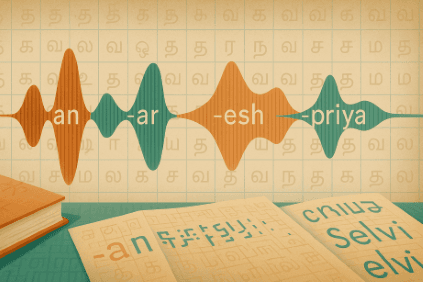
-an: the default “male-feeling” ending-ar: respect, plurality and name endings-esh: Sanskrit-flavoured modern favourite-priya: affection, love and soft-power names-selvi: older feminine pattern that still leaks through- How to model stems + endings in TamizhConnect without over-interpreting
1. Why sound endings matter in Tamil names
Tamil names are not random syllable soup.
A lot of “this sounds right” comes from sound patterns at the end of names:
-an– Karthikan, Vasantan, Ganeshan-ar– Vijayar, Kanniar (less common as strict ending, more as respectful form)-esh– Vijayesh, Karthikesh, Saravesh-priya– Deepapriya, Kavipriya, Anupriya-selvi– Kalaselvi, Bhuvanaselvi, Muthuselvi
These patterns:
- signal gender expectations (not perfectly, but strongly),
- carry Sanskrit vs Tamil vs English influence,
- track time periods (some endings are obviously “1980s / 1990s modern”, some are older),
- leak class/urbanisation/film influence.
If you pretend they don’t matter, you’re blind.
If you over-interpret them (“all -esh are X caste / Y religion”), you’re stupid.
Your job in TamizhConnect is:
- recognise patterns,
- store them cleanly,
- never derive caste, religion or exact meaning purely from sound endings.
2. -an: the default “male-feeling” ending
2.1. What it roughly signals
Names ending in -an (or -n in Tamil script) feel “masculine” in common usage:
Karthik**an**Vasant**an**Aravind**an**Vaidyaling**am/Vaithiyaling**am(similar effect)Murugan,Subramanian,Ganesan,Raman, etc.
That’s NOT a law. There are exceptions. But if you see an -an ending, chances are it’s being treated as a male name.
2.2. Origins and behaviour
You get -an from:
- pure Tamil words/names,
- Tamilised forms of Sanskrit names,
- old and modern coinages.
It shows up in:
- personal names,
- titles (e.g.,
-anin epic/royal names), - pen names,
- god names (Murugan, Karthikeyan, etc.).
-an on its own does NOT tell you:
- caste,
- religion,
- region,
- class.
It’s just a productive masculine pattern.
2.3. How to store in TamizhConnect
For a name like Vasanthan:
nameFullLatin:"Vasanthan"nameTamil:வசந்தன்(if known)nameStem:"Vasanth"nameEndingPattern:"-an"
You can later:
- search “all names with
-anending”, - see gender patterns,
- see which decades favoured which stems.
What you don’t do:
- auto-tag all
-annames as male without checking actual person data. Use it as a hint, not a fact.
3. -ar: respect, plurality and name endings
-ar is trickier because it shows up:
- in grammar (plural/respect),
- in titles (e.g., “Ayyaar” → “Aiyar/Ayyar” type endings),
- inside names (sometimes fossilised).
You won’t get as many clean everyday given names ending just in -ar as with -an or -esh, but you will see:
Kumara**r**,Vijaya**r**in some regional forms,Pillar/Pillaiyar/Pillayar-type sacred names,- respectful address:
Rajar(spoken “Raja + ar”),Annar,Avaretc., in narrative.
For genealogy:
- treat
-arcautiously. - When you see something that might be a respectful form (e.g.,
Rajarin a story), don’t confuse it with the actual registered name.
In TamizhConnect, for oral stories:
- record both:
- the registered name (e.g.,
Raja), - the respect form used in speech (e.g.,
Rajaar,Rajar),
- the registered name (e.g.,
- tag
nameEndingPatternonly for the actual name, not every respectful variant people use.
Don’t overcomplicate this one. The important part is: don’t treat respectful -ar forms as totally separate people.
4. -esh: Sanskrit-flavoured modern favourite
4.1. What you actually see
Names like:
Vijay**esh**Karthik**esh**/Karthig**esh**Sarav**esh**Yog**esh**(also common in North India)- Endless film-inspired coinages that shove
-eshonto some stem.
This is very obviously:
- Sanskrit-ish / pan-Indian sounding,
- heavily used in 80s onwards urban/aspirational naming,
- gendered male in real-world usage.
4.2. What it usually means (and what you don’t know)
Often from or echoing Sanskrit roots that imply:
- lord, ruler, chief (
-eśa/-eshfromīśa), - combined with some quality (
Yogesh,Mahesh, etc.).
But once it enters Tamil creative naming:
- half the parents don’t know or care about the Sanskrit meaning,
- they’re going for sound + vibe more than dictionary sense.
So in TamizhConnect:
- don’t waste time reverse-engineering Sanskrit etymology unless you know the family actually cared.
- Do log:
nameStem:"Karthik",nameEndingPattern:"-esh".
Makes it easy later to see:
- which branches got
-eshwaves, - how it correlates with migration, education, films, etc.
5. -priya: affection, love and soft-power names
5.1. Usage pattern
-priya is aggressively used in feminine names (and occasionally unisex):
Dee**priya**Anu**priya**Kavi**priya**Nila**priya**Siva**priya**
From Sanskrit/Tamil blends: “priya” = beloved, dear.
In practice:
- modern, slightly “soft” vibe,
- very popular from late 20th century onwards in many Tamil-speaking families,
- crosses caste/class boundaries easily.
5.2. Inference limits
Again:
- strong female association in practice,
- not a reliable caste marker,
- not a reliable religion marker (you’ll see it among Hindus, some Christians, naming-influenced families across groups).
In TamizhConnect, for Kavipriya:
nameStem:"Kavi"nameEndingPattern:"-priya"likelyGenderAtBirth:"female"(if you store that),- BUT confirm with actual data (documents / family, not just suffix).
Useful queries later:
- “How many
-priyanames post-1980?” - “Which branches renamed themselves between
-selviand-priya?” - “Do
-priyanames correlate with certain migrations/education patterns?”
That’s serious analysis. Just guessing gender and stopping there is lazy.
6. -selvi: older feminine pattern that still leaks through
6.1. What you see
Names like:
Kala**selvi**Bhuvana**selvi**Muthu**selvi**Shanthi**selvi**
Selvi itself can be a standalone name, but as a suffix it carries:
- “young woman / young lady / maiden” flavour,
- older Tamil naming style (especially mid-20th century),
- strong rural / small-town associations in some people’s heads.
Generationally, you’ll often see:
- Grandmother:
X Selvi - Aunt:
Y Lakshmi / Y Priyahybrid patterns - Younger:
Z Priya,Z Shree,Z Riyaetc.
6.2. How people treat it now
Some branches:
- drop
-selvicompletely for the next generation, - switch to
-priya,-shree, or purely English endings for a “modern” vibe, - only keep
Selvias a nickname inside family.
If you don’t record it properly, it vanishes from the dataset and you lose a visible generational marker.
6.3. How to store
For Muthuselvi:
nameStem:"Muthu"nameEndingPattern:"-selvi"legacyPattern:true(if you want to mark older-style endings)
You can then later look at:
- how quickly
-selvideclines in your tree, - which branches held onto it,
- whether drop/retention correlates with migration or politics.
7. How to model stems + endings in TamizhConnect without over-interpreting
7.1. Add a simple sound-pattern structure
Per name, add:
nameFullLatin: raw chosen Latin formnameTamil: Tamil script if knownnameStem: whatever comes before the ending pattern (your best guess, but be consistent)nameEndingPattern:- one of
"-an","-ar","-esh","-priya","-selvi", ornull/"other"
- one of
- optional:
patternConfidence:"high"if obvious,"medium"if guessed.
Example:
nameFullLatin: "Kavipriya"
nameStem: "Kavi"
nameEndingPattern: "-priya"
patternConfidence: "high"
nameFullLatin: "Karthigesan"
nameStem: "Karthig"
nameEndingPattern: "-an"
patternConfidence: "medium"   (because spelling is messy)
7.2. Use patterns as hints, not absolute truths

Things sound obvious, but you still need discipline:

Gender:

-an, -esh → often male;

-priya, -selvi → often female;

still confirm with actual data.

Caste / religion:

never infer from endings alone. If you want to track caste or religion, use explicit fields with sources.

Patterns are for:

cluster analysis,

time trends,

“when did this naming fashion enter our family?”,

not for lazy stereotype short-cuts.

7.3. Document naming shifts explicitly

When you see a clear pattern shift:

-selvi → -priya → -shree / English names,

-an → -esh,

traditional Tamil names → Sanskrit-heavy combos,

add notes at branch level:

“Post-1990, this branch shifted from -selvi to -priya endings for girls; probably influenced by urban schooling and TV serials.”

You don’t need a full PhD thesis, but you do need to acknowledge change, not pretend the pattern was always like today.

7.4. Practical next steps

Pick 30–50 names from your existing TamizhConnect data.

For each, fill:

nameStem,

nameEndingPattern (only if it matches something obvious like -an, -esh, -priya, -selvi).

Run simple filters:

How many -selvi vs -priya vs -esh vs -an by decade of birth?

Look at branch differences:

Which lines went heavy on -esh?

Which lines still have -selvi names in recent decades?

Do this and you’ll stop hand-waving about “modern names vs old names” and actually see how your family shifted over time.

But they're useful signals.
Treat them as structured, searchable data in TamizhConnect instead of vague vibes, and they start telling you something real about time, gender expectations, and cultural drift in your own tree.

For more information about Tamil naming conventions, explore our guides on [understanding Tamil naming patterns](/blog/tamil-names-ancestry) and [handling multiple name variants](/blog/multiple-name-variants-en).