Tamil Ancestry Research | Family Tree Guide
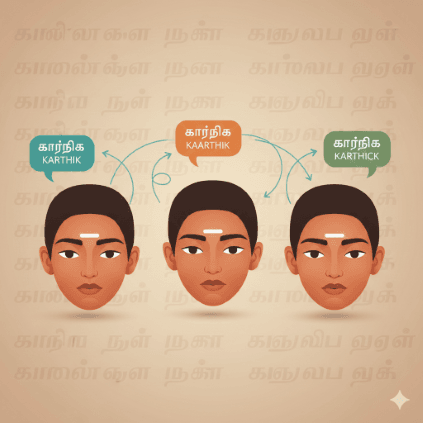
The same Tamil person can appear across records as "R. Muthukumar", "Muthukumar R.", "Ramasamy Muthukumar", "MUTHU KUMAR", "Muthu", and "M. Kumar" — six name variants for one individual. Variation comes from six predictable sources: initial order switches (A. S. ↔ S. A.), transliteration differences (Subramaniam / Subramanyam / Subramanian), diminutives used at home ("Muthu" for Muthukumar), clerks splitting compound names ("Muthukumar" → "Muthu Kumar"), English-language uppercase vs title-case conventions, and married-name changes for women. For genealogy matching you need to store all observed variants against one canonical person — never de-duplicate by string equality.
In this article:
- What “name variants” actually are
- The main types of variation you’ll see
- Why variants matter for genealogy (and how they break matching)
- How to model name variants properly in TamizhConnect
- How to decide on a “canonical” name without cheating
- Cleaning old data full of random variations
1. What “name variants” actually are
One person. Many versions:
R. MuthukumarR MUTHUKUMARMuthukumar RRamasamy MuthukumarMuthu- name in Tamil script,
- name in Sinhala script,
- name in English with three different spellings.
All of those can be the same person.
A name variant is any distinct textual form of the same person’s name that appears:
- in different documents,
- in different languages/scripts,
- in different time periods,
- in different social contexts (home vs office vs foreign country).
If you treat each variant as a different person, your tree becomes junk.
If you forcibly collapse everything into one form and pretend the rest never existed, you lose evidence and break future matching.
You need one person, many name variants, not many half-people.
2. The main types of variation you’ll see
Get clear about the categories, instead of calling everything “spelling mistake”.
2.1. Script variants (Tamil, English, Sinhala, etc.)
Same name, different script:
- Tamil:
முத்துகுமார் - English:
Muthukumar,Muthukumar - Sinhala or other scripts: another layer again.
These are not errors, they’re representations. Treat them as such.
2.2. Spelling variants (Latin script)
Common patterns:
Kumaravel,Kumaravelu,Kumaravell,KumarevelTharmalingam,Dharmalingam,DarmalingamThiruchendur,Tiruchendur,Trichendur
Reasons:
- different transliteration habits,
- different clerks/officers,
- system limits (no space, no diacritics),
- people trying to look “modern” or “easy for foreigners”.
2.3. Order variants (initial/given-name ordering)
Examples:
R. Natarajan↔Natarajan RLalgudi Ramasamy Natarajan↔Natarajan Lalgudi Ramasamy
When systems force “first name / last name”, parts get shuffled.
Content is same, order is chaos.
2.4. Expansion and compression variants
Initials vs expanded names:
R. Muthukumar↔Ramasamy MuthukumarS.K. Kumar↔Subramanian Krishnan Kumar
Sometimes expansion is true; sometimes people guess the expansion later.
You can’t treat all expansions as equally reliable.
2.5. Nicknames and pet names
Every family has:
Muthu,Raja,Baby,Bala,Chinna,Periya,Appu, etc.
These can appear in:
- school registers,
- ration cards,
- early ID proofs,
- WhatsApp contact lists.
You don’t get to ignore them. You also don’t get to pretend “Muthu” is a formal given name if it never was.
2.6. Religious / political / caste-change variants
People may change or add names when:
- converting religion (or re-converting),
- entering religious life (swami, sannyasi, fr., sr.),
- dropping caste markers,
- adding titles (Dr, Advocate, Prof, Thiru, Maulana, etc.),
- entering or leaving militant/political groups.
Example:
K. Ramasamy→K. Rajan(to drop caste)Selvi→Sister Mary SelviBalasubramanian→Bala Subramaniam→Bala S.abroad.
Each stage is a different variant.
3. Why variants matter for genealogy (and how they break matching)
If you’re sloppy with variants, three things happen:
-
Duplicate people – same person appears as:
R. Natarajan,Ramasamy Natarajan,Natarajan R,
and you think they’re three cousins instead of one individual.
-
Broken links – you mis-match:
Dharmalingamparent withTharmalingamchild,- Jaffna spelling vs Colombo spelling,
- Tamil vs English name.
-
False confidence – you say “records don’t exist” when in reality:
- they exist under a slightly different spelling,
- or in a different script,
- or with the village name attached/detached.
The point is not cosmetic.
If you track variants properly, you can:
- search once and catch all forms,
- link documents correctly,
- reconstruct life histories without guessing.
4. How to model name variants properly in TamizhConnect
You need one core profile per person, with a structured list of variants.
Conceptually, per person:
canonicalName– the form you’ll use as the main label inside your system.nameVariants[]– a list of all significant observed forms, with metadata.
4.1. Canonical name: what it is not
It is not:
- the fanciest English spelling,
- the latest passport version,
- the name you like best.
It is simply:
a stable internal handle that makes the profile easy to read and search.
You’ll decide how in section 5.
For now, accept that the canonical name is a tool, not a historical truth.
4.2. Variant structure
Each variant should have at least:
value– the raw text (e.g.,"R. Muthukumar","MUTHU KUMAR","முத்துகுமார்")script–"ta"(Tamil),"en"(English),"si"(Sinhala), etc.type– one of:"official_document"(passport, NIC, Aadhaar, birth cert, school cert),"everyday_use"(what family, friends actually used),"nickname","religious_name","guessed_expansion","data_entry_error"(if you know it’s wrong but appears in a document),
context– short description:"10th standard mark sheet","Sri Lankan NIC","Canada PR card","spoken name at home","Whatsapp contact name".
yearRange– approximate period when this form was actively used:"1970–1985","2000–present","unknown".
source– where you got it:"photo of passport","told by X (b. 1950) in 2022","school record".
confidence–"high","medium","low".
That’s the minimum to make the variant useful instead of noise.
4.3. Example variant list for one person
Person: commonly known as R. Muthukumar.
Variants might look like:
-
"value": "R. Muthukumar",
"script": "en",
"type": "official_document",
"context": "school records, India",
"yearRange": "1975–1990",
"source": "SSLC certificate photo",
"confidence": "high" -
"value": "R MUTHUKUMAR",
"script": "en",
"type": "official_document",
"context": "passport (India)",
"yearRange": "1992–2010",
"source": "passport scan",
"confidence": "high" -
"value": "Muthu",
"script": "en",
"type": "nickname",
"context": "home and friends",
"yearRange": "childhood–present",
"source": "oral, multiple relatives",
"confidence": "high" -
"value": "ராமசாமி முத்துகுமார்",
"script": "ta",
"type": "guessed_expansion",
"context": "later reconstruction – initial R assumed to be Ramasamy",
"yearRange": "reconstructed 2024",
"source": "based on father’s profile; no official doc with full form",
"confidence": "medium" -
"value": "Ramasamy Muthukumar",
"script": "en",
"type": "guessed_expansion",
"context": "used in Canadian immigration forms",
"yearRange": "2005–present",
"source": "PR card, self-chosen expansion",
"confidence": "high"(for usage, lower for “historical correctness”)
All of these hang under one person.
5. How to decide on a “canonical” name without cheating
You must pick one canonical form so the UI is not a mess. But do it in a way you can defend.
5.1. Simple rule that usually works
If the person spent most of their adult life in Tamil context:
- use a clean Tamil-style form as canonical:
- e.g.,
"R. Muthukumar"or"Ramasamy Muthukumar"
- e.g.,
- or, if you care about script, the Tamil script version as canonical display.
If the person lived most of their life under a foreign bureaucratic system where a different form dominates:
- consider using the primary official-document form as canonical:
- e.g.,
"MUTHUKUMAR RAMASAMY"from passport or"Ramasamy Muthukumar"from PR card.
- e.g.,
The key is consistency across siblings and branches, not chasing some mythical “real” name.
5.2. Never silently overwrite past reality
If the family later “fixes” a name:
- adds a surname,
- changes spellings,
- drops caste markers,
- changes religious names,
you can adopt the new form as canonical for future convenience.
But you must keep older variants in the list, with dates and context.
Example note:
Canonical name set to “Karthik Rajan” from 2010 onwards; earlier documents show “K. Ramasamy” and “Karthik Ramasamy”. Name change done to drop caste marker.
The canonical name is a convenience.
The variant list is your evidence.
6. Cleaning old data full of random variations
If your existing data is a trainwreck (it probably is), you fix it in stages, not with one magic script.
6.1. Group obviously-related variants
Start with a small subset.
For each suspected cluster like:
R. Natarajan,R Natarajan,Natarajan R,Ramasamy Natarajan,Ramasami Nadarajan,
ask:
- Do they share:
- same spouse?
- same children?
- same dates?
- same village / ooru?
- same job / migration path?
If yes, they’re very likely the same person.
Merge into one profile and push all textual forms into nameVariants.
6.2. Tag obvious data-entry errors
If one spelling is clearly a typo:
Mutthukumarin one Excel cell while everything else isMuthukumar,
you don’t delete it. You log it as:
type: "data_entry_error",- context:
"old spreadsheet, manually typed", - confidence:
"low".
Future you (or someone else) will thank you when they find some stray record.
6.3. Keep ambiguity when you genuinely can’t decide
Sometimes two variants might be:
- same person,
- or two cousins with similar names.
If you can’t resolve:
- do not merge.
- Keep them as separate profiles, but:
- add cross-notes:
- “May be same as profile X; not merged due to lack of proof.”
- keep an eye out for evidence (age, spouse, children, location) to decide later.
- add cross-notes:
Guess-merging is worse than leaving them separate.
7. What to do next (practical, not fluffy)
- Pick one person you know well (living or recently dead).
- Make a list of every version of their name you’ve seen:
- in Tamil script,
- in English (all spellings),
- in other scripts,
- nicknames,
- religious / political names.
- In TamizhConnect, create or update their profile:
- choose one canonicalName for internal use,
- build a nameVariants list with:
- value, script, type, context, yearRange, source, confidence.
- Repeat for 5–10 key ancestors, especially those:
- who migrated,
- who crossed languages (Sri Lanka → India, India → Gulf/West),
- who changed religion / caste markers.
- Only after that, start cleaning your bigger spreadsheets:
- grouping variants under single profiles,
- documenting typos,
- and writing notes where you are not sure.
If you actually treat multiple name variants as structured data – not as “spelling mistakes” – TamizhConnect will give you:
- much better matching across messy documents,
- clearer migration and identity histories,
- and far fewer fake “extra cousins” created by nothing more than stray dots, capital letters and lazy clerks.
Practical research note
Name variants should be stored as aliases, not as separate people. Keep the original spelling from each document, then add a normalized search form and a note explaining where it came from. If a variant includes an initial, village label, title, or spelling mistake, tag that reason. This helps prevent duplicate ancestors while preserving the original record evidence. Add one more field called "preferred display name" only after the evidence is clear. That lets the tree stay readable for relatives while the underlying aliases remain searchable and auditable.