Tamil Ancestry Research | Family Tree Guide
In this article:
- What we mean by “migration paths”
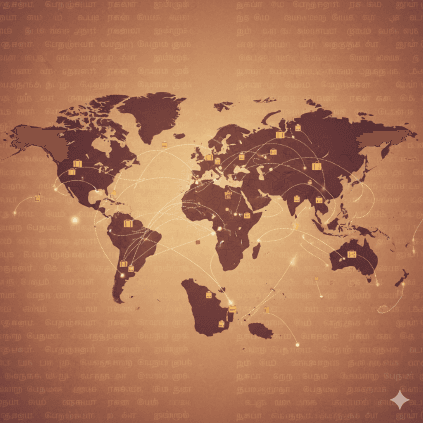
- Why Tamil migration is almost never a clean line
- The specific problems when you try to draw it in a tree or on a map
- How to break messy movements into usable segments
- How TamizhConnect can hold complex paths without lying
- Practical steps to start mapping migration in your own family
1. What we mean by “migration paths”
When people say “Our family migrated from X to Y”, it usually hides a lot of detail.
A migration path is not just:
- “Village → City”
- or “India → Foreign country”.
A serious migration path record should include:
- multiple stopping points,
- reason for each move (work, marriage, study, violence, poverty, politics),
- timeframe (even approximate),
- whether the move was temporary or permanent,
- whether the person intended to return or not.
Real life example (simplified):
Village near Kumbakonam → Madras harbour → Colombo → hill-country estate → back to village → again to Colombo → then to London.
Most family stories compress all this into:
“He went to Ceylon and then the UK.”
That compression makes migration look simple.
It was not.
2. Why Tamil migration is almost never a clean line
If you pretend Tamil migration is linear and neat, you will build fake histories.
Common realities:
2.1. Circular, not one-way
People don’t just leave home once:
- they shuttle back for marriages, funerals, temple festivals,
- they send children back to grandparents,
- they retire back to the “ooru” after decades abroad.
So you get loops:
- Village → City → Village → Different City
- India → Ceylon → India → Malaysia → India
2.2. Layered within one generation
One person can have:
- a birth place,
- a childhood place,
- a work city,
- a marriage place,
- a retirement place – all different.
If your tree only stores “Place: Chennai”, you lose most of the movement.
2.3. Hidden internal moves
Even within one city:
- multiple rented houses,
- different slums / colonies / company quarters,
- unregistered address changes.
Poor and working-class movement often never appears in formal records.
2.4. Forced and semi-forced moves
Not every move was a “choice”:
- eviction, floods, drought, riot, state projects, estate contracts, debt, war.
Families later rewrite it as:
- “We shifted for better opportunities.”
That’s a polite version. It erases pressure and coercion.
3. Why migration paths are hard to show in trees and maps
The problem is not just the data – it’s the model you’re using.
3.1. Family trees are about people, not places
A normal tree links:
- parent ↔ child,
- spouse ↔ spouse.
It does not naturally show:
- when or why each person moved,
- how multiple people travelled together,
- who stayed behind.
If you dump migration into a standard tree, you get clutter or lies.
3.2. Maps assume neat start and end points
Map pins are brutal:
- one point for “origin”,
- one point for “destination”.
But our reality is:
- ambiguous villages (“somewhere near X”),
- old names, boundary changes, merged municipalities,
- overlapping routes over multiple decades.
A line on a map suggests more precision than you actually have.
3.3. Timelines need dates you don’t have
To show a path over time, you need:
- at least rough start and end years for each segment.
Often you only know:
- “Before the war”,
- “Around the time of the big cyclone”,
- “When the sugar mill opened”.
You can still work with this, but only if you admit you are approximating.
4. Breaking messy movements into usable segments
If you want TamizhConnect (or any tool) to handle migration sensibly,
you must break it down.
4.1. Think in segments, not in journeys
For each person, define migration segments:
- [Place A] → [Place B]
- with reason, approx period, confidence level.
Example:
- Segment 1: “Village near Thiruvaiyaru → Madras harbour (c. 1938–1940). Reason: labour recruitment for Burma; medium confidence.”
- Segment 2: “Madras → Rangoon. Reason: ship labour; low confidence (family only says ‘Burma’).”
Segment-level clarity is more honest than a fake “Thiruvaiyaru → Rangoon” direct line.
4.2. Use rough time windows
You will often not know exact years. Use:
- c. 1930s
- “late 1960s”
- “before 1947”
- “between 1980–1985”
Store these as:
- start year (approx)
- end year (approx)
- plus a note explaining the guess:
“Estimated based on daughter’s birth year (1963) being in Chennai.”
4.3. Separate physical move from emotional identity
A person can live in:
-
Chennai for 40 years,
yet still call themselves: -
“Kumbakonam people”.
In your data:
- record current residence,
- record ancestral ooru,
- record self-claimed identity (“still says he is from Kumbakonam even after 4 decades in Bangalore”).
This makes future interpretation easier and more accurate.
5. How TamizhConnect can hold complex migration paths without lying
TamizhConnect cannot magically fix messy reality.
But it can give you structures that are at least honest.
5.1. Use dedicated migration notes for each person
For any person with known movement, add a “migration” section:
- bullet-list each segment:
- From, To, Approx period, Reason, Confidence, Source.
Example:
- From: Kallidaikurichi → To: Colombo
- When: c. 1950–1952
- Reason: joined brother in shop work
- Confidence: medium
- Source: Told by S. Lakshmi (b. 1945) in 2022
This reads better than one vague sentence dumped into a biography.
5.2. Use tags to group similar patterns
Tag people and stories with:
#estate-labour#gulf-migration#urban-slum-to-apartment#partition-move#refugee#return-migration
Over time you can see:
- how many from your extended family share the same pattern,
- which branches became “middle-class” because of a single migration jump.
5.3. Accept that some paths stay incomplete
In your TamizhConnect notes, explicitly mark:
- “Path incomplete – only know he worked ‘in the North’ for a few years.”
- “Don’t know whether she ever returned to village after marriage – unresolved.”
This is more useful than pretending the person simply teleported from one place to another.
6. Practical steps to start mapping migration in your own family
Don’t overthink. Start with concrete moves you already know.
6.1. List first known moves for 5–10 people
For example:
- “Thanjavur side village → Chennai”
- “Jaffna → Madurai”
- “Village near Erode → Coimbatore → Gulf”
Write each as:
- person,
- from,
- to,
- rough when,
- why (even if vague).
6.2. Talk to elders with tight, specific questions
Instead of asking:
- “Tell me about our migration history” (too broad),
ask:
- “Before that house in Saidapet, where did we live?”
- “When you say ‘he went to Malaya’, do you know which estate or town?”
- “Did he go alone or with relatives / neighbours?”
Every answer becomes another segment.
6.3. Enter segments into TamizhConnect and keep revising
For each person:
- Add basic profile.
- Add 1–3 migration segments with:
- from, to, period, reason, confidence, source.
- Add tags (
#migration, plus more specific ones). - Update when you get better information, without deleting your earlier notes – just mark what was corrected.
If you keep doing this over years, you will end up with:
- not a clean fairy-tale line,
- but a dense, realistic map of how your family actually moved through the world.
Migration paths will always be hard to show perfectly.
The point is not to pretend otherwise.
The point is to record them honestly enough that future generations can still see the complexity instead of just a flat “we moved from village to city” slogan.
Practical research note
For complex migration paths, record the route as stages rather than one line. A family may move from village to town, then to a port, then abroad, then back through marriage or work. Each stage should keep its own date range, reason, source, and confidence level. This makes the map honest and helps relatives understand why two branches remember the same journey differently.