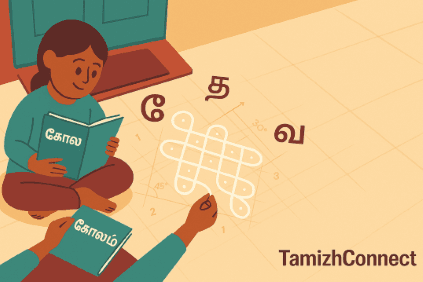
Overview: Kolam Patterns: Mathematical Beauty & Tamil Cultural Heritage
Kolam represents one of the most sophisticated intersections of mathematics, culture, and spirituality in Tamil tradition. While many think of kolam as simple decoration – pretty patterns on thresholds – the practice encompasses far more complexity and significance. Kolam sits at the entrance of Tamil homes as a sacred space where:
- People enter and leave
- Guests feel welcome
- Daily spiritual routines begin and end
- The home meets the outside world
Kolam is not "women’s work" or "just tradition." It is a structured practice that encompasses multiple layers of meaning:
- Mathematical concepts: Symmetry, geometry, counting, and spatial relationships
- Step-by-step thinking: Sequential steps and rule-following
- Cultural preservation: Traditional motifs and regional variations
- Daily practice: Maintaining routines across seasons
- Family identity: Household-specific patterns and inherited knowledge
For genealogical research and cultural preservation, kolam represents a living repository of mathematical, cultural, and family history data that connects mathematics, spirituality, and genealogy in unique ways.
Understanding Kolam’s Mathematical and Cultural Significance
Kolam patterns demonstrate sophisticated mathematical concepts while preserving cultural traditions:
- Algorithmic art: Systematic creation following specific rules and procedures
- Symmetry systems: Complex geometric patterns utilizing reflection, rotation, and translation
- Counting systems: Natural mathematical error detection and correction during creation
- Cultural documentation: Behavioral protocols that define household identity
- Knowledge transmission: Matrilineal inheritance of mathematical and cultural practices
Understanding these elements helps preserve the full scope of kolam’s cultural and mathematical value for future generations.
Kolam as Algorithmic Art
When someone creates a kolam, the process is systematic:
- Choose dot grid: Select specific dot arrangements
- Follow rules: Apply predetermined patterns for line placement
- Repeat motifs: Use geometric elements like curves and loops
- Follow constraints: Maintain specific rules about symmetry
- Complete the pattern: Finish while honoring mathematical rules
This sequence creates a precise process. The result is artistic and spiritual. But the process follows strict mathematical rules.
Dot Grid Configurations
Kolam mathematics starts with dot arrangements:
- Odd-numbered grids:
3x3,5x5,7x7,9x9, etc. (most common) - Rectangular grids: Like
4x5,6x4, or8x6for specific designs - Triangular patterns: Dots arranged in triangular formations
- Complex structures: Combinations of different sized grids
- Asymmetrical arrangements: For specific ritual purposes
When someone says:
"In our house, Paati always prefers 7-dot kolam on Fridays for Lakshmi Puja."
This statement shows important structured information:
- Number preference: The choice of 7 dots has cultural meaning (7 is auspicious)
- Ritual connection: Links to specific deities and days
- Family transmission: Technique passed through family lines
- Regional variation: Household-specific preferences
From a genealogical perspective, mapping "which kolam configurations were common in your household" provides data about cultural practices and regional variations. This helps trace family origins and cultural preservation patterns.
Kolam as Cultural Information
Two neighboring houses can have very different kolam styles. This shows that:
"Kolam design is not just regional. It’s family-specific, reflecting unique lineages."
Knowledge Transmission Patterns
The typical inheritance pathway follows:
- Direct matrilineal transmission: Grandmother → Mother → Daughters/Granddaughters
- Extended family learning: Aunt, cousin, sister-in-law instruction
- Community learning: Neighbors and community knowledge sharing
- Formal instruction: Teachers or community centers in modern times
This creates an informal but structured family record:
- Mapping "who learned kolam from whom" documents family knowledge flow
- Many families maintain core design sets across decades
- Each generation introduces subtle changes
- Regional variations become household-specific through these transmissions
Important genealogical questions include:
- "Who taught you kolam first?" – Reveals primary family connections
- "Do you remember whose kolam style this particular pattern represents?" – Identifies ancestral connections
- "Are there kolams for death anniversaries, weddings, Pongal, or other occasions?" – Documents household practices
The answers show:
- Relationship strength: Which family connections were influential
- Community proximity: Which households maintained close cultural ties
- Ritual preservation: How ceremonial practices moved across family branches
- Regional identity: Which regional traditions were prioritized in the household
Mathematical Principles
The mathematical sophistication in kolam deserves recognition. The practice engages with mathematical concepts naturally.
Symmetry Systems
Kolam naturally uses sophisticated symmetry concepts:
- Reflection symmetry: Left-right, top-bottom mirror relationships
- Rotational symmetry: 90°, 180°, 360° rotational patterns
- Translational symmetry: Repeating motifs across the grid
- Combination symmetries: Complex interplays of multiple symmetry types
- Asymmetrical variations: Deliberate breaks in symmetry for aesthetic purposes
Observing pattern preferences reveals mathematical thinking:
- Four-fold rotational favoring: Indicates spatial reasoning
- Horizontal reflection consistency: Shows systematic copying
- Complex multi-symmetry combinations: Demonstrates advanced spatial abilities
- Deliberate symmetry breaking: Shows creative intervention
Counting Systems and Error Correction
The kolam creation process includes natural mathematical error detection and correction:
- Dot counting: Creators verify count accuracy throughout the process
- Grid checking: Maintaining correct grid dimensions
- Path validation: Ensuring continuous, unbroken design execution
- Mistake identification and repair: Diagnosing problems and fixing them
When someone notices a miscounted dot or path error:
- They identify the specific mathematical problem
- They apply correction strategies while maintaining design integrity
- They preserve the overall rule structure while fixing local errors
This represents sophisticated mathematical and algorithmic thinking in practical application.
In families where:
- Elders created intricate kolams daily
- Younger generations are disconnected from the practice
You observe the literal abandonment of advanced mathematical and spatial reasoning traditions. This happens because descendants assume it’s merely decorative rather than recognizing its cognitive sophistication.
Kolam as Cultural Documentation
Thorough kolam documentation captures behavioral protocols that define household identity:
Frequency Patterns and Ritual Discipline
Essential genealogical documentation includes:
- Daily versus occasional practice: Was kolam created every day or only on specific days/festivals?
- Timing requirements: Was creation required before anyone could leave the house?
- Exception protocols: How were missed days handled?
- Seasonal variations: Did different patterns appear during specific seasons?
These answers reveal the intensity of ritual discipline within each family branch and can identify:
- Strict traditional households versus more flexible approaches
- Regional practice variations in ritual requirements
- Generational changes in ritual adherence
- Cultural preservation priorities within the family
Content Motif Analysis and Symbolic Meanings
Documentation of kolam content reveals cultural information:
- Pure geometric curves: Focus on mathematical beauty and abstract spiritual concepts
- Botanical motifs: Lotus, flowers, leaves indicating natural connections
- Animal representations: Birds, fish, deer reflecting occupation or spiritual associations
- Ritual objects: Lamps, conches, vessels connecting to specific worship traditions
- Deity-specific symbols: Patterns reserved for particular gods or goddesses
- Narrative elements: Scenes from epics or cultural stories
- Names or numbers: Embedded during special occasions
Each motif category connects to:
- Deity preferences: Specific religious affiliations
- Occupational heritage: Fish patterns in coastal families, agricultural motifs in farming households
- Regional associations: Local legends, temple iconography, or community-specific traditions
- Social status: Complexity and materials used indicating household resources
- Artistic sophistication: Advanced technique showing cultural accomplishment
- Cultural syncretism: How traditional patterns adapted to contemporary contexts
Material and Technique Variations
Additional documentation should capture:
- Powder selection: Rice flour, chalk, stone powder, or flower petals
- Color usage: Single-color versus multi-color patterns
- Duration: Quick morning designs versus elaborate weekend creations
- Size: Small threshold patterns versus large courtyard displays
- Tools: Freehand creation versus stenciled production
5. Systematic Kolam Documentation for Family History
Effective kolam documentation requires structured approach using genealogical principles and digital tools:
5.1 Visual Documentation and Metadata Tagging
Comprehensive documentation requires:
-
Photograph systematic collection during significant occasions:
- Pongal and harvest festivals: Traditional patterns specific to agricultural celebrations
- Weddings and family celebrations: Elaborate designs with special motifs
- Death anniversaries and remembrance: Specific patterns for memorial occasions
- Major religious festivals: Deity-specific designs for particular celebrations
- Daily practice: Representative samples of routine household patterns
- Seasonal variations: Different patterns for different times of year
-
Comprehensive metadata tagging for each image:
- Location specificity: House address, street, district, state, country
- Temporal precision: Exact date, time of day, season, and year
- Creator identification: Person who drew the kolam with their relationship to the family
- Occasion context: Specific festival, ceremony, or daily practice
- Ritual significance: Religious, cultural, or household-specific meanings
- Technical assessment: Dot count, complexity level, and creation time
- Regional attribution: Specific regional school or family style attribution
In genealogical platform thinking like TamizhConnect, each kolam image should connect to:
- Person nodes (representing the creator and their relationships)
- Event nodes (specific celebrations, dates, or ritual observances)
- Geographic nodes (location-specific traditions and regional variations)
- Temporal nodes (generational changes and historical documentation)
- Technique nodes (specific styles, methods, and family traditions)
5.2 Narrative Documentation and Pattern Descriptions
Supplement visual records with detailed narrative information:
Technical descriptions should include:
- Dot count specifications and grid arrangements
- Traditional names for specific kolam patterns (many have culturally significant names)
- Seasonal or occasion-specific usage patterns
- Regional variations and school-specific techniques
- Tool requirements and material specifications
- Creation sequence and step-by-step procedures
Cultural context documentation should capture:
- Origin stories: How specific patterns entered the family
- Transmission narratives: Who taught whom and when
- Ritual associations: Religious or spiritual significance
- Regional attributions: Geographic origins of family-specific patterns
- Innovation records: New patterns created within the family
- Modification documentation: How patterns evolved within the family
Written records should attach to specific family members:
“Ammamma’s signature 7-dot kolam, exclusively used on Fridays for Lakshmi worship; initially learned from her mother in Thanjavur district during the 1950s; represents the Thanjavur traditional school; typically completed in 20-25 minutes using rice flour.”
This single documentation entry encodes:
- Lineage information: Person → Mother → Previous generation transmission
- Geographic attribution: Thanjavur district cultural school identification
- Ritual context: Friday Lakshmi worship tradition
- Technical specifications: 7-dot grid system and timing requirements
- Material preferences: Rice flour usage indicating traditional approach
6. Kolam in Diaspora Context: Survival, Adaptation, and Preservation
For Tamil families now living in:
- Singapore, Malaysia, Sri Lanka
- Gulf countries (UAE, Saudi Arabia, Qatar, Kuwait, Oman, Bahrain)
- Europe (UK, Germany, Netherlands, France, etc.)
- North America (USA, Canada)
- Oceania (Australia, New Zealand)
- Africa and other regions
Kolam practice often undergoes significant transformation or reduction:
Common diaspora patterns:
- Reduced frequency: From daily practice to occasional festival decoration
- Simplified designs: Complex patterns replaced by basic geometric forms
- Alternative materials: Rice flour replaced by chalk or commercial powders
- Modified timing: Morning ritual interrupted by work schedules
- Commemorative practice: Limited to major occasions rather than daily observance
- Cultural performance: Done primarily for cultural education rather than ritual necessity
Critical preservation opportunities:
Primary documentation should focus on:
- Identifying the last family member who possessed comprehensive kolam knowledge
- Recording their complete pattern repertoire before knowledge disappears
- Preserving any family notebooks, printed kolam books, or instructional materials
- Capturing audio/video demonstrations of pattern creation processes
- Documenting the ritual, spiritual, and cultural significance of specific designs
- Transcribing traditional names, stories, and associated practices
Digital preservation strategies:
- High-resolution photography of traditional patterns
- Step-by-step video documentation of creation processes
- Audio interviews with elderly practitioners
- Written tutorials from knowledgeable family members
- Community collaboration to pool collective knowledge
- Cross-generational teaching documentation
Even if no current family members actively practice kolam, systematic documentation creates instructional resources for future generations who may wish to revive the tradition.
7. Kolam as STEM-Culture Bridge: Educational and Academic Applications
Kolam serves as an excellent bridge connecting cultural heritage with science, technology, engineering, and mathematics education:
7.1 Mathematical Education Applications
Geometry and spatial reasoning:
- Symmetry exploration: Hands-on experience with reflection, rotation, and translation
- Coordinate systems: Grid-based planning and execution
- Pattern recognition: Visual and geometric pattern analysis
- Measurement and proportion: Spatial relationship understanding
- Geometric construction: Practical application of geometric principles
Algorithmic and computational thinking:
- Sequential procedures: Step-by-step pattern creation processes
- Rule-based systems: Constraint following and systematic approaches
- Error detection and correction: Problem-solving and debugging skills
- Pattern generalization: Modifying and adapting basic templates
- Computational modeling: Using algorithms to generate kolam patterns
7.2 Technology Integration
Digital kolam creation:
- Programming projects: Simple code that plots dots and creates lines following kolam rules
- Pattern generators: Software that can create and modify kolam designs
- Virtual reality applications: Immersive kolam creation and learning experiences
- AI analysis: Machine learning systems that recognize and classify kolam patterns
- Digital preservation: Online repositories of kolam patterns and techniques
Comparative analysis:
- Compare computer-generated kolams with human-created versions
- Highlight where traditional practitioners deliberately break symmetry for aesthetic reasons
- Demonstrate the superior aesthetic and creative judgment of human creators
- Show how technology can assist but not replace traditional knowledge
7.3 Interdisciplinary Learning
Mathematics and art integration:
- Geometric art: Practical demonstration of mathematical concepts
- Cultural applications: Mathematics in real-world cultural contexts
- Historical connections: Ancient mathematical knowledge and contemporary applications
- Creative expression: Mathematical concepts expressed through artistic creation
Science connections:
- Material science: Properties of traditional kolam materials (rice flour, chalk, sand)
- Physics principles: Adhesion, spreading, and particle distribution
- Biology connections: Natural materials, biodegradability, and environmental impact
- Chemistry: Color variations, material combinations, and weather resistance
8. Advanced Kolam Analysis: Mathematical and Cultural Research Potential
Kolam patterns represent a rich field for interdisciplinary research combining:
- Mathematical topology: Continuous curve analysis and surface coverage
- Graph theory: Path optimization and vertex connectivity
- Group theory: Symmetry operations and transformation analysis
- Ethnomathematics: Cultural mathematical practices and knowledge systems
- Anthropological research: Gender roles, cultural transmission, and ritual practice
- Computer science: Pattern recognition, algorithm design, and artificial intelligence
8.1 Research Applications
Mathematical research:
- Optimization problems: Efficient path planning for kolam creation
- Symmetry analysis: Classification of kolam symmetry types
- Complexity measures: Quantifying kolam pattern sophistication
- Algorithm development: Automated kolam generation systems
- Topological properties: Surface coverage and path continuity analysis
Cultural preservation:
- Ethnographic documentation: Comprehensive cultural practice recording
- Linguistic preservation: Traditional names and descriptions
- Intergenerational transmission: Knowledge flow documentation
- Regional variation mapping: Geographic pattern distribution studies
- Historical evolution: Pattern changes over time and across generations
8.2 Preservation Strategies
Community-based preservation:
- Elder knowledge documentation: Comprehensive pattern collection
- Skill-sharing workshops: Intergenerational teaching sessions
- Digital archives: Comprehensive pattern and technique databases
- Educational integration: Kolam in school curricula and cultural education
- Academic partnerships: University collaborations for systematic study
Technology-enabled preservation:
- Mobile applications: Kolam learning and practice tools
- Virtual reality: Immersive kolam learning environments
- Artificial intelligence: Pattern recognition and preservation systems
- Social media platforms: Community sharing and collaboration
- Blockchain technology: Authenticity verification and provenance tracking
9. Kolam in Contemporary Context: Evolution and Innovation
Modern kolam practices demonstrate how traditional forms adapt to contemporary contexts:
9.1 Contemporary Innovations
Material innovations:
- Eco-friendly alternatives: Biodegradable and sustainable materials
- Weather-resistant options: Patterns suitable for various climates
- Color varieties: Expanded palette while maintaining traditional forms
- Mixed media: Combining traditional and modern elements
Design innovations:
- Contemporary motifs: Modern cultural references integrated with traditional forms
- Size adaptation: Patterns suitable for various spaces and contexts
- Speed optimization: Quick patterns for busy contemporary lifestyles
- Minimalist approaches: Simplified patterns for modern aesthetic preferences
9.2 Cultural Synthesis
Cross-cultural adaptation:
- Global fusion: Incorporating elements from other cultural traditions
- Religious inclusivity: Adapting for diverse religious contexts
- Secular contexts: Cultural celebration without religious emphasis
- Educational contexts: Teaching aids in multicultural environments
10. Practical Applications for Family Researchers
For genealogical researchers and family historians, kolam documentation provides unique insights:
10.1 Geographic Origins
- Regional pattern analysis: Identifying specific regional schools and techniques
- Migration tracking: Following family movements through pattern changes
- Community connections: Identifying close family relationships through shared patterns
- Cultural preservation: Documenting how families maintained traditions across distances
10.2 Generational Changes
- Ritual evolution: How practices changed within families across generations
- Knowledge retention: Tracking which family members maintained specific knowledge
- Innovation documentation: New patterns created within specific family branches
- Cultural adaptation: How families adapted practices to new environments
10.3 Social Documentation
- Economic indicators: Materials and complexity indicating household resources
- Social connections: Patterns learned from neighbors or community members
- Religious affiliations: Deity-specific patterns indicating worship traditions
- Educational levels: Complex patterns indicating traditional learning and practice maintenance
Conclusion: The Mathematical and Cultural Significance of Kolam
Daily kolam creation represents one of the most sophisticated intersections of mathematics, culture, and spirituality in Tamil tradition. This practice embodies:
- Advanced mathematical concepts: Symmetry, geometry, algorithmic thinking, and spatial reasoning
- Cultural preservation: Direct transmission of traditional knowledge and spiritual practices
- Family identity: Household-specific patterns and lineage-specific techniques
- Daily discipline: Consistent practice demonstrating cultural commitment
- Community connection: Visible expression of cultural identity and hospitality
For families serious about preserving Tamil heritage while also documenting mathematical and cognitive traditions, kolam represents one of the most structured cultural practices available for genealogical documentation. The practice combines artistic expression with mathematical precision, spiritual intention with algorithmic execution, and individual creativity with traditional constraint-following.
Rather than dismissing kolam as "mere decoration" or "traditional art," recognize it as a living repository of mathematical, cultural, and genealogical information that deserves systematic documentation alongside other family records. The patterns, instructors, occasions, and rules behind kolam creation provide concrete evidence of cultural identity, family connections, and regional origins.
The mathematical sophistication evident in kolam creation demonstrates that traditional Tamil knowledge systems encompassed advanced spatial reasoning and pattern recognition. By preserving and documenting kolam traditions, families maintain connections to this sophisticated cultural heritage while providing future generations with rich examples of how mathematical concepts and cultural practices can integrate seamlessly.
Key Kolam Documentation Priorities
- Visual documentation: Photograph kolam patterns during significant occasions and daily practice
- Technical descriptions: Record dot count specifications, creation sequences, and traditional names
- Cultural context: Document ritual significance, seasonal variations, and regional attributions
- Instructor identification: Record who taught whom and the transmission pathways
- Family-specific patterns: Document household traditions that distinguish your family’s practices
Continue Your Tamil Cultural Heritage Journey
To continue exploring your Tamil heritage and connect with the mathematical and cultural richness of Tamil traditions, consider reading about preserving cultural heritage, documenting family traditions, or understanding Tamil cultural practices. Our family tree builder includes features designed specifically to help Tamil families document the rich cultural practices like kolam that define their unique heritage.
Additionally, explore these related resources:
- Documenting family history from elders to preserve cultural knowledge
- Cultural preservation strategies for comprehensive heritage maintenance
- Tamil migration and cultural adaptation to understand how traditions evolve in diaspora
Don’t let the mathematical and cultural richness of kolam traditions disappear with the current generation. Proper documentation ensures that future generations can appreciate and continue this sophisticated integration of mathematics, art, and spirituality that defines such an important aspect of Tamil cultural heritage.