Tamil Ancestry Research | Family Tree Guide
In this article:
- What “Karaikudi” actually means in family talk
- Chettinad region, Nagarathar finance and global trade
- Mansions, tiles and layout – reading a house as an archive
- Labour, caste and who is missing from the glossy stories
- Migration from Karaikudi – Burma, Malaya, cities, Gulf and beyond
- How to record Karaikudi / Chettinad roots in TamizhConnect
- Questions to ask your own family
1. What “Karaikudi” actually means in family talk
You’ll hear:
- “We’re from Karaikudi.”
- “Chettinad side, Karaikudi line.”
- “Nagarathar family from Karaikudi.”
Strip the vagueness.
Fact first:
- Karaikudi is a city in Sivaganga district, Tamil Nadu, widely recognised as the main town and “capital” of the Chettinad region.
- Chettinad itself is a network of 70–80 villages and a couple of towns spread across Sivaganga and Pudukkottai districts, historically home to the Nattukottai Chettiar / Nagarathar merchant–banker community.
Family talk often collapses all of that into one line: “Karaikudi”.
Inside TamizhConnect you need to unpack:
- Is your family in Karaikudi town, or one of the Chettinad villages with Karaikudi as the market/education hub?
- Which nagaram / theru / kovil-based cluster?
- Pre-independence merchant line? Post-1960s salaried-class? Or something else entirely?
2. Chettinad, Nagarathar finance and global trade
Karaikudi isn’t just some random “heritage town”. It’s the urban centre of a region built on finance and trade.
Key points:
- Chettinad is the historic home of the Nagarathar (Nattukottai Chettiar) community – Tamil Saivite merchant–bankers who operated networks across South and Southeast Asia (Burma, Ceylon, Malaya, Singapore, etc.).
- Their business model:
- temple-centric and caste-network-based trust,
- indigenous banking (kanduvatti, hundi, moneylending, trade financing),
- reinvestment of overseas profits into mansions, temples and education back home.
If your line is Nagarathar / Chettiar and you ignore the finance side, you’re throwing away half the story.
Inside TamizhConnect, for every serious ancestor in this web, you should be recording:
- where they operated (Rangoon, Penang, Colombo, Saigon, etc.),
- what kind of finance (pawn-broking, trade credit, estate finance, urban lending),
- ties to temples, kovils and community trusts in Chettinad which structured those flows.
If your line is non-Chettiar but based in Karaikudi/Chettinad, then your story is about:
- supplying labour, services, food, crafts, and administration to this merchant hub,
- or working in schools, government offices and small businesses that grew alongside it.
Both are legitimate – just don’t pretend you were “traders” if you weren’t.
3. Mansions, tiles and layout – reading a house as an archive
This is the part everyone romanticises, usually without understanding.
3.1. What makes a Chettinad house different
Research and travel accounts are clear:
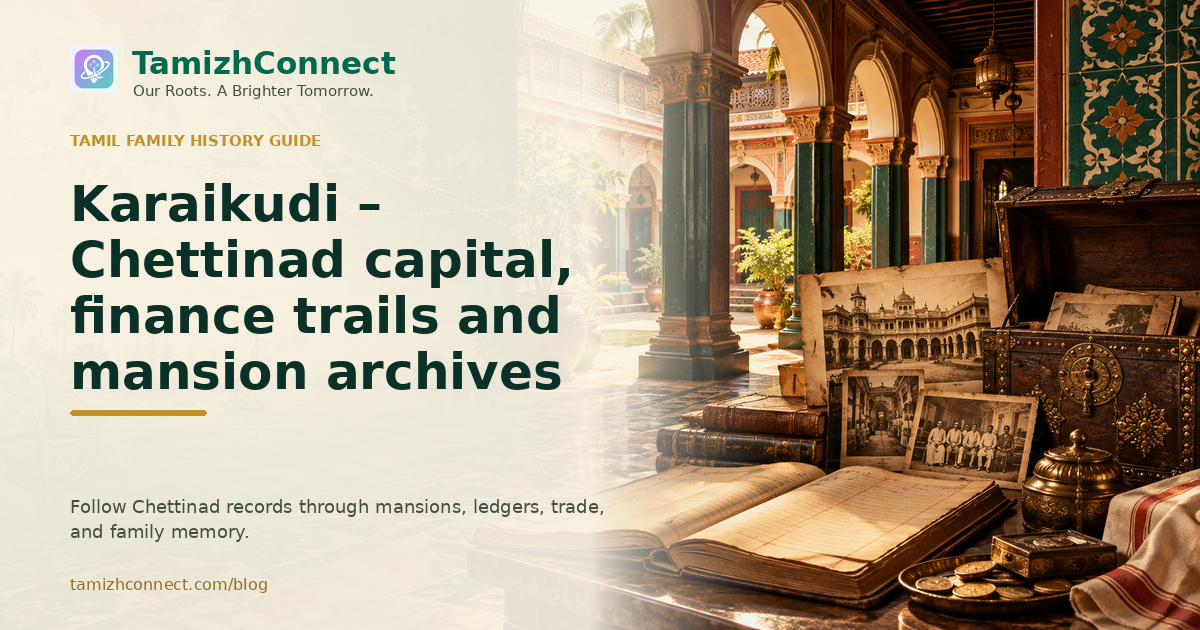
- Chettinad houses and mansions are famous for monumental facades, long axial plans, huge courtyards, and lavish materials – Burma teak, Italian or other imported marbles, Belgian glass, carved doors.
- Many have Athangudi tiles – locally made patterned tiles from villages near Karaikudi – plus intricate plasterwork, stained glass, and imported fittings.
Translation: each house is not just “big” – it is a data set on:
- which decades money was flowing in,
- which ports and countries the family was connected to,
- which craftsmen and materials they could hire or import.
3.2. How to read a mansion structurally
Forget the Instagram shots. Look for:
- Street façade – inscriptions, dates, donors’ names, emblems.
- Sequence of spaces –
- thinnai / verandah → reception hall → inner courtyards → women’s quarters → kitchen → storerooms.
- Functional clues –
- room count and scale (joint family vs nuclear),
- dedicated rooms for accounts, guests, storage, weddings,
- special access routes for workers vs guests.
In TamizhConnect, for any house that still exists or is remembered:
- map the basic layout in notes (“three courtyards, eastern street-facing thinnai, separate backyard for kitchen workers”),
- attach photos of key features (inscriptions, doors, tiles, ceiling work),
- record who used which part (gender, age, caste divides).
The house is one of your best genealogical documents – if you treat it that way.
3.3. Decline, sale and fragmentation
Plenty of Chettinad mansions are now:
- locked and decaying,
- partially demolished,
- sold off room by room,
- converted to hotels/heritage stays.
You need to record:
- when and why bits were sold (tax, debt, lack of heirs, migration, political change),
- who got which share when families split,
- what documents survive (sale deeds, partition deeds, court cases).
Don’t write some “golden age” sob story and skip the actual transactions.
4. Labour, caste and who is missing from the glossy stories
The tourist version of Karaikudi is mansions, tiles and spicy Chettinad cuisine. That version erases a lot.
Truth:
- Behind every mansion and “heritage house” is a long history of cooks, cleaners, carpenters, masons, tile makers, palmyrah workers, domestic workers and agricultural labourers, most from non-Nagarathar communities and often from oppressed castes.
- Their names rarely appear in house name boards, family trees, or glossy books.
If your line is Nagarathar / upper caste:
- be explicit in private TamizhConnect notes about which communities worked in your kitchens, fields, construction and household – and on what terms (daily wage, long-term service, quasi-bonded).
If your line is from those labouring communities:
- stop reducing your history to “worked for Chettiars”.
- record skill (tile work, carpentry, cooking, weaving, brickwork),
- record seasonality (which months in Chettinad, which months outside),
- record constraints (untouchability, spatial segregation, wage disputes, strikes).
Your archive should make power relations visible, not bury them under “we all lived together happily”.
5. Migration from Karaikudi – Burma, Malaya, cities, Gulf and beyond
Chettinad is a classic case of a region whose people worked elsewhere and funneled money back home.
5.1. Older South/Southeast Asian routes
For roughly a century, Nagarathar-linked migration ran through:
- Burma (Myanmar), Ceylon/Sri Lanka, Malaya/Malaysia, Singapore and other colonial nodes,
- typically as bankers, moneylenders, traders, sometimes linked to estates and businesses run by others.
If you have an ancestor “who went to Rangoon / Penang / Kandy”:
- log exact town/city and type of work,
- note how long they stayed and whether family joined them,
- track what happened around WWII / independence / nationalisation (losses, flight, re-rooting in India).
5.2. Post-independence and contemporary migrations
Later phases include:
- movement into Indian cities (Chennai, Madurai, Trichy, Bangalore, Mumbai, Delhi) for business, education and salaried jobs,
- Gulf migration for trade, construction, finance and services,
- professional migration to US/Europe/Australia for IT, finance, academia, medicine, etc.,
- plus out-migration of non-Nagarathar communities for labour and small trade.
In TamizhConnect, you should not write “went abroad” and stop. For each migrant:
- break into segments like:
Village near Karaikudi → Rangoon (banking clerk) → Karaikudi (retired, built house),Karaikudi town → Chennai (college) → Dubai (accountant) → Toronto (PR).
- give approximate years and reasons (business expansion, political trouble, education, marriage, debt).
6. Capturing Karaikudi and Chettinad Heritage in TamizhConnect with Precision
Treat "Karaikudi" as a precision problem, not a slogan.
6.1. For each person with Karaikudi / Chettinad connection, record:
-
Place granularity
- exact village/town, street / theru, taluk, district, state, country,
- explicitly mark if it’s one of the Chettinad villages vs Karaikudi town.
-
Community and role
- Nagarathar / other caste,
- trader / banker / artisan / labourer / cook / carpenter / temple staff / government staff,
- owner / partner / clerk / contract labour / domestic worker.
-
House / mansion data (if any)
- name of the house (if it has a traditional name),
- approximate construction/renovation decades,
- key features (courtyards, Athangudi tiles, imported materials),
- current status (occupied, locked, sold, hotel, demolished).
-
Business and finance
- type of business (moneylending, trade in rice/spices/textiles, shops, hotels, modern companies),
- where it operated (local, national, overseas),
- notable collapses, lawsuits, wind-ups.
-
Migration segments
- each move with from / to / approx years / reason / source (who told you or which document).
-
Labour and caste context (PRIVATE)
- who worked for this family and on what terms,
- link to particular villages/streets around the house,
- any known conflicts, unions, strikes, or reforms.
6.2. Use tags like you mean it
Example tags inside TamizhConnect:
#karaikudi#chettinad/#nagarathar/#chettiar#chettinad-house/#athangudi-tiles/#burma-teak#merchant-banking/#moneylending/#south-east-asia-trade#household-labour/#tile-workers/#carpenters#gulf-migration/#malaya-migration/#burma-migration/#city-migration
Tag:
- people,
- stories,
- documents (sale deeds, partnership deeds, temple donation receipts, bank records, passports).
That’s how you later see pattern clusters instead of isolated anecdotes.
7. Key Questions to Validate Your Karaikudi Family Heritage
If someone in your line says "We’re from Karaikudi", don’t let them off with that.
7.1. Place and house
- “Exact village or street – which theru, which kovil zone?”
- “What was the house called? Who built it, roughly which decade?”
- “Has it been sold, split or converted? When and why?”
7.2. Work and money
- “What was the first money-making activity we know of in this line – lending, shops, agriculture, crafts, service?”
- “Which towns/countries did we have regular business in?”
- “Who kept the accounts, who did the travelling, who did the house running?”
7.3. Labour and neighbours
- “Which families or communities worked in our house or fields?”
- “Which caste and village did the tile/carpentry/cleaning workforce come from?”
- “Any disputes, strikes, or fallouts we conveniently stopped mentioning?”
7.4. Migration and loss
- “Who first left Chettinad for Rangoon/Malaya/Colombo/cities/Gulf, and under what conditions?”
- “Which migrations were profit-driven, which were forced (war, nationalisation, bankruptcy)?”
- “What properties did we lose, sell or abandon because of these moves?”
Then:
- Create or update the relevant profiles in TamizhConnect.
- Fill in:
- precise Karaikudi/Chettinad locations,
- house/mansion details,
- business and labour context,
- migration segments.
- Attach:
- house photos, title deeds, court papers, passports, business documents, temple receipts.
- Tag everything with
#karaikudiplus specific context tags.
If you do that honestly, “Karaikudi” stops being just mansions and spicy food.
It becomes a hard, structured record of trade, houses, labour, caste and migration – the forces that actually built and reshaped your family.