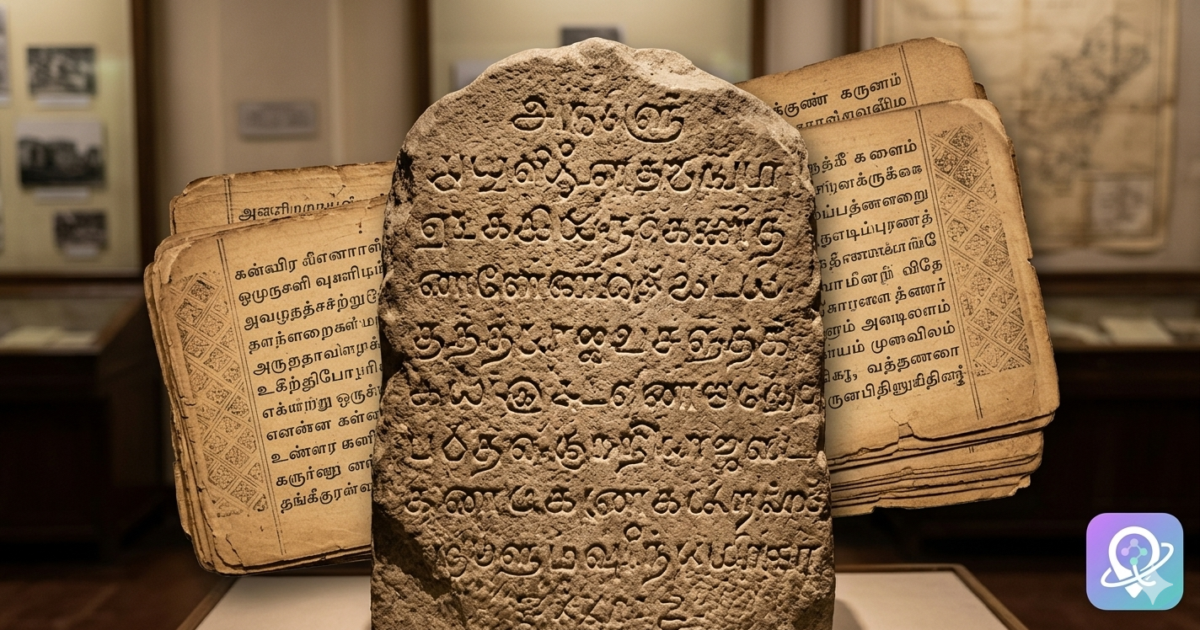
Tamil is one of four classical languages officially recognized by the Indian government (alongside Sanskrit, Kannada, and Telugu), with the longest continuous literary tradition of any Dravidian language — the earliest extant grammar Tolkāppiyam dates to roughly 300 BCE – 100 CE, and unbroken written production continues to the present. Tamil belongs to the Dravidian language family, genetically unrelated to Indo-European languages like Sanskrit (despite extensive vocabulary borrowing over the last 2,000 years). The language has passed through distinct stages — Old Tamil (pre-700 CE), Middle Tamil (700–1600 CE), and Modern Tamil (post-1600) — each documented in dateable inscriptions and literary works.
The Dravidian Foundation and Early Inscriptions
The Tamil language is the southernmost member of the Dravidian language family, a group of languages predominantly spoken in South India and parts of Sri Lanka, as well as by diaspora communities worldwide. Unlike the Indo-European family, which includes Sanskrit, Hindi, and most European languages, the Dravidian family has its own distinct proto-language and grammatical structures. The earliest definitive evidence of written Tamil comes from cave inscriptions, often associated with Jain monks, dating back to the 3rd century BCE. These inscriptions, written in Tamil-Brahmi script, demonstrate an already developed grammatical structure and vocabulary, suggesting an even earlier oral tradition. The script itself, while influenced by Brahmi, adapted unique features to represent Tamil phonemes, underscoring the language’s independent development. These early records offer invaluable glimpses into ancient Tamil society, trade, and religious practices, providing a tangible link to a distant past.
The Sangam Age: A Golden Era of Literature
The period from roughly the 3rd century BCE to the 3rd century CE is known as the Sangam Age, a golden era for Tamil literature. This period saw the creation of an extraordinary corpus of poetry and grammar, collectively known as Sangam literature. Divided into Ettuthogai (Eight Anthologies) and Pathupattu (Ten Idylls), these works are characterized by their sophisticated poetic conventions, vivid imagery, and profound insights into human emotions and societal norms. The poems are broadly categorized into Akam (inner life, love, and family) and Puram (outer life, war, heroism, and governance), reflecting a comprehensive worldview. The grammatical treatise Tholkappiyam, attributed to Tholkappiyar, is another cornerstone of this period. It is the oldest extant Tamil grammar text, meticulously detailing phonology, morphology, syntax, and poetic conventions, demonstrating the highly organized and systematic nature of the language even in ancient times. The themes, vocabulary, and grammatical structures preserved in Sangam literature provide a rich foundation for understanding the evolution of Tamil.
Post-Sangam and Bhakti Literature
Following the Sangam period, the Tamil language continued to evolve, giving rise to new literary forms and religious movements. The Post-Sangam period (roughly 3rd to 6th centuries CE) saw the emergence of ethical and didactic works, most notably the Thirukkural by Thiruvalluvar. Comprising 1,330 couplets, the Thirukkural is a masterpiece of ethical philosophy, covering dharma (virtue), porul (wealth), and inbam (love), and remains a foundational text in Tamil culture. Its universal themes and concise wisdom have led to its translation into numerous languages worldwide. From the 6th to the 9th centuries CE, the Bhakti movement swept across South India, profoundly influencing Tamil language and literature. Devotional hymns, sung by the Shaivite Nayanmars and Vaishnavite Alvars, poured forth in simple yet powerful Tamil, making complex spiritual concepts accessible to the common people. The Tevaram and Nalayira Divya Prabandham are monumental collections of these hymns, showcasing a vibrant, emotionally charged language that continues to resonate with devotees today. This period solidified Tamil’s role not just as a literary language but also as a sacred language.
Medieval and Modern Tamil
The medieval period (roughly 9th to 18th centuries CE) witnessed further advancements in Tamil literature, including the rise of epic poetry and commentaries. Kamban’s Ramavatharam, a Tamil retelling of the Ramayana, is a literary epic of immense scale and poetic brilliance, showcasing the language’s capacity for narrative grandeur. Scholarly commentaries on Sangam works and ethical texts also flourished, preserving and interpreting earlier literature for new generations. The arrival of European powers, particularly the Portuguese, Dutch, and British, from the 16th century onwards, brought new influences. While initial interactions were primarily commercial, missionary efforts led to the development of Tamil printing technology in the 17th century, a significant milestone. The 19th and 20th centuries saw a resurgence of Tamil identity and literary modernism. The rediscovery and publication of ancient Sangam texts sparked a renewed appreciation for classical Tamil. Modern Tamil literature embraced new genres like novels, short stories, and plays, and the language adapted to express contemporary scientific, political, and social ideas. Today, Tamil continues to thrive as a vibrant language of administration, education, media, and culture, constantly evolving while retaining its deep historical roots.
Tamil’s journey from ancient inscriptions to its modern form is a testament to its enduring vitality and the continuous efforts of its speakers to cultivate and preserve it. Its distinct identity, rich literary heritage, and continuous evolution mark it as a truly remarkable classical language, holding a unique and revered place in the global linguistic landscape.