TamizhConnect Blog
3 Mar 2026 · TamizhConnect
Tamil and Telugu: Separate Branches, Shared Roots
Tamil genealogy article
Tamil and Telugu are distinct sister languages within the Dravidian family, both evolving independently from a common ancestor, Proto-Dravidian, rather than one being a root of the other.
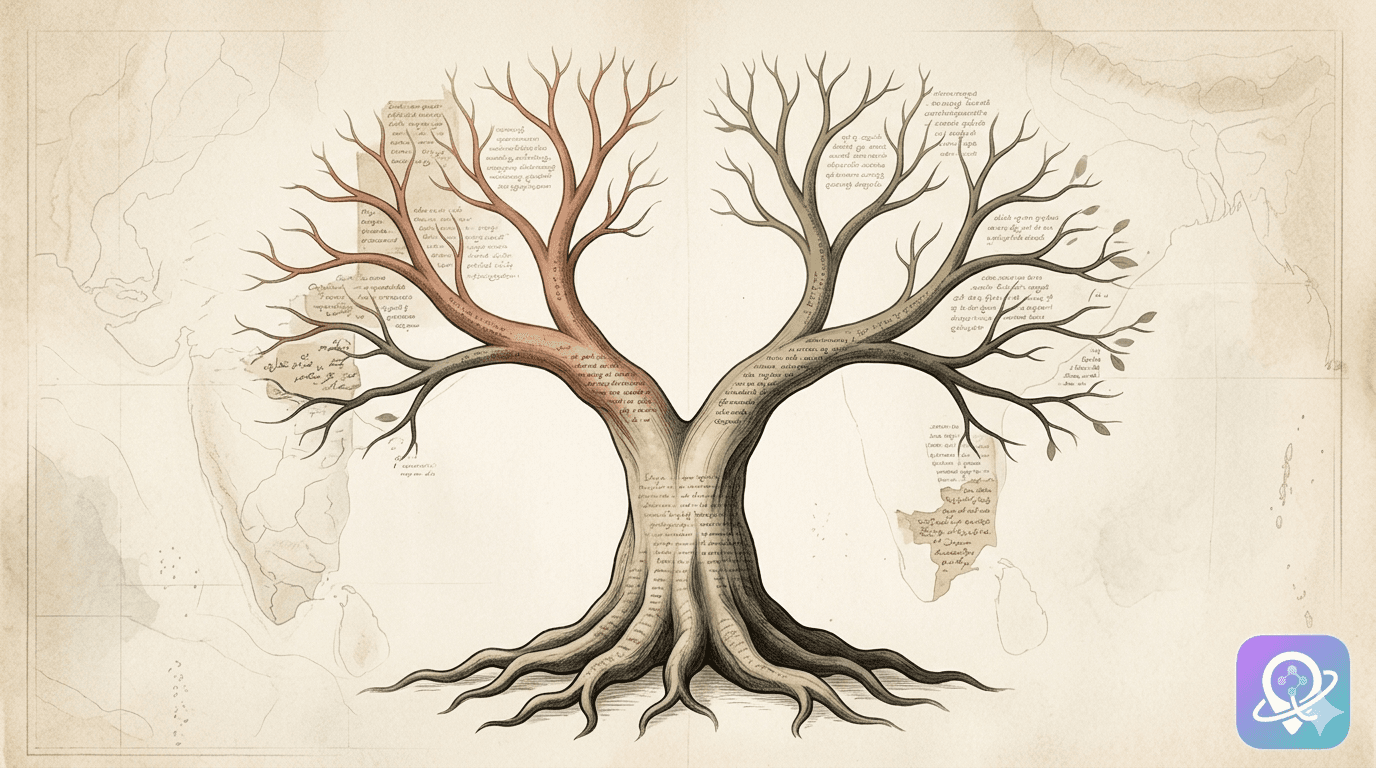
Tamil and Telugu are linguistic cousins, not parent and child: both descend independently from Proto-Dravidian (~4,500 years ago) through different sub-branches — Tamil via South Dravidian, Telugu via South-Central Dravidian. Neither is the "source" of the other. This matters for ancestry research because migrations between Tamil and Telugu regions over the last 1,000 years (Vijayanagara military settlements, Chola agricultural expansions, post-independence labour flows) have produced families who speak one language but descend from speakers of the other. The ~45% of shared vocabulary makes each easy for a native of the other to partially understand — but that is cousin-level similarity, not direct inheritance.
The Proto-Dravidian Ancestor
The Dravidian language family, comprising over 80 languages spoken predominantly in South India and parts of Sri Lanka, Pakistan, and Afghanistan, traces its origins to a hypothetical common ancestor known as Proto-Dravidian. Linguists reconstruct Proto-Dravidian through comparative analysis of its modern descendants, identifying shared vocabulary, grammatical structures, and sound changes. While no written records of Proto-Dravidian exist, its reconstruction is crucial for understanding the evolutionary paths of languages like Tamil and Telugu. It is believed that Proto-Dravidian speakers occupied a significant area of ancient India, and its subsequent breakup led to the formation of various branches. The most widely accepted model posits a split into three main branches: South Dravidian, Central Dravidian, and North Dravidian, with Tamil belonging to the South Dravidian branch and Telugu to the South-Central Dravidian branch.
Divergence and Distinct Branches
Around 1500 BCE to 1000 BCE, Proto-Dravidian began to fragment, leading to the formation of distinct sub-families. Tamil belongs to the South Dravidian I (SDr-I) group, which also includes Malayalam, Kannada, and Kodava. Telugu, on the other hand, is part of the South-Central Dravidian (SCDr) group, along with languages like Gondi and Konda. This classification immediately clarifies that neither language is a direct 'root' of the other, but rather they branched off from the Proto-Dravidian tree at different points or along different lines of descent. The separation allowed each language to evolve independently, influenced by its unique geographic, cultural, and historical contexts. Over centuries, these influences led to significant phonological, morphological, and lexical divergences, even as a core of shared Dravidian features persisted.
Key Linguistic Similarities
Despite their distinct evolutionary paths, Tamil and Telugu share fundamental Dravidian characteristics. Both are agglutinative languages, meaning they build words by adding suffixes to a root word to express grammatical relations like tense, mood, and case, rather than using prepositions or auxiliary verbs as in Indo-European languages. For example, both languages extensively use suffixes for verb conjugations and noun declensions. They also share a basic Subject-Object-Verb (SOV) word order, which is characteristic of the Dravidian family. Many core vocabulary items related to family, body parts, and basic actions also show cognates, reflecting their common ancestry. For instance, the word for 'fish' is meen in Tamil and meenu in Telugu, and for 'water', it's neer in Tamil and neeru in Telugu, demonstrating clear phonetic correspondences derived from Proto-Dravidian forms.
Pronounced Differences and External Influences
While sharing a common heritage, Tamil and Telugu have developed significant differences. Tamil boasts the oldest surviving literature among Dravidian languages, with the Tolkāppiyam dating back to at least the 3rd century BCE, and has a strong tradition of linguistic purism, often resisting Sanskrit influence in its classical forms. Telugu, while also having an ancient literary tradition dating to the 11th century CE, has historically absorbed a substantial amount of Sanskrit vocabulary and grammatical structures, particularly in its written and formal registers. This difference in external influence is one of the most striking distinctions. Phonologically, Tamil maintains certain retroflex consonants and the alveolar trill 'ṟ' that are less prominent or have evolved differently in Telugu. Grammatically, while both are agglutinative, the specific sets of suffixes, case markers, and verb conjugations vary significantly, making them mutually unintelligible without dedicated study. For example, the plural marker in Tamil is often -kal (e.g., maram 'tree', marangkaḷ 'trees'), whereas in Telugu, it is typically -lu (e.g., cheṭṭu 'tree', cheṭṭlu 'trees').
Dispelling Misconceptions
The idea that Tamil is the 'root' of all Dravidian languages, or that Telugu somehow emerged directly from Tamil, is a common misconception that arises from Tamil's documented antiquity and its significant role in Dravidian studies. While Old Tamil provides invaluable insights into Proto-Dravidian features due to its conservative nature, it is more accurate to view it as a highly preserved direct descendant of Proto-Dravidian, rather than the parent of other branches. Similarly, Telugu's unique development, including its extensive Sanskritization, marks it as a distinct and vibrant branch that evolved in parallel, not as a derivative of Tamil. Both languages represent independent lines of descent from the same venerable ancestor, each contributing uniquely to the rich linguistic diversity of South India.
In conclusion, Tamil and Telugu are not parent and child, but rather siblings or cousins, sharing a common linguistic grandparent in Proto-Dravidian. Their individual journeys, marked by shared heritage and distinct innovations, highlight the fascinating process of language evolution and the deep historical connections that bind the peoples of South India.
Share this article
TamizhConnect
TamizhConnect helps Tamil families worldwide trace their ancestry using voter records, indenture archives, and origin village matching. Our research team combines genealogy expertise with digitised Tamil Nadu datasets to help you discover your roots.
Ready to start your Tamil family tree?
TamizhConnect helps you discover relatives, trace your origin village, and keep your family history alive for the next generation.
Create your free TamizhConnect accountGo to my family treeDocument Digitisation
Have old documents? Upload them and we'll verify, trace, and add them to your tree.
Was this article helpful?
Get new articles in your inbox
Tamil genealogy tips, research guides, and new feature updates.
You might also like
Tamil and Telugu: Shared Roots, Distinct Branches (English)
Tamil and Telugu are distinct branches of the South Dravidian language family, both originating from a common ancestor, Proto-Dravidian, but evolving independently over millennia.
06 Mar 2026
Tracing Dravidian Roots: Tamil and Telugu's Shared Heritage (English)
Tamil and Telugu are distinct branches of the South Dravidian and South-Central Dravidian language families, respectively, both originating from Proto-Dravidian.
01 Mar 2026
The Dravidian Language Family: Origins and Relationships (English)
Explore the shared roots and distinct paths of Tamil, Telugu, Kannada, and Malayalam, understanding their common linguistic heritage and individual literary journeys.
29 Jan 2026
The Dravidian Language Family: Common Roots, Distinct Paths (English)
Explore the shared origins and unique evolutions of Tamil, Telugu, Kannada, and Malayalam, the four major Dravidian languages.
27 Jan 2026
தமிழ் மூதாதையர் ஆய்வு நூலகம் (Tamil)
TamizhConnect-க்கு தேவையான தமிழ் வம்சாவளி முறைகள், பதிவுகள், இனவியல் மற்றும் பாரம்பரியச் சரிபார்ப்புக்கான அனைத்து ஆழமான வழிகாட்டிகளும் ஒரே இடத்தில்.
02T21:31:40.701Z Sep 2026
Tamil ancestry research: Complete guide for genealogical methods (English)
All our deep-dive guides on Tamil genealogical methods, records, ethnography, and heritage validation for TamizhConnect.
02T21:31:40.700Z Sep 2026
Related by topic
From Ancient Shores: The Shared Tapestry of Tamil and Malayalam (English)
Explore the deep linguistic and historical roots connecting Tamil and Malayalam, tracing their divergence from a common ancestor through centuries of cultural and geographical evolution.
17 Mar 2026
Tracing the Ancient Roots of Tamil Language (English)
Tamil is one of the world's longest-surviving classical languages, with a rich history distinct from Indo-Aryan languages like Sanskrit. This post explores its independent evolution.
24 Feb 2026
More from TamizhConnect
Tamil Elder Interview Kit: Ready-to-Use Questions & Prompts (English)
A ready-to-copy interview kit for capturing Tamil family history from elders — grouped by topic, sequenced from easy to sensitive, with recording tips and follow-ups that unlock the stories behind the names.
21 Aug 2026
The Tamils of Dharavi: A Hundred Years from Tirunelveli to Mumbai (English)
From the droughts of Tirunelveli to the tanneries and textile mills of Mumbai, the Tamil community of Dharavi has built one of the largest Tamil cities outside Tamil Nadu. With redevelopment underway, here's how families can preserve their migration story for the next generation.
15 May 2026
Core topics
What is Tamil, really? Language, identity, and where it comes from
A clear, human explanation of what Tamil is-language, identity, people, and history-plus how to talk about it without stereotypes.
4 Feb 2026
What Defines Tamil Identity Beyond Borders and Sub-Groups? (English)
Tamil identity is primarily defined by shared language and cultural heritage, rather than by geographic borders or internal sub-group affiliations. This core identity persists across the diaspora and within Tamil Nadu.
17 Apr 2026
Continue reading
Genetic Ancestry Tests for Sri Lankan Tamils: What to Expect (English)
2 Mar 2026
Crafting Your Tamil Family History: Narrative Paths to Explore (English)
27 Feb 2026
How to find your Kula Deivam: A guide to Tamil ancestral deities
26 Feb 2026
How to read Tamil electoral rolls: A genealogy research guide
26 Feb 2026